
Microscope for Coins: What You Actually Need for the Job You Have
For grading coins, the tool is a 5x to 10x loupe, and a good one runs $17 to $50. A digital coin microscope earns its place for hunting mint errors, attributing varieties, and taking photos, not for assigning a grade.
 Ray Ostrander · Updated July 24, 2026 · how I decide
If you buy through a link here, the site earns a little. It's never why anything gets picked.
There are two different jobs here, and they take two different tools. If you’re looking at a coin to judge its condition, the tool is a loupe at 5x to 10x, and a good one costs between about $17 and $50. If you’re hunting mint errors, attributing die varieties, or taking pictures to show people, that’s when a digital coin microscope earns its keep, starting around $35.
Buy for the job you actually have. That’s the whole page, and the rest is me showing my work.
I should say up front: I taught earth science for thirty-one years, and I’m not a numismatist. I learned this counter because readers kept asking about it, and I went and read what the graders themselves say. So everywhere below, I’ll tell you whose answer it is.
What's on this page
Why “how much magnification” is the wrong first question
Here’s the confusion the whole market runs on, and one collector described it perfectly while shopping for his first loupe: he wasn’t sure what magnification was best for coins, because the ones for sale ranged from about 20x to over 100x.
Look at that range. The shelf is showing him 20x to 100x, and the correct answer is at or below 10x. The products are teaching him the wrong lesson before he’s spent a dime.
The people who grade coins for a living are unusually consistent about this. A professional grader at PCGS puts the working range plainly: the most common loupes found with graders and discerning collectors run from 5X to 10X power, and anything higher than 10 is generally only used for counterfeit detection, variety attribution, and pinning down grade-limiting problems.
CoinWeek lands in the same place and adds the warning: the ideal range falls between 5x and 7x, and you should avoid excessive magnification.
And the collectors themselves say it in one line: 10x is what you want, because if it can’t be seen at 10x, it isn’t going to be noticeable to the naked eye anyway. Another one draws the map even finer: 6x for grading, 10x for varieties and some counterfeit detection, and anything variety-wise that needs more than 10x isn’t much of a variety.
Three separate sources, no coordination, same answer. That’s about as solid as consensus gets.
What over-magnifying actually does to a coin
This is the part that surprises people, and it’s the reason the pros warn you off the big numbers.
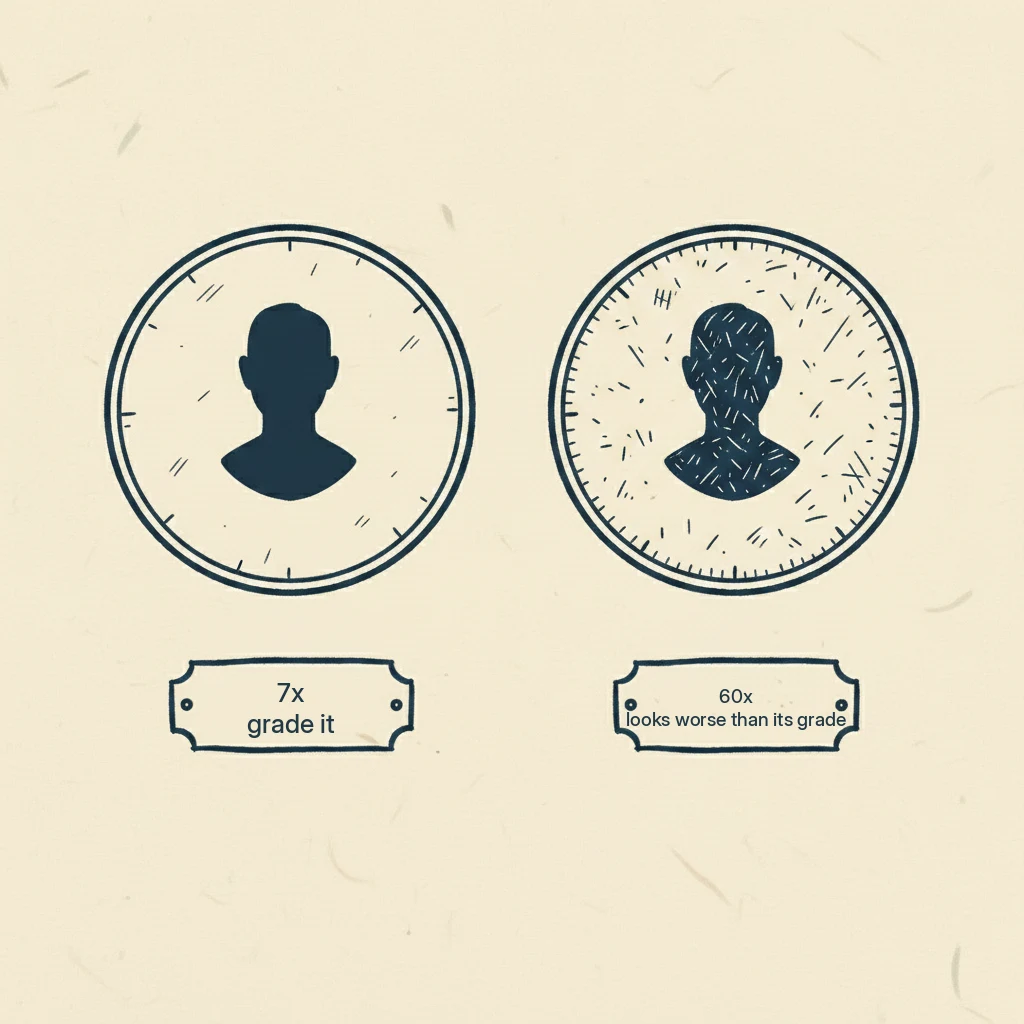
A grade isn’t a measure of microscopic perfection. As CoinWeek puts it, coin grading depends on eye appeal, not microscopic perfection. The grade describes how the coin looks to a trained eye at normal viewing distance.
Now crank the magnification to 60x. Every coin, including a genuinely lovely one, turns into a landscape of scratches, pits, and hairlines. The coin didn’t change. Your standard did. And now you’re staring at a beautiful piece thinking it’s damaged, because you’re looking at it at a scale nobody grades at.
Over-magnification doesn’t just waste money. It actively misleads you about what you own.
The three shelves, and who each one is for
The market will show you three price classes. Here’s what each is honestly for.
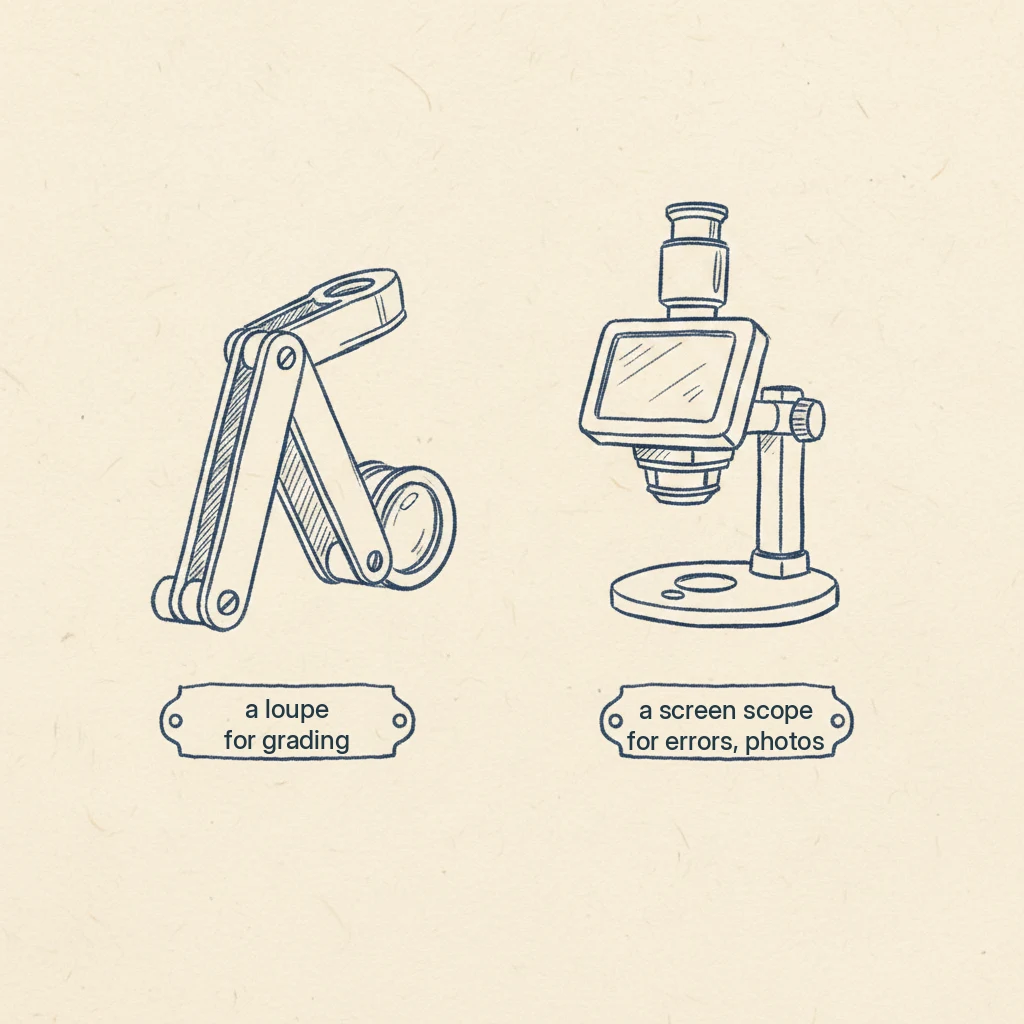
The loupe: $17 to $50. This is what graders use. A loupe is just a small folding magnifier you hold up to your eye. The one the experts name is a Hastings triplet, which means three lenses bonded together, and the reason they name it’s that the three-lens design kills the distortion you get around the edges of cheap glass. CoinWeek says to expect to spend $50 to $150 for a quality example, and on the shelf right now you can find a GemOro Hastings triplet 10x for about $17, generic 10x triplets from about $14 to $24 (LED versions around $19), and a branded “Hastings 10X optical grade” at about $52, which lands right at the floor of the range the experts named.
The digital screen microscope: $35 to $160. This is a small scope with its own screen. It isn’t the grading tool. It’s the error-hunting and photo-sharing tool, and for that it’s genuinely good. A TOMLOV P10 pocket scope with a screen runs about $35 at 100X. A DM4W coin scope is about $50. Up at the top, a DM9 at 1200X is about $96, a DM10 about $110, and a DM9 Max at 1500X about $160.
The stereo microscope: $156 to $500 and up. These are the two-eyepiece scopes that give you a real three-dimensional view at low power, and the retailers pitch them for inspecting mint marks, surface wear, scratches, and fine details, to grade, authenticate, and preserve coins with confidence. An AmScope stereo scope starts around $156 and the popular ones run $220 to $300, with the serious ones climbing past $500. If you’re deep into authentication work, that’s a real tool. For a first-time coin hobbyist, that’s my definition of the over-buy: several hundred dollars to do a job a $20 loupe does better.
Here’s my judgment, stated as judgment: buy the loupe first, always. If you outgrow it, you’ll know exactly why, and you’ll know exactly which of the other two shelves you’re reaching for.
The magnification lie on cheap microscopes
You’ll see budget microscopes advertising 1600X or 2000X. Treat that number the way you’d treat a used-car ad written entirely in capital letters.
Even microscope sellers will tell you to avoid the low-cost scopes claiming 1600X or 2000X, because they typically use poor-quality lenses and deliver very little clarity. Big magnification through bad glass gives you a big blurry nothing. The number on the box is the cheapest thing to manufacture.
The same trick runs the telescope aisle, where the boxes scream about 600x. It’s the same con wearing a different hat, and it works because a number feels like proof.
What actually predicts a good instrument: a metal frame, a non-slip base, and a smooth focus system. Boring things. Boring things are what survive.
One product I’ll name as a warning rather than a recommendation: a 30X/60X pocket magnifier two-pack sells for about $27, and that’s precisely the trap the first-time buyer walks into. It’s cheap, it sounds powerful, and it’s the wrong power for grading a coin.
How the pros actually hold the thing
This costs nothing and it’s the fastest improvement most people can make.
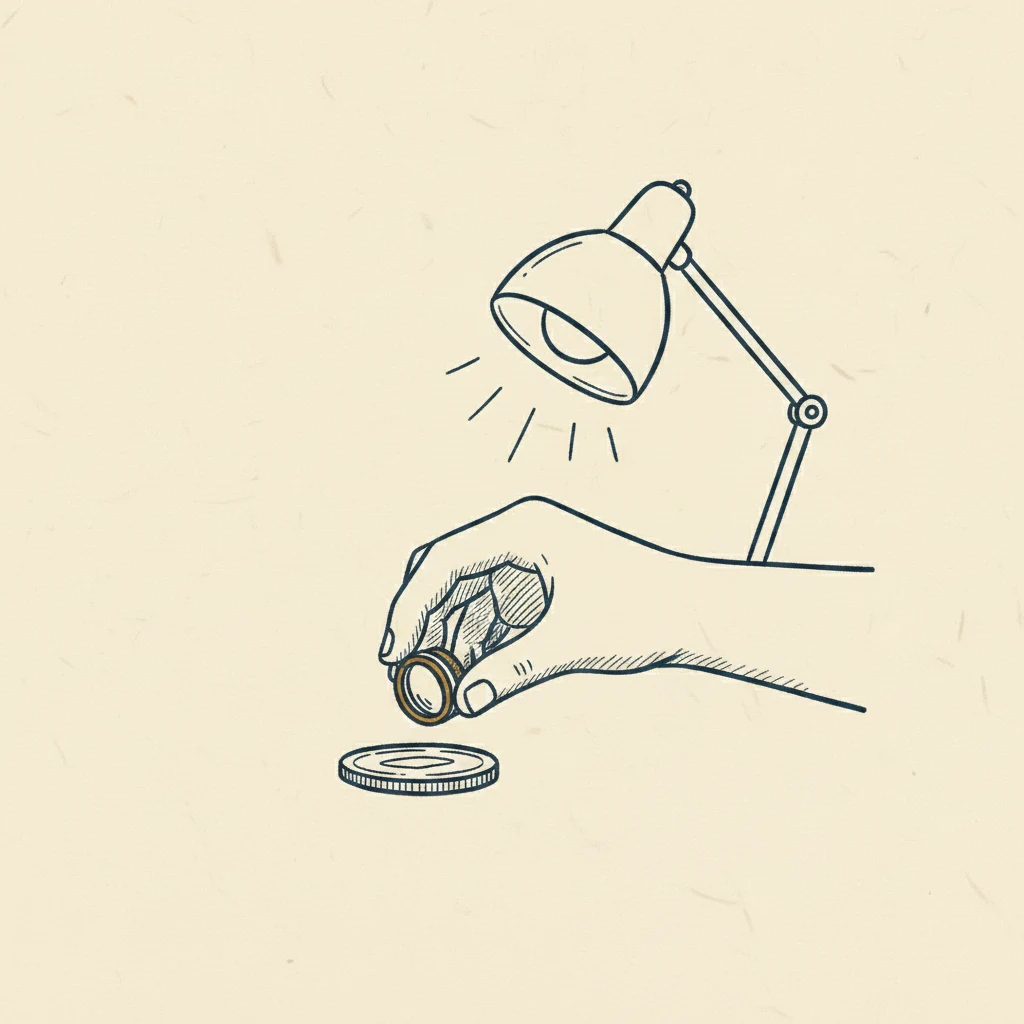
Bring the loupe all the way up to your eye, millimeters away, and then bring the COIN up to the loupe. The most common mistake, according to PCGS, is holding the loupe out at arm’s length like a detective in a movie. Loupe to eye, coin to loupe.
Light matters as much as glass. The grader’s setup is a darkened room with a single covered light source, a 75 to 100 watt incandescent bulb. Collectors say the same thing in fewer words: you need a good light source. The light is what makes luster and hairlines show themselves.
Handle the coin by its edge, and wash your hands first. Gloves are for high-grade vintage copper, not for everything.
And on glass quality, from the same professional: cheap lenses can create bends and distortion around the edges of the view. Good glass looks the same in the middle as it does at the rim. That’s the entire argument for the triplet design, and it’s why the pros name it.
Questions people actually ask
What magnification do I need to look at coins?
For judging condition, 5x to 10x, and most graders live in the 5x to 7x range. Go above 10x only for counterfeit detection or attributing a variety. That ceiling comes from PCGS, from CoinWeek, and from collectors themselves, which is a rare three-way agreement.
Do I need a microscope or a magnifying glass for coins?
If the job is grading, a loupe. If the job is finding mint errors, attributing varieties, or photographing coins to share, that’s what a digital coin microscope is for, and they start around $35. Both are legitimate. They’re just answers to different questions.
Is a 1000x microscope good for coins?
No, and not for the reason people expect. It isn’t only that the cheap ones have poor glass, though they do. It’s that grading depends on eye appeal, not microscopic perfection, so extreme magnification shows you flaws no grader is grading on and makes a good coin look mistreated.
What’s a Hastings triplet loupe?
A loupe built from three lenses bonded together, which is the design the grading world settled on because it keeps the image clean out to the edges instead of bending and smearing there. It’s the loupe CoinWeek names as the best performer. Expect $50 to $150 for a quality one, though triplets branded Hastings show up on the retail shelf for closer to $17.
Can a digital coin microscope grade my coins?
It can show you the surface in extraordinary detail on a screen, which is wonderful for spotting a doubled die or a repunched mint mark. It can’t tell you the grade, and used carelessly it will talk you out of a coin that’s perfectly nice. Grade with the loupe. Hunt with the scope.
What I’d tell a collector at the counter
Buy the 10x triplet loupe. Spend twenty dollars, get a decent light, and learn to bring the coin to the glass.
If you find yourself chasing die varieties six months from now, buy the screen microscope then, and buy it for that job with your eyes open. You’ll be spending that money on the right question, which is the only kind of money in this hobby that never feels wasted.
Ray Ostrander
Ray spent three decades explaining the sky to twelve-year-olds and their parents, and every January, hearing which Christmas telescopes ended up in the closet. He doesn't own a wall of gear and won't pretend to. He reads everything, tells you what owners agree on, and flags what's just his judgment. His goal is simple: no more January closets.