
Best Binoculars for Alaska Cruise: What to Pack for the Deck
For an Alaska cruise, get a waterproof 7x or 8x pair. A Celestron Outland X 8x42 runs about $100, and lower power holds steadier on a moving deck than the big magnification numbers do.
 Ray Ostrander · Updated July 24, 2026 · how I decide
If you buy through a link here, the site earns a little. It's never why anything gets picked.
Yes, bring binoculars. Get a waterproof, fog-proof pair at 7x or 8x power, not 10x or 12x. The Celestron Outland X 8x42 sits right at about $100 as I write this, which is exactly the budget most people name. On a moving ship, a steady low-power view beats a shaky strong one every time.
That’s the whole answer. Everything below is why, and what to do if your situation is a little different from the standard one.
What's on this page
- Do you even need them?
- The power number is the trap on a boat
- The two numbers on the box
- The one thing you can't skip: waterproof and fog-proof
- What to actually buy under $100
- If you want to spend more
- The traps on this shelf
- Questions people actually ask
- What I'd tell a parent in the hallway
- While you're figuring this out
Do you even need them?
This is the part people ask sheepishly, like it might be a silly question. It isn’t. You’re paying for a trip where the whole point is looking at things, and you want to know if the gear is one more thing to buy and haul.
Owners on this one are about as close to unanimous as travelers ever get. The line that keeps coming up from people who have already taken the trip: “Do not go on an Alaskan cruise without a pair. You don’t need a fancy pair, but a pair is absolutely essential.” That’s not a gear person talking. That’s somebody who stood on a deck and watched a distant shape in the water turn out to be a whale.
Cruise passengers also keep mentioning the same trip texture, and it changes what you need. There’s often a wildlife expert onboard, and park rangers come aboard at Glacier Bay. Somebody will be pointing at things and telling you what they are. When that happens, you want your own glass in your hands, not a shared pair passed down the rail.
The power number is the trap on a boat
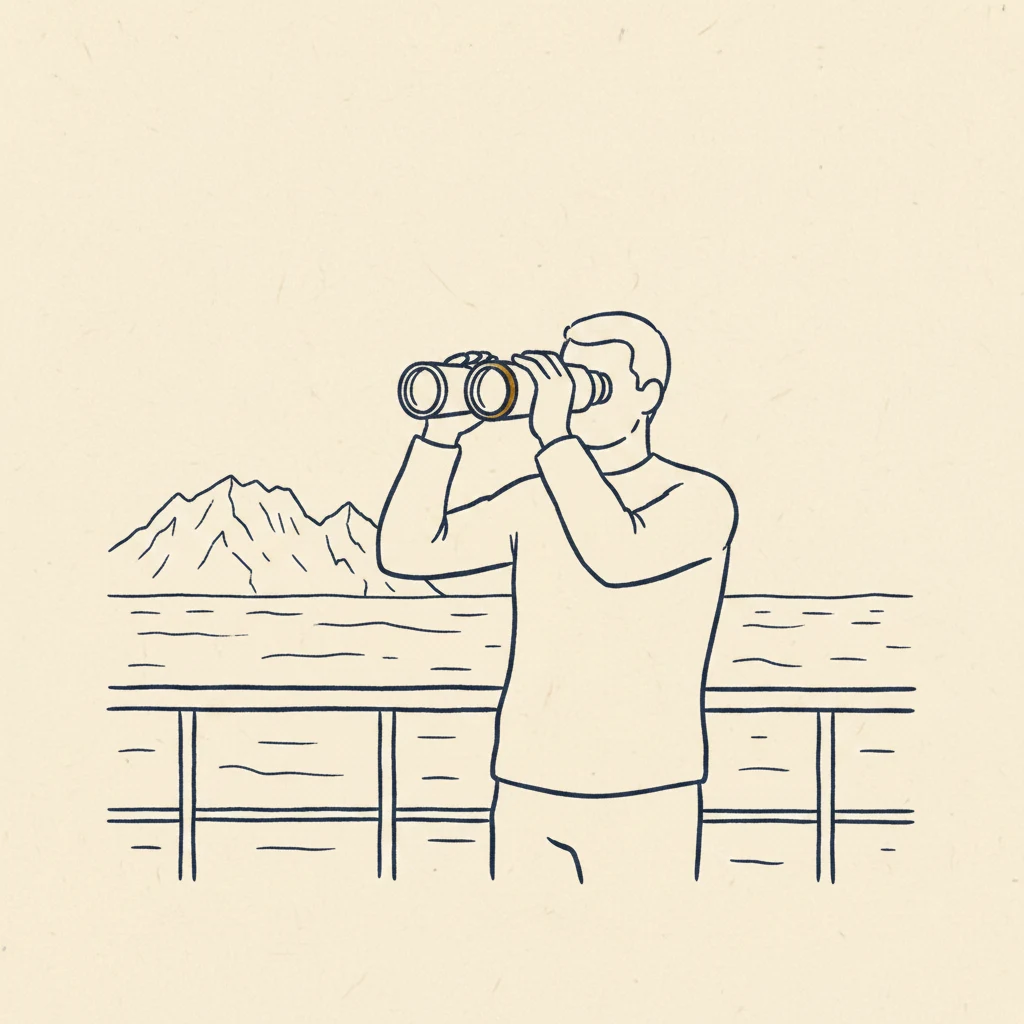
Walk into the aisle and the boxes are shouting numbers at you. 10x. 12x. Bigger is better, right? That instinct is the one thing standing between you and a good trip.
A binocular enlarges everything in front of it, and every small sway of your hands rides along, blown up by the same amount. The people who make these optics say it plainly: the higher the magnification, the more unstable the image gets, because your own unsteadiness grows right alongside the whale. That’s physics, not opinion. It’s true standing still in your living room, and a moving deck only stacks its own sway on top.
So a 12x pair on a rocking deck doesn’t show you twelve times more whale. It shows you a whale that won’t sit still, and after two minutes of that you put the binoculars down and rub your eyes.
That’s why purpose-built marine binoculars run at low power. Steiner, the marine-optics specialist, builds its flagship at 7x, a 7x50 made to hold a steady image even in rough seas. My read is that 8x is a fine ceiling on a big, stable vessel like a cruise ship, and I wouldn’t push past it.

The two numbers on the box
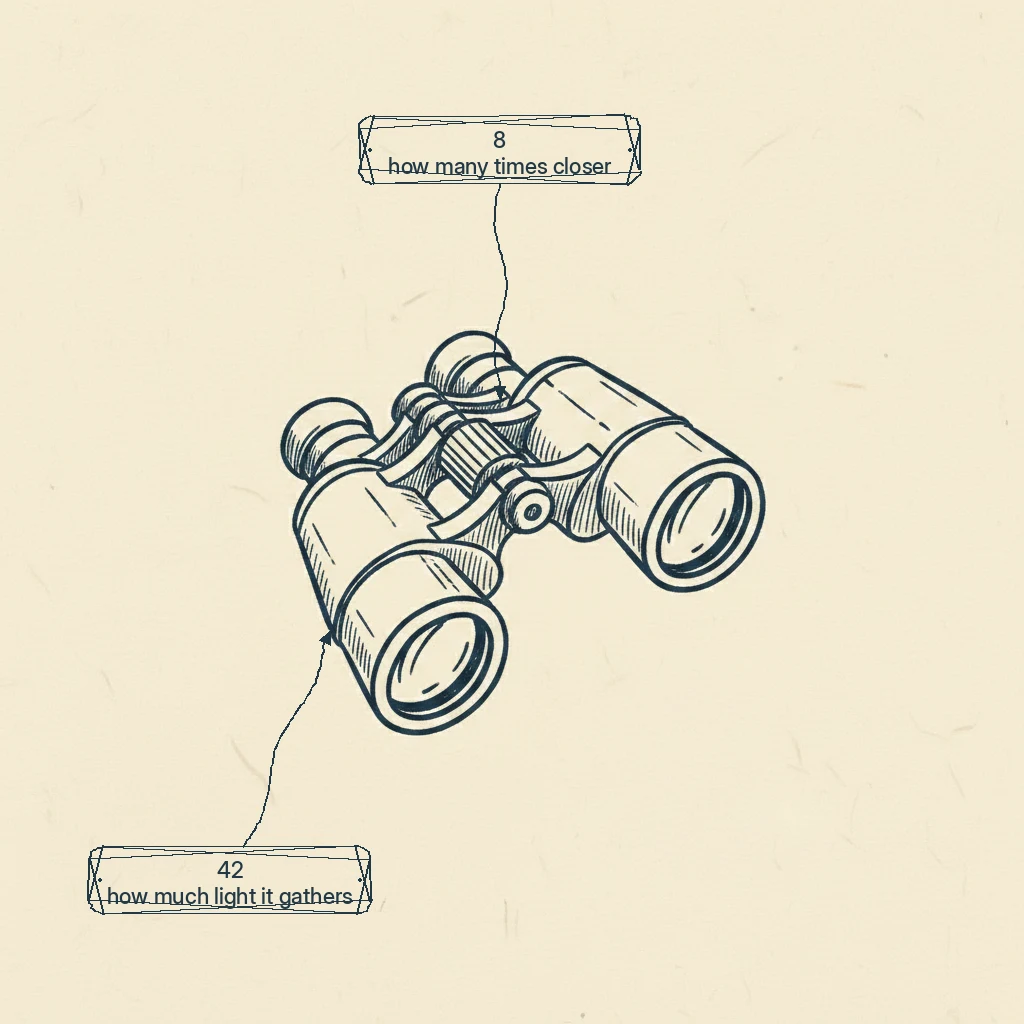
Every pair is named with two numbers, like 8x42, and nobody ever tells you what they mean.
The first number is magnification, which is just how much closer the thing looks. 8x means the whale looks eight times closer than it does to your naked eye.
The second number is the objective, which is just the width of the front lenses in millimeters, the end that gathers light. 42mm is a good honest size. More light in the front means a brighter picture, which matters a lot in Alaska, because Alaska specializes in gray.
So 8x42 reads as: brings things eight times closer, gathers a decent amount of light. On a boat, you want that first number modest. That’s my judgment, and the steadiness physics above is why I hold it.
The one thing you can’t skip: waterproof and fog-proof
Alaska is going to rain on you. Spray comes over the rail, weather rolls in, and you walk from a warm cabin out into cold wet air, which fogs up anything that isn’t sealed against it.
Waterproof and fog-proof isn’t a nice-to-have on this trip. It’s the one feature I won’t let you skip, because of what Alaska’s wet, cold air does to unsealed optics. A sealed pair shrugs. An unsealed pair gets a cloud inside it that you can’t wipe off, and now you own a paperweight for the rest of the trip.
If a pair doesn’t say waterproof and fog-proof on it, it isn’t the pair for this trip, no matter what the price is.
What to actually buy under $100
Most people asking this question say the same thing: budget’s about a hundred bucks, we have a balcony, we aren’t going to become binocular people. Good. That’s an honest brief, and it has an honest answer.
| what you want | the pair | about what it costs |
|---|---|---|
| The one-trip answer | Celestron Outland X 8x42 | about $100 (the sticker says about $110, the street price sits right at $100) |
| Same idea, smaller and lighter | Celestron Outland X 8x25 | about $70 |
| Cheapest thing that still works | occer 12x25 | about $36 |
| If you decide you like this | Celestron Nature DX 8x42 | about $160 on the street (sticker about $180) |
The Outland X 8x42 is the pick. It’s waterproof, it’s 8x, and it’s a great option for exactly the person who won’t use them much afterward. That last part isn’t an insult. It’s the correct way to buy for a trip like this.
About that occer 12x25 at roughly $36. It’s a genuine best seller with tens of thousands of ratings, and it’s a fair pick for people who just want something small in a jacket pocket. But look at the numbers: 12x power, 25mm front lenses. That’s exactly the high-power, small-light combination the steadiness physics argues against, and I’m not going to pretend that tension away. It’s a real tradeoff, and it’s yours to make. If pocketability is the thing that decides whether you actually carry them out on deck, the compact wins, because a pair in your pocket beats a better pair back in the cabin.
If you want to spend more
You don’t need to. But the shelf keeps going, so here’s what’s up there.
The step-up all-rounder is the Celestron Nature DX 8x42 at about $160 on the street, or the ED version at about $200. The stickers say $180 and $230, so shop around. Same sensible 8x42 shape, better glass.
Then there’s the actual marine class, the binoculars built for people who work on boats. A Hawke Endurance ED Marine 7x32 runs about $340. A Steiner Navigator Open-Hinge 7x30 runs about $500. Notice something: the real marine gear is 7x. The professionals went down in power, not up. That tells you more about what works on the water than any box copy will.
One brand note, because you may run into it in an old article: the Opticron Savanna WP 6x30 gets recommended in places, and it’s discontinued at the big retailers now. Don’t chase it. If you’re shopping that band, the named replacement is the Opticron Discovery SP 7x28 at about $95, though it may be a special order that takes several weeks, which is no good if your ship leaves in ten days.
The traps on this shelf
The bigger number. There’s no equivalent of the telescope aisle’s ridiculous “600x” claim in binoculars, but the same instinct is running the same con on you. Bigger magnification number, better product. On a moving deck, it’s backwards.
Buying unsealed. A cheap non-waterproof pair on an Alaska cruise is money set on fire in the rain.
Overbuying for a one-time trip. If you’re never going to pick these up again, spending $350 to look at a glacier once isn’t a flex, it’s a January closet with a better view. Buy the pair that does the job, use it hard, and if you turn out to love it, that’s a wonderful problem to solve later.
Questions people actually ask
Do we need binoculars if we have a balcony?
Yes, and the balcony is the reason. From a balcony you’re looking out at open water and shoreline for hours with nobody in your way. That’s prime glassing. Owners who have taken the trip are direct about it: you don’t need a fancy pair, but a pair is essential.
Is 10x better than 8x for a cruise?
Not on a moving ship. Higher power magnifies your own motion along with the view, so the image gets harder to hold steady. Marine binoculars are built around 7x for exactly this reason, with 8x to 10x considered usable on large stable vessels. A cruise ship is stable, so 8x is a comfortable ceiling.
Can I just get a cheap compact pair?
You can, and lots of people do. The occer 12x25 runs about $36 and sells enormously. The catch is that it’s high power with small front lenses, which is the shaky, dim end of the tradeoff. If pocket size is what gets you out on deck with them, take it. Just know what you traded.
What about one pair for two people?
Bring two. That one is purely my judgment, but I hold it firmly. Somebody is always going to be pointing at the water saying “there, there, right there” while the other person is the one holding the binoculars. Two modest pairs will make you happier on this trip than one nice pair you keep handing back and forth.
Do I need actual marine binoculars?
No. The marine models are built for people working on smaller boats in worse conditions, and they cost three to four times what a good waterproof 8x42 costs. What you should steal from them is the design lesson: they run at 7x. Follow the power, not the price tag.
What I’d tell a parent in the hallway
Get the waterproof 8x42, spend about a hundred dollars, and stop thinking about it.
You aren’t buying optics. You’re buying the moment a gray shape in the water resolves into a whale while somebody next to you is still squinting. That’s worth about what a nice dinner ashore costs, and unlike the dinner, you get to bring it home and use it at the ball game.
While you’re figuring this out
You’re probably also wondering:
- Whether the whale-watching answer is different from the cruise answer, because a small boat isn’t a cruise ship: binoculars for whale watching
- Whether any of this works if you wear glasses, which is the question I care about most: binoculars for glasses wearers
- Whether one eye is enough, if you want something even smaller in the jacket: monocular for bird watching
- What to do with the pair once you’re home and the sky is dark: stargazing for beginners
Ray Ostrander
Ray spent three decades explaining the sky to twelve-year-olds and their parents, and every January, hearing which Christmas telescopes ended up in the closet. He doesn't own a wall of gear and won't pretend to. He reads everything, tells you what owners agree on, and flags what's just his judgment. His goal is simple: no more January closets.