
Binoculars for Glasses Wearers: The One Number to Check
If you wear glasses, buy binoculars with at least 16mm of eye relief (17 to 21mm is better) and twist the eyecups down. That gets you the full circle instead of a tunnel.
 Ray Ostrander · Updated July 24, 2026 · how I decide
If you buy through a link here, the site earns a little. It's never why anything gets picked.
Look for eye relief of at least 16mm, and 17 to 21mm is more comfortable. Then twist or fold the eyecups all the way DOWN, so your glasses can sit in that space instead of the rubber cups. That’s the whole fix. One number on the box, one twist of the eyecups, and you get the full circle instead of a keyhole.
I wear thick glasses. I’ve worn them for most of my life, and I have spent thirty-one years having them in the way of things. So this page is the one I’d have wanted somebody to just hand me.
What's on this page
The problem you already have
You put the binoculars up to your glasses and the picture is wrong. It’s small, it’s ringed in black, and it feels like looking down a pipe. You take your glasses off and it gets better, except now you can’t focus, and now you’re the person on the boat holding their glasses in one hand and squinting.
Nobody tells you why. And the spec that explains it’s sitting right there in every listing, buried under the star ratings, in a unit nobody explains.
Here’s how one buyer put it, and I promise you’re not alone: “I wear glasses and I’m having difficulty understanding eye relief.” He’d figured out that eye relief mattered enough to pick one model over another for it. He still couldn’t get anybody to explain what it actually was, or what to do with the eyecups.
So let’s just do that.
What eye relief actually is
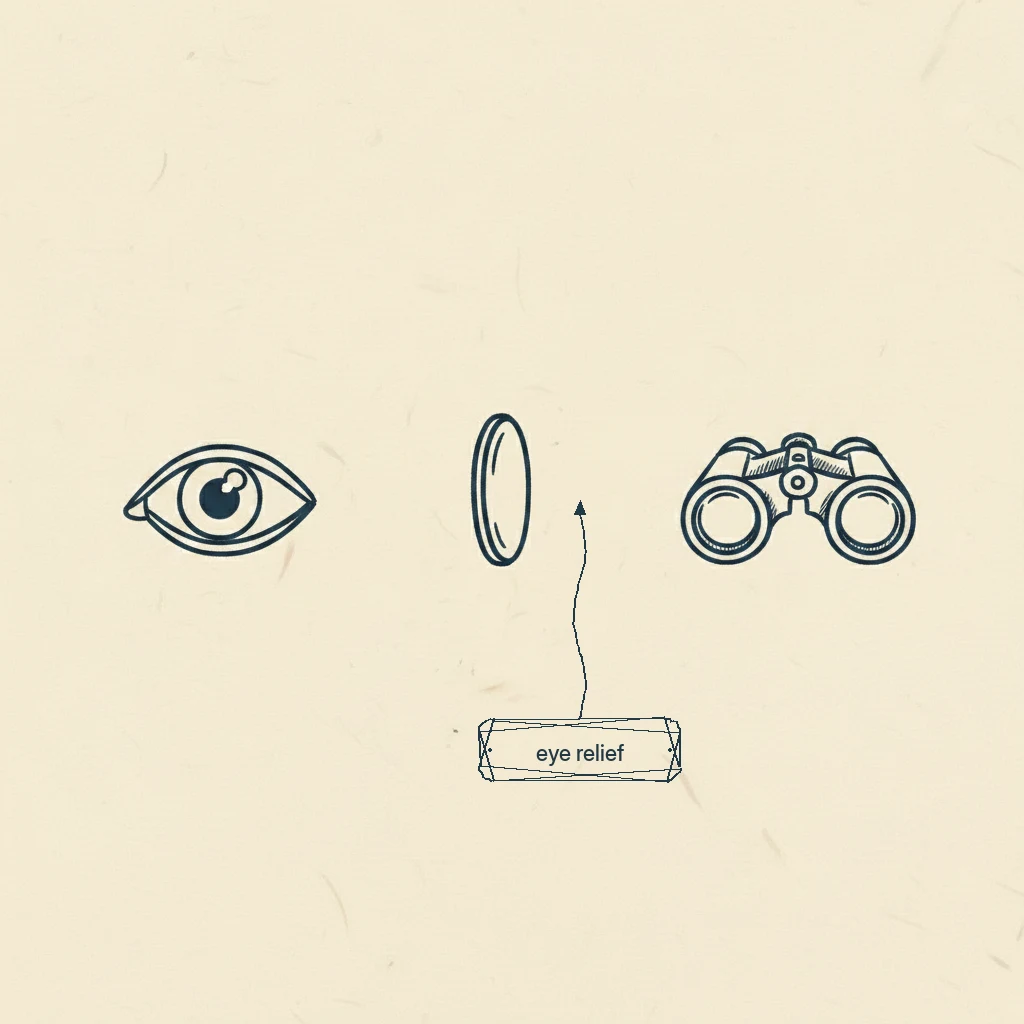
Eye relief is the distance between the lens you look into and your eye, at the spot where you can still see the whole picture.
Your eye needs to be at that distance. Not closer, not farther. Get it right and you see the whole bright circle. Get it wrong and the edges collapse into black and you’re looking down that pipe.
Now add glasses. Your glasses lens sits out in front of your eyeball, and it isn’t moving. So your eye is parked farther back from the binoculars than it would otherwise be. The binoculars have to be able to deliver the full picture from farther away, which means they need MORE eye relief. That’s it. That’s the entire mystery.
This is why eye relief is the number to watch. Audubon puts the birding range at 15 to 20mm: about 16mm is the practical floor once you add glasses, 17 to 18mm is where it gets comfortable, and if your prescription is strong you want to be up near 20.
The one action: eyecups DOWN
Look at the rubber cups around the eyepieces. On most binoculars they twist up and down, or fold back if they’re the softer kind. They exist to hold your bare eye at exactly the right distance.
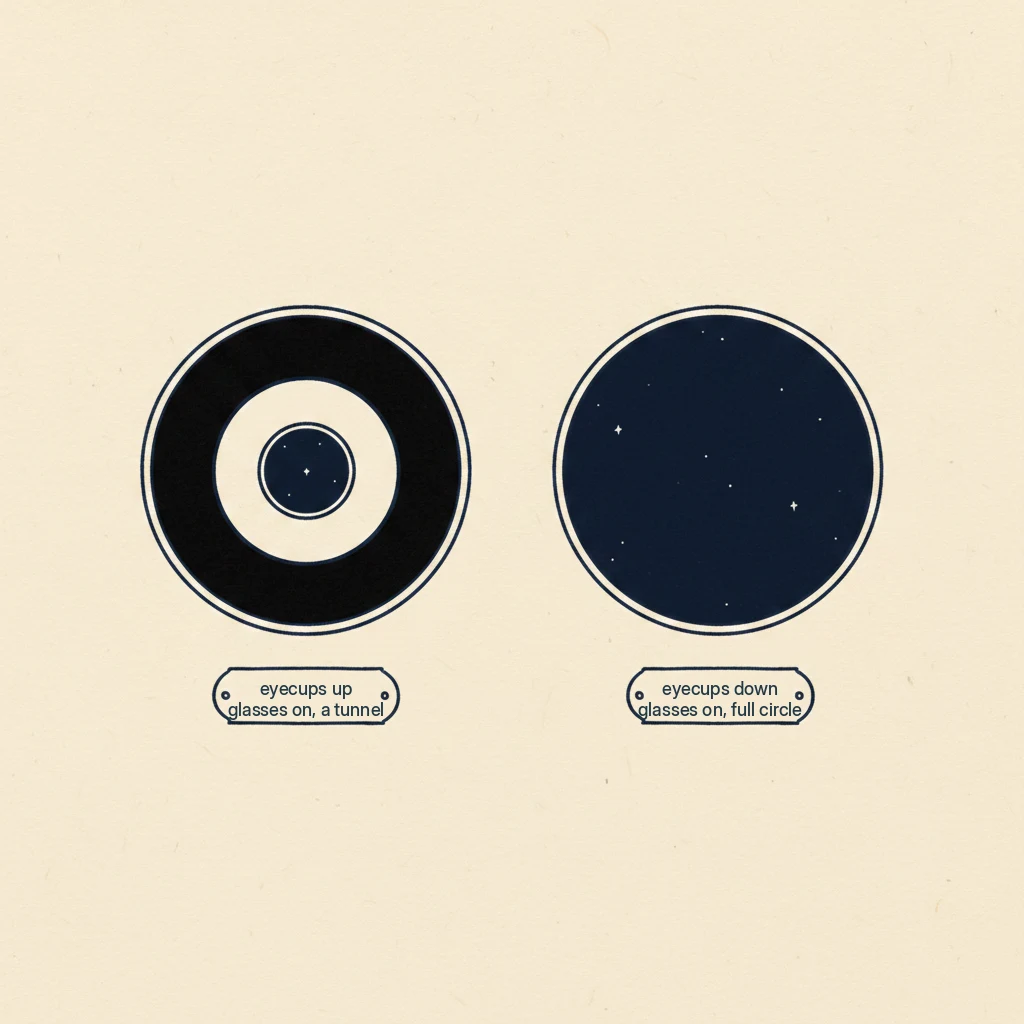
But when you’re wearing glasses, your glasses are already occupying that space. If you leave the eyecups up, they push your glasses (and your eye behind them) too far back, and you lose the edges of the picture.
So: eyecups down. Audubon says it straight: use the eyecups in the fully retracted position with your eyeglasses, and fully extended without them. Your glasses are already occupying the eye-relief space, so the cups have to get out of the way. That’s the fix nobody mentions in the listing, and it costs nothing.
If you’ve been fighting the tunnel view, try this before you buy anything else. It may be that your current pair was fine and the cups were up.
What to check before you buy
Three things, and only three.
The eye-relief number, in millimeters. At least 16. Aim for 17 to 21. If the listing doesn’t say, that’s not a shrug, that’s a reason to go find the number or go somewhere else. Plenty of pages bury it or leave it out entirely, and buying blind on the one spec that decides whether the thing works for your face is a bad trade.
Twist-up eyecups with real stops. You want cups that lock at more than one position, so you can set them down and have them stay there. Single-position cups mean you can’t get a repeatable fit with your glasses on.
Cups that won’t scratch your lenses. Owners bring this up, and it’s a fair point that never makes it into a review: you’re pressing rubber against glass you paid for. Look at what’s touching your lenses.
One more thing worth knowing, from an owner with a good eye for detail: how thick your glasses lenses are matters, especially on a pair with borderline eye relief. Thick lenses push your eyes back farther still. If your prescription is strong, buy above the minimum, not at it.
The compact trap
This is the one that costs people money.
Small pocket binoculars usually run short eye relief with small eyecups, which is exactly backwards from what a glasses wearer needs. They’re the pair you want to buy, because they’re light and cute and they fit in a jacket. They’re the pair most likely to hand you the black ring.
If you wear glasses, a full-size pair, an 8x42 shape, is the friendlier body fit. That’s my judgment, and the eye-relief math above is why I hold it. A compact can work, but you have to check the number harder, not less.
A shelf that actually passes
These are real eye-relief specs pulled from the retailer’s spec sheet, not from my head. All three clear the 16mm bar comfortably. Prices are street prices as I write this, and the manufacturer’s sticker runs higher on each.
| model | eye relief | about what it costs |
|---|---|---|
| Celestron Nature DX 8x42 | 17.5mm | about $160 (sticker says about $180) |
| Celestron Nature DX ED 8x42 | 17.8mm | about $200 (sticker says about $230) |
| Celestron TrailSeeker 8x42 | 17mm | about $280 (sticker says about $320) |
Notice they all land in the same 17mm neighborhood, right where the experts said comfortable begins. That’s the point of this page in one table: the brand race is noise, the number is the answer.
The honest “boring cousin” pick here isn’t a brand at all. It’s a spec: any 8x42 with eye relief of 16mm or more and multi-stop twist-down eyecups. Buy that, from whoever’s got it, at whatever price you’re comfortable with.
Questions people actually ask
What if the listing doesn’t say the eye relief?
Then you don’t know whether it fits your face, and that’s the one thing you needed to know. Plenty of listings bury the number or leave it out. Go find it on the manufacturer’s spec sheet, ask the retailer, or move on to a pair that tells you. Buying without that number is the actual trap on this shelf.
How much eye relief do I really need?
At least 16mm, and more is more comfortable. The range people who wear glasses keep naming is 17 to 21mm. If your lenses are thick, buy above the minimum rather than right at it, because a thick lens pushes your eye back even farther.
Why do I see a black ring around the picture?
Your eye is sitting too far back from the eyepiece, so the edges of the view fall away. Usually it’s the eyecups: they’re up, and your glasses are holding you off. Twist them down. If they’re already down and the ring is still there, that pair doesn’t have enough eye relief for your face.
Are compact binoculars bad for glasses wearers?
Not automatically, but they’re the risky category. Small binoculars tend to have short eye relief and small eyecups, which is the wrong shape for a face with glasses on it. If you want a compact, insist on seeing the eye-relief number first.
Do expensive binoculars have better eye relief?
Not necessarily, and that’s a genuinely useful thing to know. Look at the table above: the pair at about $160 has slightly MORE eye relief (17.5mm) than the pair at about $280 (17mm). Eye relief is a design choice, not a price tier. Check the spec, not the sticker.
What I’d tell a parent in the hallway
Find the eye-relief number before you find the brand. Sixteen millimeters is the floor, seventeen and up is where it gets comfortable, and then you twist the eyecups down and forget about it.
You aren’t buying a compromise pair, and you aren’t stuck with the tunnel. The good news about being a glasses wearer in this aisle is that once you know the number, the number does the shopping for you.
While you’re figuring this out
You’re probably also wondering:
- What to bring on the trip that started this whole search: best binoculars for an Alaska cruise
- Whether the boat changes the power you want: binoculars for whale watching
- Whether one eyepiece is simpler than two when you wear glasses: monocular for bird watching
- What to look at after dark once the pair is in your hands: stargazing for beginners
Ray Ostrander
Ray spent three decades explaining the sky to twelve-year-olds and their parents, and every January, hearing which Christmas telescopes ended up in the closet. He doesn't own a wall of gear and won't pretend to. He reads everything, tells you what owners agree on, and flags what's just his judgment. His goal is simple: no more January closets.