
The Best Spotting Scope for the Money: Why the Cheap One Claims More Power
For the money, a 20-60x60 to 20-60x80 scope like the Athlon Talos at about $200 is the pick, and plan to live in the middle of that zoom. The tell: premium makers cap at 48x while budget scopes advertise 60x. And the tripod isn't included.
 Ray Ostrander · Updated July 24, 2026 · how I decide
If you buy through a link here, the site earns a little. It's never why anything gets picked.
You’ve already made peace with not buying the best one. You just want to know where your money stops doing anything, so here it’s up front. For the money, a 20-60x60 or 20-60x80 scope is the honest configuration, and something like the Athlon Talos 20-60x80 at about $200 is a genuinely good pick, partly because it’s one of the few that comes with a little tripod in the box. Plan to spend most of your time in the middle of that zoom range, not the top. Here’s the tell that proves why: the premium scopes, the ones with the best glass, stop at 48 power, while the cheap ones advertise 60. And whatever you buy, budget for a real tripod, because the scope is useless without one and it’s almost never included.
Let me show you each of those, because on this door the lies are specific and the money is real.
What's on this page
- First, whose aisle this is
- Here's what's actually happening with the magnification
- The air gets a vote
- The same lie, four aisles over
- The price on the box isn't the price
- How big a scope, really
- The value shelf, and one honest caveat about prices
- Is a scope even the right answer?
- Already own a 20-60x budget scope?
- Questions people actually ask
- What I'd do, counting my dollars
First, whose aisle this is
Quick heads-up, same as a few other pages here. The spotting-scope world is written for hunters and target shooters. The reviews, the forums, the whole vocabulary, all of it assumes you’re glassing a ridgeline for elk. If you’re a birder, or you just want to see something far away clearly, you’re a guest in their aisle reading their specs. That’s fine, the optics are the same, but I’ll keep the language in plain terms and leave the hunting jargon where I found it.
Here’s what’s actually happening with the magnification
This is the fact the whole page turns on, and once you see it you can’t unsee it.
A man with forty years behind a scope put it plainly: many high-end spotting scopes cap their magnification at 48 power. The best makers, the ones charging serious money for serious glass, deliberately stop at 48. Meanwhile the budget scope on the shelf beside them proudly advertises 20 to 60 power. So the cheap scope claims a bigger top number than the expensive one. Sit with that. The 60 isn’t there because the budget scope is more capable. It’s there because a bigger number sells a cheaper scope, and it’s the number you’ll actually use the least.
Why won’t the good makers give you 60? Because they know what happens when you get there, which brings me to the thing no amount of money can fix.
The air gets a vote
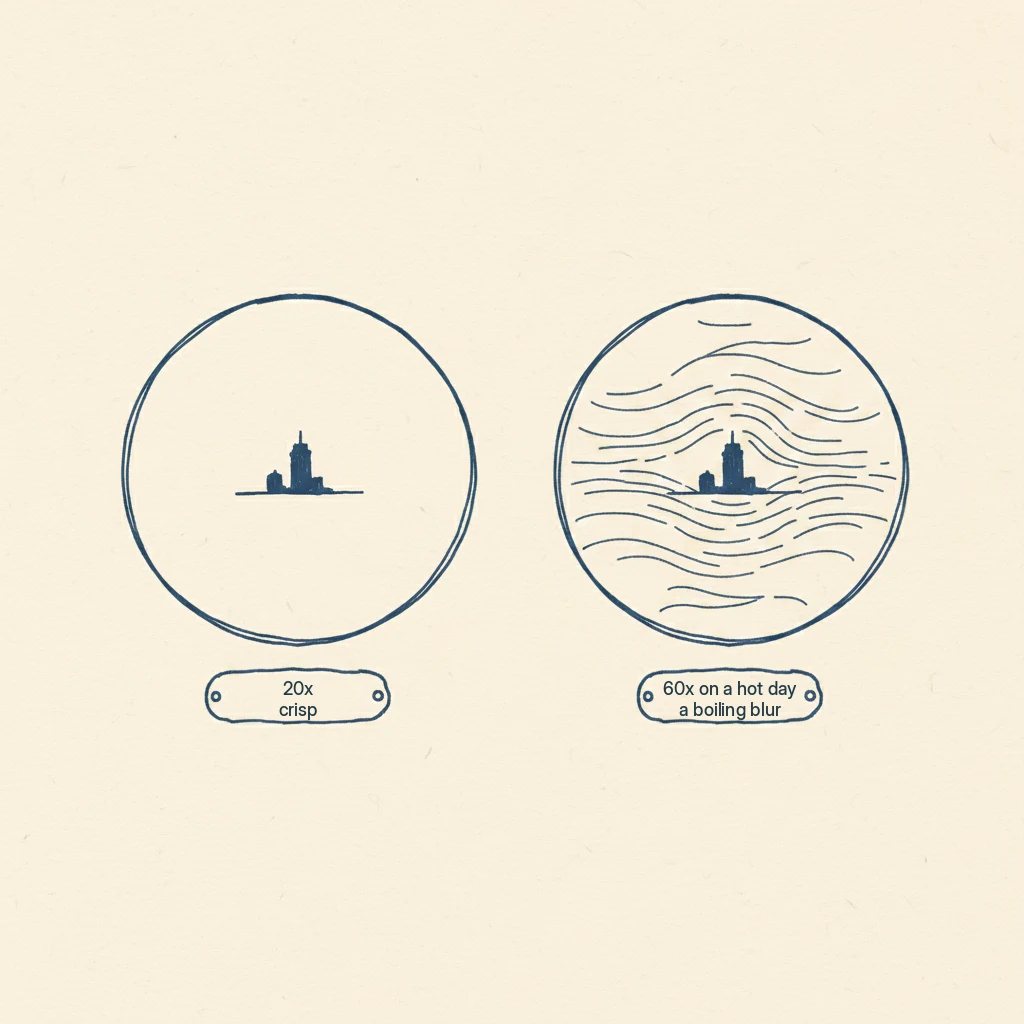
Push any scope to the top of its range and point it a long way off, and you run into the atmosphere. Heat shimmer, haze, the boiling air over warm ground. The same forty-year field man says it flat out: at long distance, heat waves bother all optics, good and bad. That’s the most democratic sentence in this whole hobby. You can’t buy your way out of the air.
I trust it because it turns up from three completely different directions. The long-distance binocular people found the same wall. Amateur astronomers will tell you the thing that changed their view from one night to the next was the moisture and haze, not the telescope. And here it’s again on the spotting scope. On a hot afternoon at real range, cranking to 60 power doesn’t buy you a better look. It buys you a magnified view of the boil. That’s exactly why the top of a cheap zoom is a fiction most days, and why the good scopes don’t bother pretending.
The same lie, four aisles over
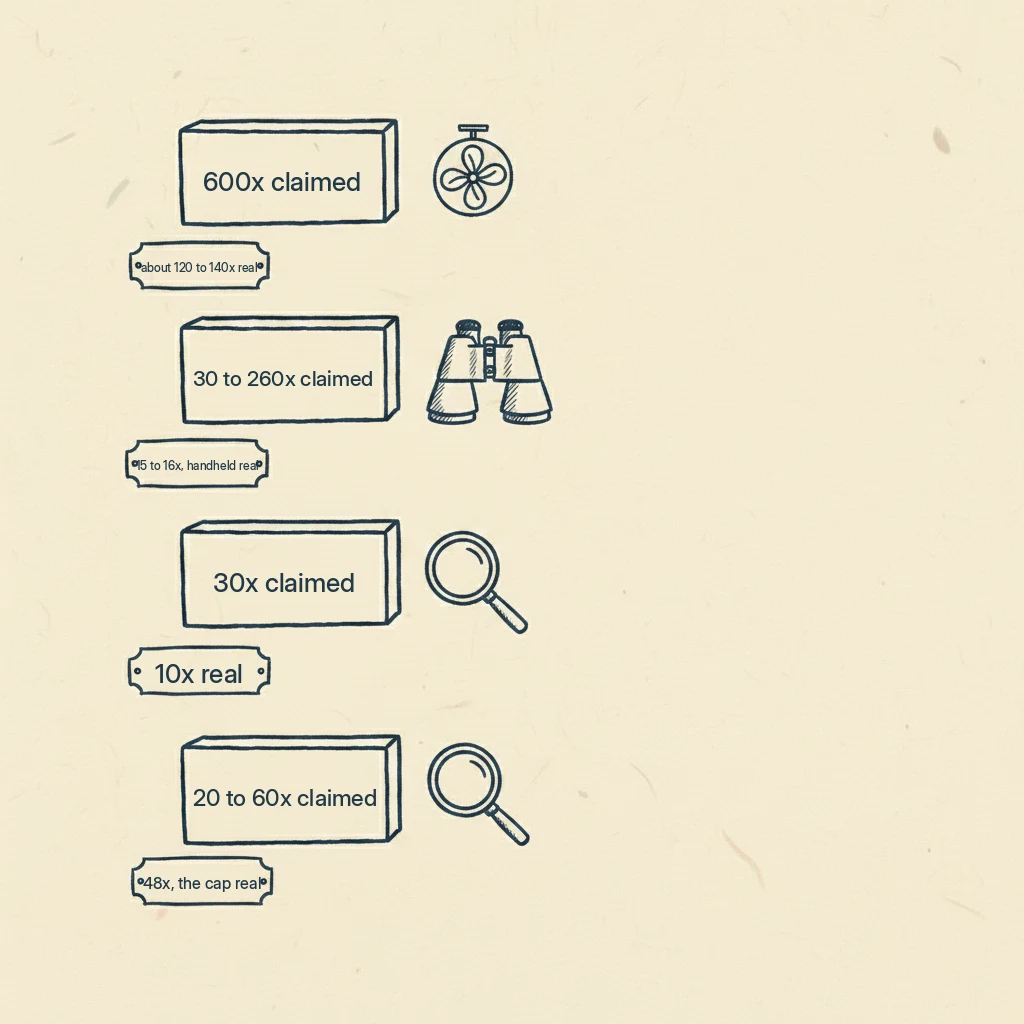
I want to zoom out for a second, because this isn’t a spotting-scope quirk. It’s the single most reliable scam-tell in this entire store, and I can show it to you in four different products at once.
A department-store telescope screams “600x!” on the box, when the physics caps a small scope somewhere around 120 to 140 power before the image falls apart. A binocular listing advertises “30-260X,” when nobody can hold more than about 15 or 16 power steady in two hands. A cheap reading magnifier stamps “30X” on the package, when even professional coin graders work at 10. And now the spotting scope promises 60, while the best makers won’t build past 48. Four products, one trick, and it’s always the same shape: the number on the box gets bigger as the glass gets worse. Learn to read that number backward and you’ll never be fooled in this aisle again.
The price on the box isn’t the price
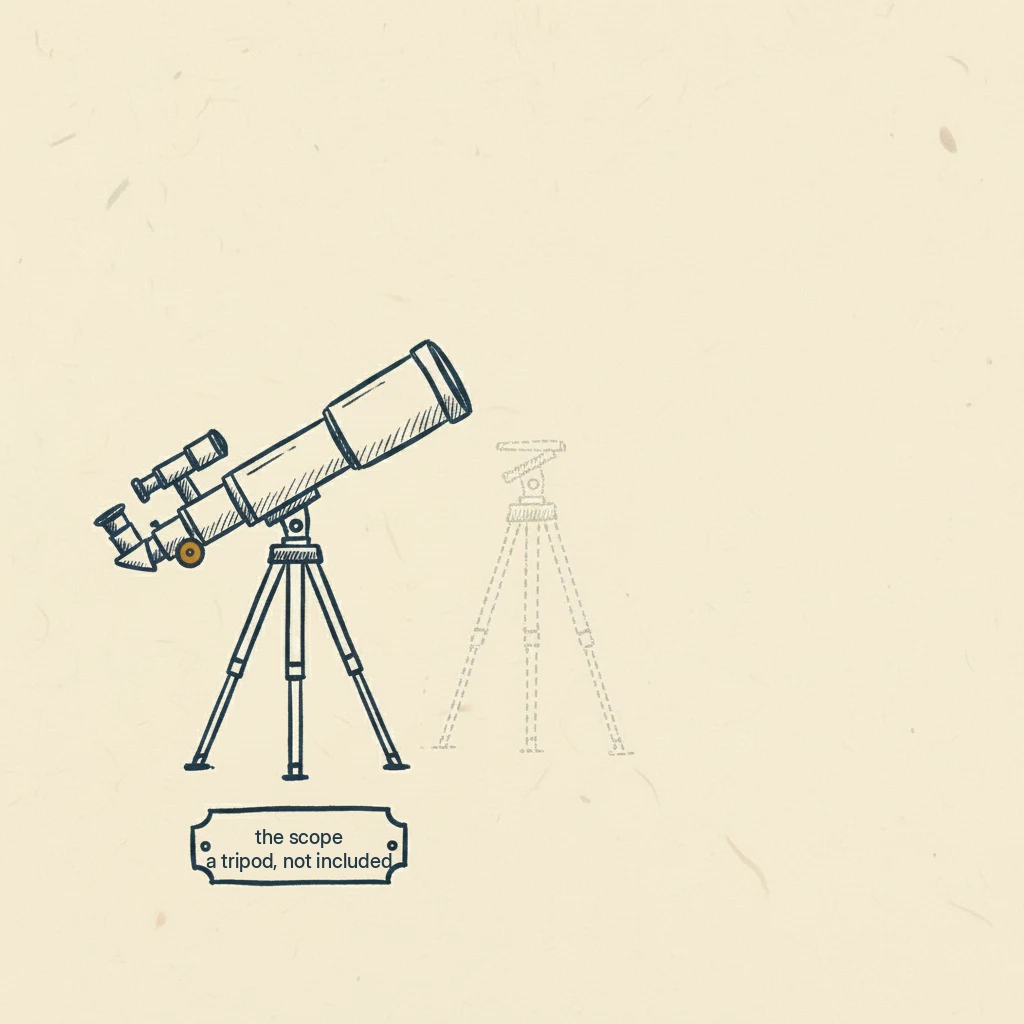
Here’s the second thing the sticker hides, and it’s the one that catches people. A spotting scope isn’t a handheld device. At these magnifications your hands would turn the image to jelly, so it lives on a tripod, always. And the makers, in the polite words of the buying guides, “often leave tripod selection to the buyer.” Translation: the price on the box isn’t the price of the thing you’ll actually use.
A tripod solid enough to hold a scope still, plus the little adapter to mount it, comes to roughly $140 and $20. That’s real money you have to add to every scope price you see, and skimping here undoes everything, because a wobbly $30 tripod turns a good scope into a blurry one. The one happy exception is that a few budget scopes include a small tabletop tripod, which is why the Athlon Talos I mentioned is one of the only scopes whose sticker price is close to its true price. For anything else, add the tripod into your budget before you fall in love with a number.
How big a scope, really
There’s an honest disagreement here worth handing you straight, because the sources don’t fully agree and I’m not going to pretend they do.
One camp says go 80mm. The bigger front lens gathers noticeably more light, around 50 percent brighter than a smaller one, and at the under-$500 price point the 20-60x80 is the common, sensible choice. That’s a real argument, and if your scope will mostly ride in a truck to a fixed spot, I’d listen to it.
The other camp is the forty-year field man, and he votes with his feet. He owns an 88mm for serious work, but the scope he actually carries hunting is a 65mm Nikon, because an 80mm scope plus a tripod is a genuine load to haul up a hill, and the one that stays home shows you nothing. His own recommendation is a mid-sized 16-48x65. And notice what he picked: a scope that stops at 48 power. He’s spending his own money on the honest ceiling.
So the synthesis is the same rule that governs half of this site: the 80mm is brighter and better, and the 65mm is the one you’ll actually carry. If you drive to your viewing, go bigger. If you walk to it, go lighter, and don’t feel like you’re settling.
The value shelf, and one honest caveat about prices
The scope I keep coming back to is the Athlon Talos 20-60x80 at about $200, called the best budget pick for 2026, fully multi-coated and waterproof, with that included tabletop tripod and, by the reviews, performance that rivals scopes costing twice as much. That’s the clearest value on the shelf.
There’s a well-regarded comparison of budget scopes with price bands worth glancing at, but I have to be straight with you about it: that page has been updated over years, and its prices are of uncertain vintage, so treat these as rough neighborhoods, not today’s tags. In that comparison the picks ran roughly $250 to $650, names like the Nikon ProStaff, the Vanguard Endeavor, the Celestron Regal, and a Kowa. And here’s the quiet tell again, sitting right in the table: four of the six scopes a forty-year user actually rated cap at 48 power or below. The spec sheet corroborates the whole page.
Is a scope even the right answer?
Worth asking before you spend, because sometimes it isn’t. If you’ve landed here from trying to push a binocular to see farther, the real fork is glass on a tripod. A good 10x42 binocular with a tripod adapter, or a higher-power binocular like a 15x56 that comes with an adapter, is the sensible middle rung between handheld binoculars and a full spotting scope. And here’s a genuinely counter-intuitive number to keep you honest: that Athlon Talos scope at about $200 actually costs less than a premium 15x binocular at around $350. Cheaper doesn’t mean worse here, it means you’re paying for the tripod-mounted design instead of the compromise of holding it. If your looking is mostly stationary, the scope wins on both price and reach.
Already own a 20-60x budget scope?
A lot of you reading this already bought one, because it’s the best-selling kind there is, and I don’t want you to feel cheated. You weren’t. Your scope is genuinely useful, and here’s how to get the most from it: live in the lower and middle of that zoom, roughly 20 to 40 power, where the image is bright and steady, and treat the 60 as an occasional peek for a cool, still morning rather than your everyday setting. Put it on a solid tripod and use the part that works. That’s not a consolation prize. That’s how the people who know these scopes actually use them.
Questions people actually ask
What magnification spotting scope should I buy?
A 20-60x is fine to own, but plan to use the lower and middle of that range, around 20 to 40 power, for most viewing. The very top is where heat shimmer and glass limits catch up with you, which is exactly why the premium makers cap their scopes at 48. Buy the zoom, but don’t buy it for the 60.
Is a 60mm or 80mm spotting scope better?
The 80mm is brighter and better for detail, especially from a fixed spot. The 60 to 65mm is lighter and the one you’ll actually carry any distance. If you drive to your viewing, go 80. If you hike to it, go 65 and don’t look back. The best scope is the one that comes with you.
Do I need a tripod for a spotting scope?
Yes, always, and it’s not optional. At these magnifications a scope is unusable handheld, and the makers usually don’t include a tripod. Budget roughly $140 for a sturdy one and $20 for the adapter on top of the scope price. A cheap, wobbly tripod will ruin a good scope, so this isn’t the place to skimp.
How much should I spend on a spotting scope for the money?
A strong value scope like the Athlon Talos runs about $200 and includes a small tripod. Solid mid-range picks climb toward $500. Above that you’re paying for premium glass that mostly shows up in bad light and at long range, right where the air fights you anyway. For most buyers, the money stops working hard somewhere in the $200 to $500 range.
What I’d do, counting my dollars
If a spotting scope turns out to be more than you need, and for a lot of people a good binocular on a tripod is plenty, that crossover question lives at telescope for bird watching, which is really about how far your glass reaches on land.
So here’s where I’d leave you, as someone counting his dollars. Buy in the middle of the zoom, not for the 60 that the good makers won’t even build. Buy the objective size you’ll actually carry, not the biggest one on the shelf. And put your leftover money into a tripod that holds still, because that’s the part of this purchase the sticker quietly left off. Do those three things and about two hundred dollars buys you a scope that sees everything the air will let it, which, on most days, is all any scope can promise you.
Ray Ostrander
Ray spent three decades explaining the sky to twelve-year-olds and their parents, and every January, hearing which Christmas telescopes ended up in the closet. He doesn't own a wall of gear and won't pretend to. He reads everything, tells you what owners agree on, and flags what's just his judgment. His goal is simple: no more January closets.