Telescope for Bird Watching: The One You Want Is Called a Spotting Scope
For bird watching you want a spotting scope, not an astronomical telescope: 20 to 40x, a 60 to 80mm lens, a right-way-up image, on a tripod. But for most birding a good 8x binocular is the better first buy.
 Ray Ostrander · Updated July 24, 2026 · how I decide
If you buy through a link here, the site earns a little. It's never why anything gets picked.
If you’re shopping for a telescope to watch birds, here’s the one thing worth knowing before you spend. The tool for the job has a different name: a spotting scope. You want 20 to 40x magnification, a 60 to 80mm lens, a right-way-up image, and always a tripod. And for most bird watching, honestly, a good 8x binocular is still the better first buy, with the scope saved for distant, still birds like shorebirds, hawks, and waterfowl.
Nobody asks the wrong question here. “Telescope for bird watching” is exactly what you mean: a tool that pulls a far-off bird in close. There just happens to be a right one and a wrong one, and I’d rather you hear that from a neighbor than learn it after the box is open.
What's on this page
Why an astronomy telescope fights you on birds
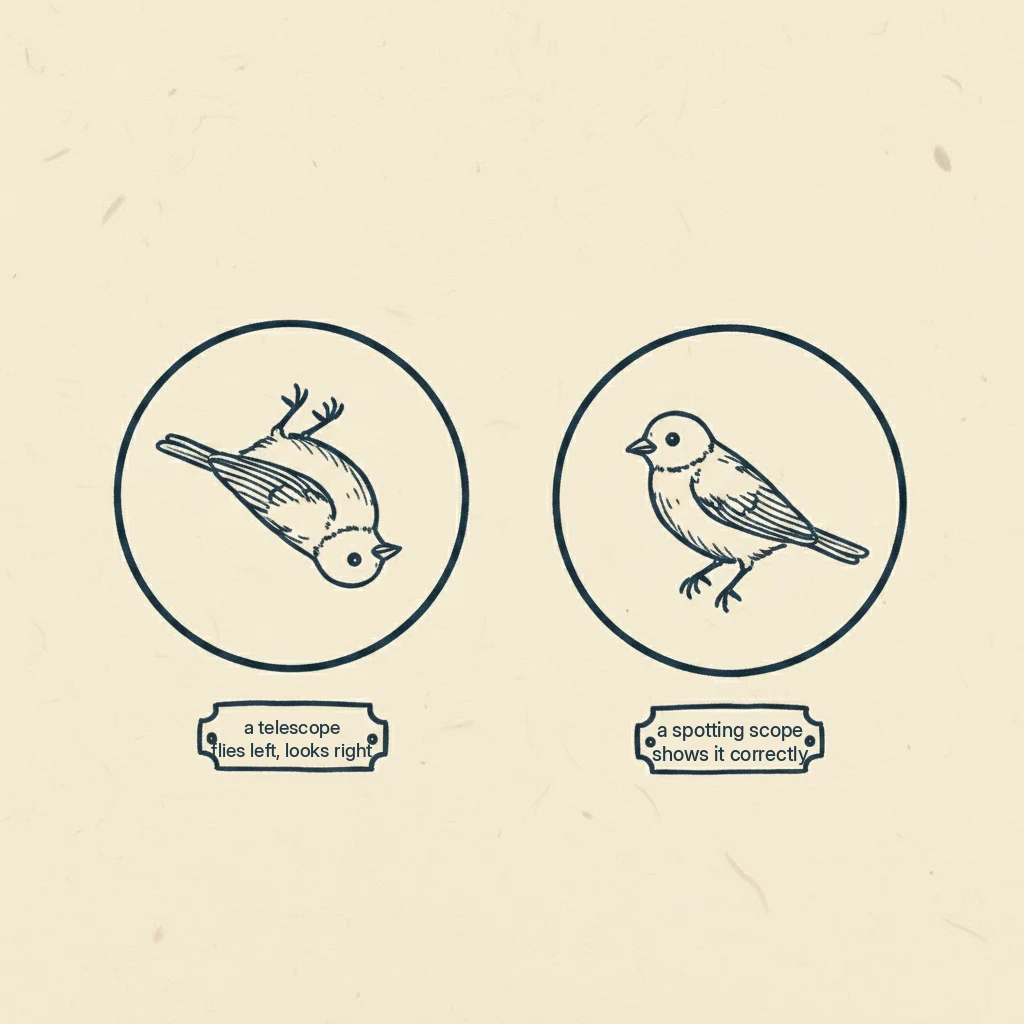
Here’s the mismatch. A telescope built for the stars gives you a view that’s upside-down, and often flipped left-to-right too. Out in space that doesn’t matter one bit: a star is a star whichever way up it sits. On a bird it matters a lot. The bird seems to drift right in the eyepiece when it’s actually flying left, so you spend the whole time chasing it the wrong way. It’s maddening, and it’s not your fault. It’s the wrong tool.
A spotting scope is built from the start for looking at things on the ground. It shows you a correct image, right-way-up and the right way around, at a magnification tuned for daylight distance instead of faint starlight. That’s the whole difference, and it’s the difference between watching a bird and losing it.
The spec that matters, in plain words
You don’t buy a birding scope by brand. You buy it by a short spec, and here it is. Magnification of about 20 to 30x is the all-round sweet spot, and 40x is about the ceiling before things get dim and shaky. The lens on the front, the objective, wants to be 60 to 80mm: big enough for a bright image, not so big it’s a boat anchor.
Then there’s one body choice. A straight scope, where you look straight through, is better for quickly tracking a moving bird and for glassing from inside a car. An angled scope, where the eyepiece sits at a tilt, is easier to share in a group and better for anything up high. Neither is wrong. Pick the one that matches how you’ll actually use it.
And the tripod isn’t optional. A spotting scope at 30x is unusable held in your hands: every heartbeat becomes an earthquake in the view. Budget for the tripod as part of the purchase, not as a someday extra.
The honest part: most birders want binoculars first
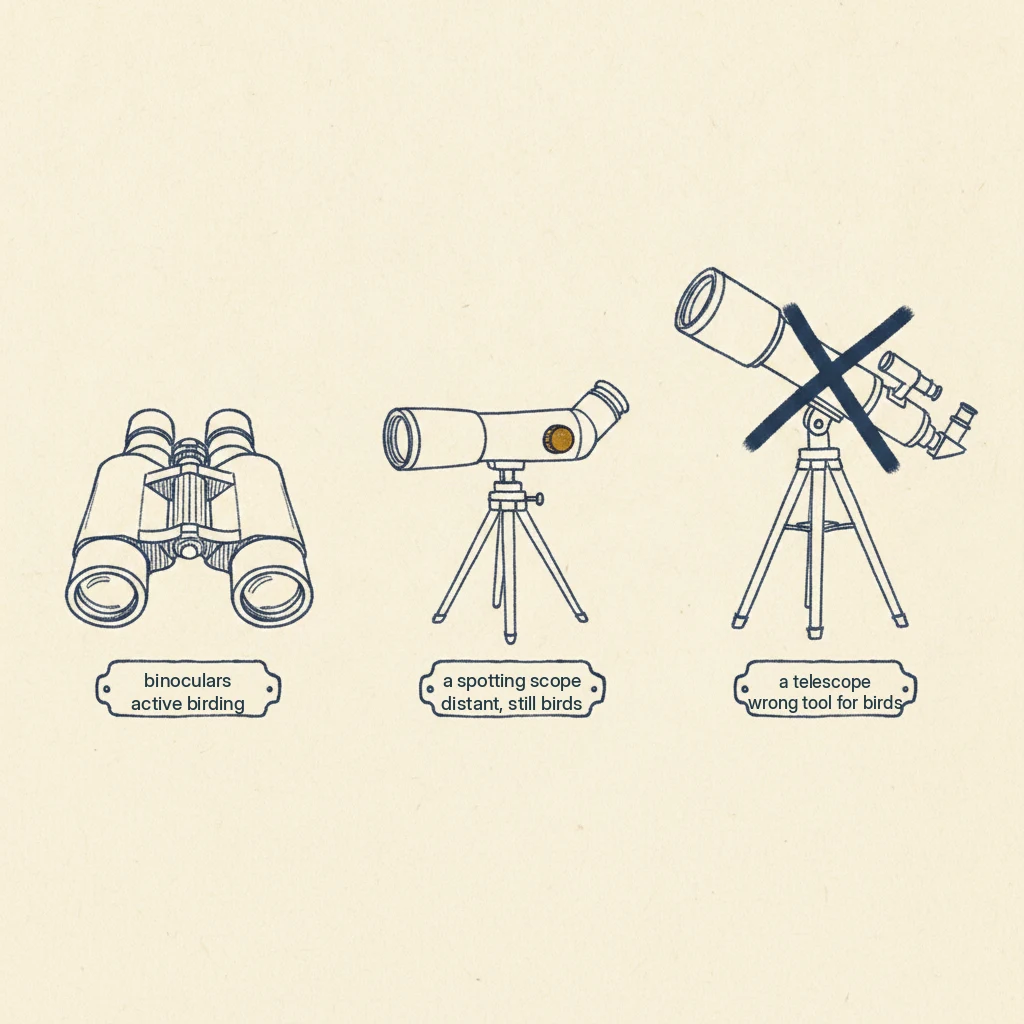
I sell a lot of people out of a scope on this page, and I do it on purpose. For active bird watching, the flitting warblers and the yard birds and the walk in the woods, a good 8x binocular beats a spotting scope every time. It’s lighter, it’s faster to the eye, it has a wide field so you can find the bird at all, and it costs less. You’ll also carry it to the game and on the trip, so it never gathers dust.
The spotting scope earns its place for the other kind of birding: a distant, patient bird that holds still. A hawk on a far snag, ducks across a lake, shorebirds on a mudflat. That’s when 30x on a tripod shows you a bird a binocular only hints at. So the honest order for most people is binoculars first, a spotting scope second, once you know you’re the kind of birder who sits and watches the far edge of the water.
The birding spotting-scope shelf
All researched, none tested by anyone here, and you’ll find that said plainly on the About page. Prices are rounded to what I’m seeing as I write this, cheapest first.
- Celestron LandScout 60mm, about $90, a 12 to 36x entry scope for a first look at whether you’ll use one.
- Celestron LandScout 80mm, 20 to 60x, about $160, more lens and a proper birding zoom for the money.
- Celestron Ultima 80, 20 to 60x, about $230, the step up in glass and brightness.
- Hawke Nature Trek 9 to 27x56, about $290, a compact, lower-power scope that travels well.
- Hawke Endurance ED 15 to 45x60, about $590, where the “ED” glass sharpens up color and edge detail. The 20 to 60x68 runs about $790, and the big 25 to 75x85 about $890.
For a first birding scope, the LandScout 80mm around $160 is plenty to learn on, and if birding sticks, the Endurance ED line is where the view gets genuinely crisp.
Questions people actually ask
Can I use a regular telescope for bird watching?
You can, but you’ll fight it. An astronomical telescope shows birds upside-down and often reversed, at magnifications meant for faint stars rather than daylight. You’ll struggle to find the bird and struggle to follow it. A spotting scope shows a correct, right-way-up image at bird-friendly power. For birds, it’s the right tool by a wide margin.
What magnification do I need for a birding scope?
About 20 to 30x for all-round birding, and 40x as a practical ceiling. Past that the image gets dim and every tiny shake is magnified into a blur, even on a tripod. A zoom eyepiece that runs 20 to 60x gives you room to reach up when the air is steady and back off when it isn’t. Steady beats powerful.
Do I really need a tripod for a spotting scope?
Yes, without exception. At birding magnifications a scope is unusable handheld, because your pulse alone jitters the view. Treat the tripod as part of the scope, not an accessory. If a “bird telescope” deal doesn’t include a decent tripod, budget for one before you decide it’s a bargain.
Should I buy a spotting scope or just good binoculars?
For most birding, buy the binoculars first. A good 8x pair is lighter, faster, wider, and cheaper, and it handles the great majority of what you’ll watch. Add a spotting scope later, only if you find yourself wanting to study distant, still birds across water or open ground. Then it’s worth every penny.
What I’d tell a parent in the hallway
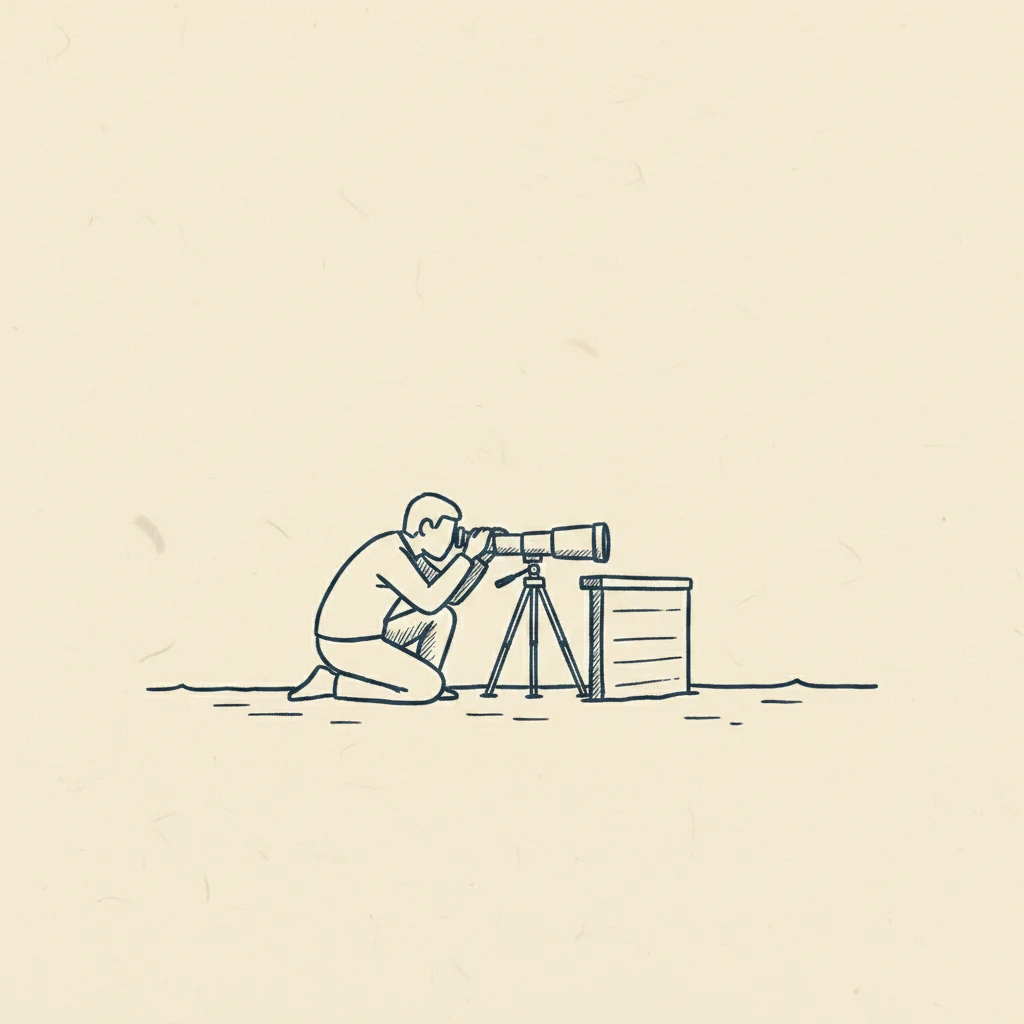
If you mostly walk and watch, buy a good 8x binocular and skip the scope entirely. If you’re the type who sits at the edge of a marsh and studies the far birds, buy a spotting scope with a 60 to 80mm lens, a 20 to 40x zoom, and a real tripod, starting around $160. Just don’t point an astronomy telescope at a bird and expect to enjoy it.
A few things you’re probably also wondering:
- Wondering what an astronomy telescope is actually for? See telescope to see planets.
- Comparing telescopes in general first? See best telescope.
- Ready to start with binoculars, the better first buy? See best binoculars for alaska cruise.
- Want something pocket-sized for one eye? See monocular for bird watching.
Ray Ostrander
Ray spent three decades explaining the sky to twelve-year-olds and their parents, and every January, hearing which Christmas telescopes ended up in the closet. He doesn't own a wall of gear and won't pretend to. He reads everything, tells you what owners agree on, and flags what's just his judgment. His goal is simple: no more January closets.