
The Best Magnifying Glass for Coins Is a Loupe, and 10x Is All You Need
For coins you want a 5x to 10x loupe, not a big desk magnifying glass. The ANA and professional graders both use 5x to 10x, and a good 10x triplet loupe at about $15 covers essentially everything.
 Ray Ostrander · Updated July 24, 2026 · how I decide
If you buy through a link here, the site earns a little. It's never why anything gets picked.
For coins, you want a 5x to 10x loupe, not a big desk magnifying glass. The American Numismatic Association and professional graders both work in that 5x to 10x range, and a good 10x triplet loupe, about $15 to $17, covers essentially everything a collector needs to see. Higher power, the 16x and 30x gadgets the shelf pushes, actually makes a good coin look flawed. This is the whole answer, and it saves you money.
I’ll be straight with you: I’m not a numismatist. I learned this counter for the readers who kept asking, the way I learned everything, by reading what the graders and the associations actually recommend. What follows is that, translated into plain words.
What's on this page
”Magnifying glass” and “loupe” are the same idea
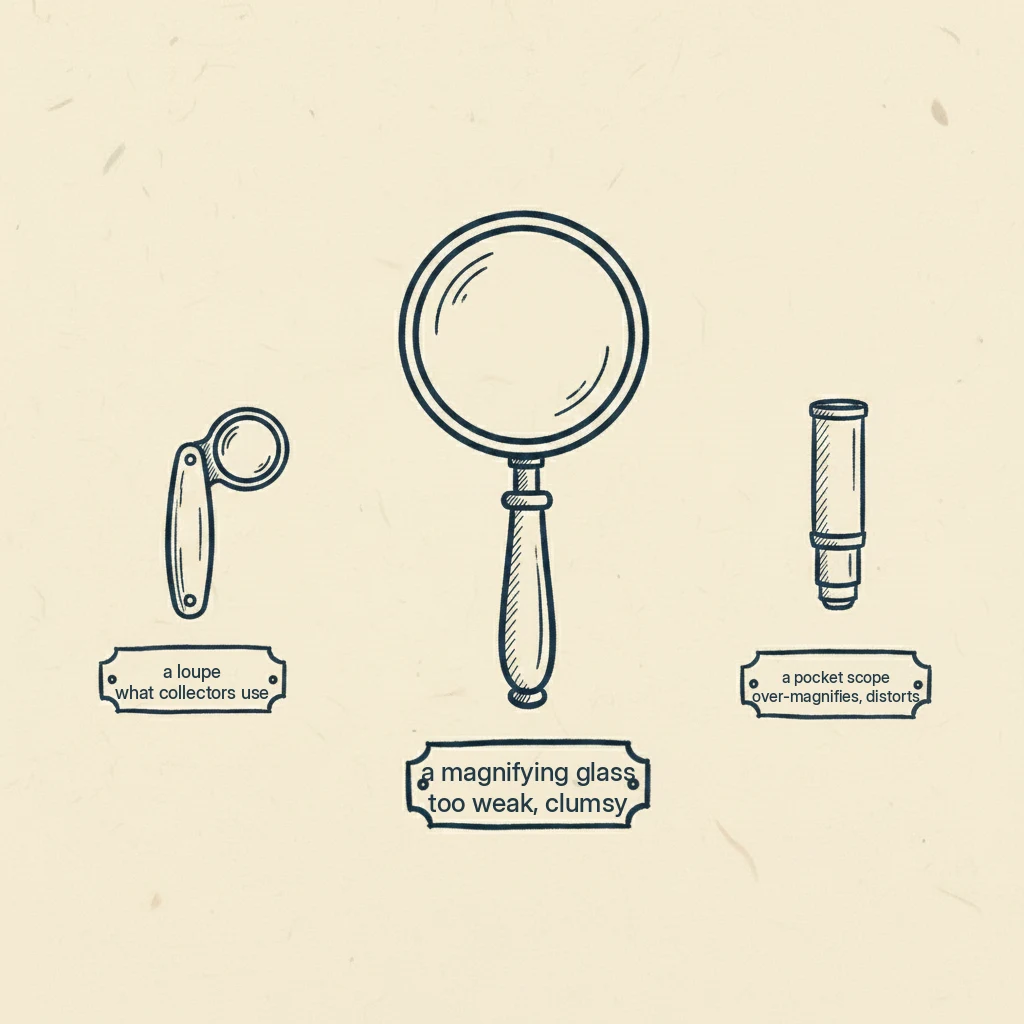
You searched for a magnifying glass, and that’s exactly the right instinct. The collector’s version just has a different name: a loupe. Here’s what’s actually happening. A loupe is a small, folding magnifier, usually 5x to 10x, that you hold right up to your eye. That’s the whole difference from the big handheld magnifying glass you’re picturing. You bring the coin up to the loupe, close to your eye, instead of holding a large lens out at arm’s length.
For a coin, the loupe wins on every count. It’s stronger where it counts, it’s steadier because it’s braced against your face, and it’s small enough to live in a pocket or a coin box. A big desk magnifying glass is weaker and clumsier for this particular job. Same family of tool, better shape for the work.
Why 10x is the ceiling, not the floor
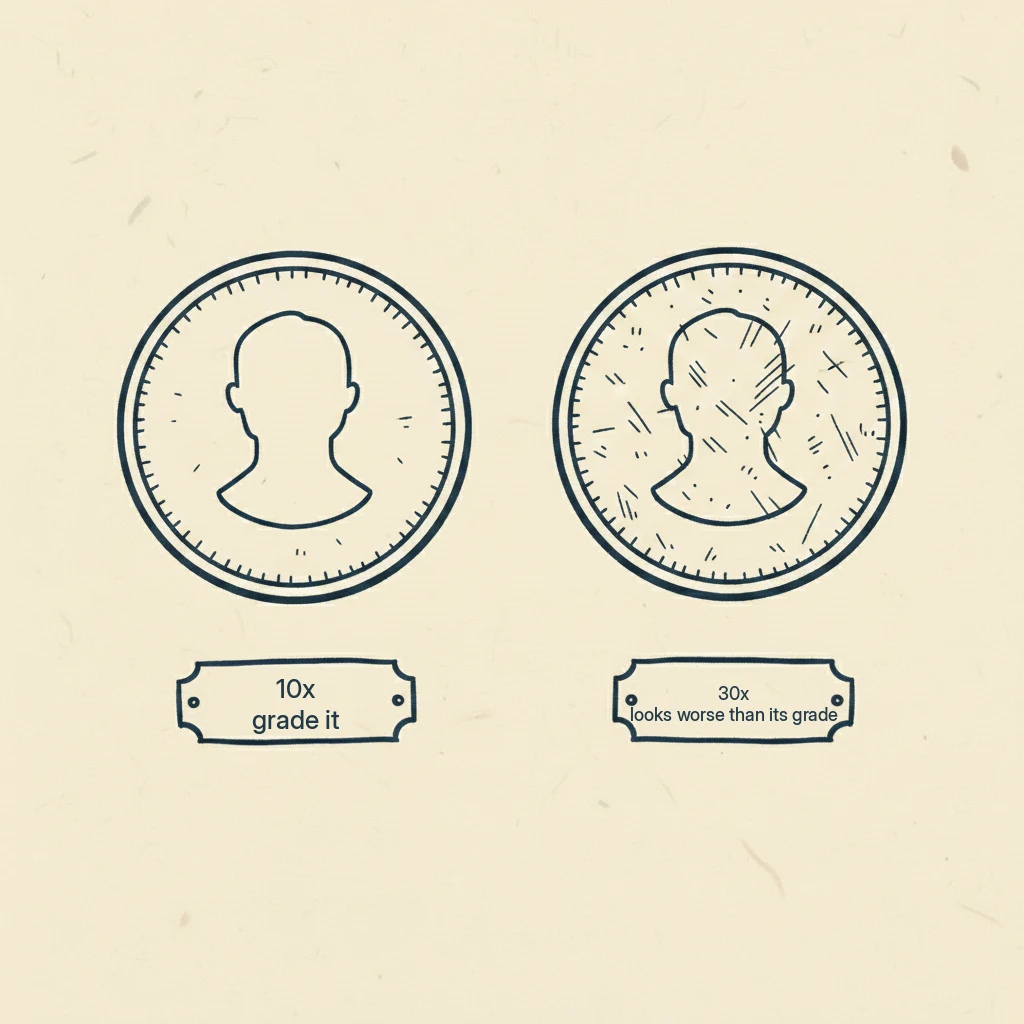
Here’s the part the coin aisle gets backward, and it’s the same mistake the telescope aisle makes with magnification. More power isn’t better. The people who grade coins for a living settle on 5x to 10x, and they do it on purpose. The American Numismatic Association recommends 5x to 10x for inspecting, sorting, and grading. The grading service PCGS says anything above 10x is generally only used for spotting counterfeits or hunting tiny die varieties, not for normal collecting. One veteran put it simply: 6x to grade, 10x for the variety hunting, and anything that needs more than 10x isn’t much of a variety.
There’s a reason to actively avoid the high-power gadgets. A coin is graded on its overall eye appeal, not on microscopic perfection. Crank a good coin up to 30x and every tiny, meaningless mark leaps out, so a perfectly nice coin suddenly looks damaged. You end up talking yourself out of good coins because a gimmick showed you flaws that don’t matter at normal viewing. A 10x loupe shows you the coin the way it’s actually judged.
What makes a good loupe: the triplet lens
One spec is worth knowing, and it’s the difference between a loupe that helps and one that lies to you. Look for a “triplet.” That means three lens elements bonded together, and they exist to kill the distortion you get from cheap single-lens magnifiers, the kind that bend and smear everything toward the edges of the view. On a coin, edge distortion can make a straight rim look wavy or invent a problem that isn’t there. A triplet gives you a clean, flat, honest image corner to corner.
The classic version collectors name is the Hastings triplet. A budget triplet does the job for about $15, and a premium Hastings example runs $50 to $150 if you want glass you’ll keep for decades. Either way, the word to shop for is triplet.
How to actually use it
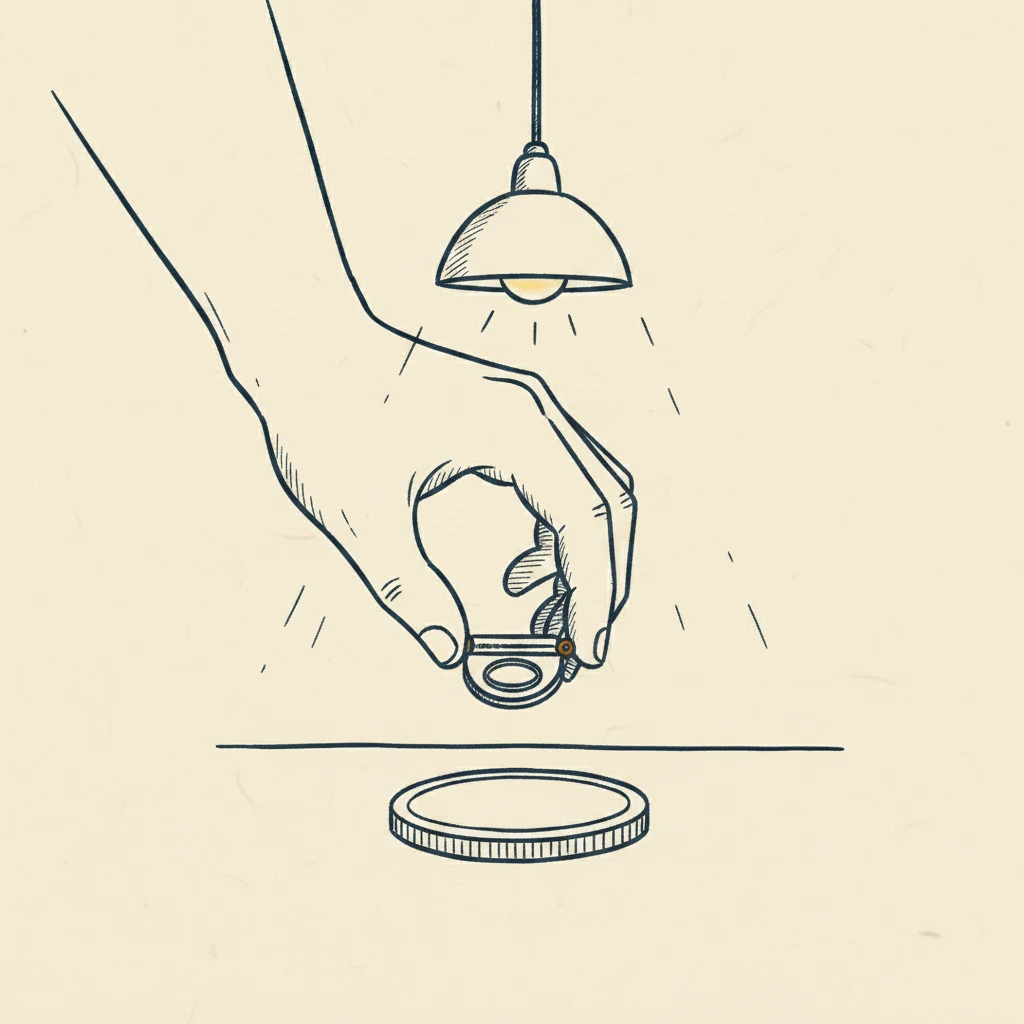
Since the “magnifying glass” buyer often hasn’t used a loupe, here’s the technique the graders use, because the tool only works if you hold it right. Bring the loupe up to your eye first, almost touching your brow, then bring the coin up to the loupe until it snaps into focus, usually an inch or two away. Don’t hold the loupe over the coin on the table like a magnifying glass. Light matters too: work in a darkened room with a single light source, something around 75 to 100 watts, and tilt the coin so the light rakes across the surface. That’s how the details come alive.
The coin loupe shelf
All researched, none tested by anyone here, and you’ll find that said plainly on the About page. Prices are rounded to what I’m seeing as I write this.
- A generic 10x21mm triplet loupe, about $14 to $24, with lit LED versions around $19. Plenty for most collectors.
- GemOro Hastings Triplet 10x, about $17. A well-regarded name-brand triplet at a beginner price.
- A branded Hastings 10x optical-grade triplet, around $52, the entry to the quality tier.
- A premium Hastings triplet, $50 to $150, the buy-it-once option.
And the one to walk past: a 30x/60x pocket magnifier two-pack sells for about $27, and it’s exactly the over-power gadget that makes your coins look worse than they are. Cheap, and the wrong tool. If you also want to photograph coins or inspect them on a screen, that’s a different tool entirely, a coin microscope, and I walk through when it’s worth it on the microscope page.
Questions people actually ask
What magnification do I need to look at coins?
5x to 10x, and a single 10x loupe handles nearly everything. That’s the range the American Numismatic Association and professional graders use for inspecting and grading. A 10x covers reading mint marks, checking wear, and spotting most varieties. You only reach for higher power to hunt counterfeits or the tiniest die varieties, and even then, more power usually just adds confusion.
Is a jeweler’s loupe good for coins?
Yes, a jeweler’s loupe is exactly the right tool, as long as it’s in the 5x to 10x range and uses a triplet lens. “Jeweler’s loupe” and “coin loupe” describe the same small folding magnifier. Avoid the very high-power jeweler’s loupes marked 16x or more, since that much magnification works against you when you’re judging a coin’s overall look.
Why not just use a strong magnifying glass or a 30x scope?
A big magnifying glass is too weak and awkward for the fine detail on a coin, and a 30x scope goes too far the other way. At 30x, every trivial mark shows and a solid coin looks damaged, because coins are graded on eye appeal, not microscopic perfection. The 5x to 10x loupe sits right in the useful middle, which is why the pros live there.
What I’d tell a collector across the counter
Buy a 10x triplet loupe, spend about $15 to $20, and learn to bring the coin to the glass under a single raking light. That one tool does the grading job the way the graders do it. Skip the big magnifying glass and skip the 30x gadget, because neither shows you the coin the way it’s actually judged.
One more thing you might be weighing:
- Wondering whether you actually need a microscope instead? See microscope for coins.
Ray Ostrander
Ray spent three decades explaining the sky to twelve-year-olds and their parents, and every January, hearing which Christmas telescopes ended up in the closet. He doesn't own a wall of gear and won't pretend to. He reads everything, tells you what owners agree on, and flags what's just his judgment. His goal is simple: no more January closets.