
How to Use a Telescope When It Feels Like It's Broken
Can't see anything? Four fixes handle almost every case: dust cap off, lowest-power eyepiece first, finder scope aligned in daylight, and point at the Moon. The scope is probably fine, and so are you.
 Ray Ostrander · Updated July 24, 2026 · how I decide
If you buy through a link here, the site earns a little. It's never why anything gets picked.
Can’t see anything through your telescope? Four fixes handle almost every case, in this order: take the dust cap off, start with your lowest-power eyepiece (the biggest number on it, 25mm or 32mm), line up the little finder scope in daylight on a distant pole or tree, and point at the Moon first. Give the scope twenty to thirty minutes outside to cool down, and expect the view to be dimmer and without color, not like the photo on the box.
That’s the whole rescue, and I’ll walk you through every piece of it. But first, the thing nobody on the shelf says out loud.
What's on this page
Your telescope is probably fine, and so are you
I taught middle-school science for thirty-one years, and every December a few kids would tell me, lit up, that a telescope was coming for Christmas. Then January would arrive, and so would the quiet version: it’s in the closet. It didn’t work. If that’s where you’re right now, standing in a cold yard with a disappointed kid and a tube that shows you nothing, I want to catch you before that closet.
Because here’s what the people who have been doing this for decades actually say. One longtime observer put it plainly: most of the frustration that gets blamed on the telescope is really total inexperience of the buyer, not the failings of the instrument. He taught one struggling owner how to work the mount, and the man ended up happy as a clam. Another cringes when people call these scopes hobby killers, because his own first scope still lives in his house and the neighborhood kids love it on the Moon. And the ones who own expensive rigs will tell you the same trap catches them too: a premium mount becomes a hobby killer when you can’t get it aligned. The failure runs all the way up the price ladder. It isn’t a cheap-scope problem, and it isn’t a you problem. It’s that nobody told you four things.
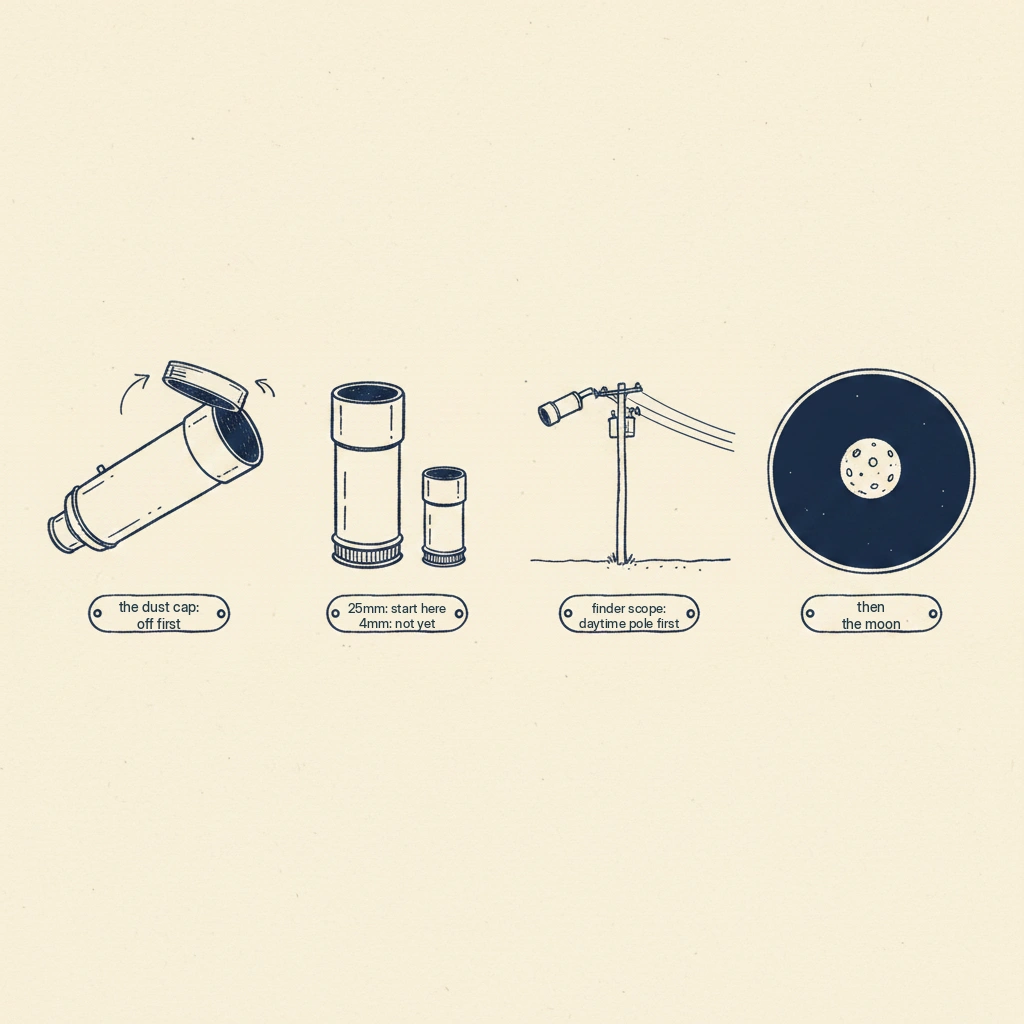
The four things, in order
One: the cap. Take off every dust cover. All of them. Even people who have done this for years forget the one on the front of the tube, and a capped scope shows you exactly nothing. Check it first, every time, before you assume anything is wrong.
Two: the lowest power first. This one is backwards from your instinct, so read it twice. The eyepiece you want to reach for is the small one with the big magnification, and that’s the wrong move. Start with the eyepiece that has the highest number of millimeters on it, the 25mm or the 32mm, because a higher number there means less magnification and a much wider view. Here’s what’s actually happening: a wide, low-power view is how you find anything at all. A 25mm eyepiece is usually a good place to start, and a 32mm is perfect for finding your way around. The powerful eyepiece comes later, once the object is already centered.
And this is the corridor’s oldest trap sitting right in front of you. The number the box screams about, the “600x,” is the number that makes your telescope nearly impossible to aim. Useful magnification is capped by the width of the light-gathering end, not by the dial, so cranking the power on a small tube just hands you a big, dim, wandering blur. If you want the full version of why that number on the box is a lie, it lives on the number on the box. For tonight, just start low.
Three: the finder scope, aligned in daylight. The little scope riding on top is your aiming sight, and out of the box it points nowhere near where the main tube points. You fix that in the afternoon, not in the dark. Find a distant stationary object, a telephone pole or the top of a far tree, and center it in the main eyepiece. Lock the telescope so it can’t move. Now look through the finder and turn its adjustment screws until it’s centered on the exact same spot. That’s the standard alignment procedure, not one person’s trick. It’s the step almost every frustrated first-nighter skipped.
One hard safety line while you’re doing this in daylight, and it matters more than anything else on this page: never point your telescope at the Sun. It can destroy your telescope, and it can destroy your eyes. Align on a pole, a tree, a chimney. Never the Sun.
Four: the Moon first. Not a planet, not a star you read about, the Moon. It’s big, it’s bright, it’s impossible to miss, and it’s the target the sources agree you should start on. Point there, get it roughly in the finder, then look through the low-power eyepiece and work the focus.
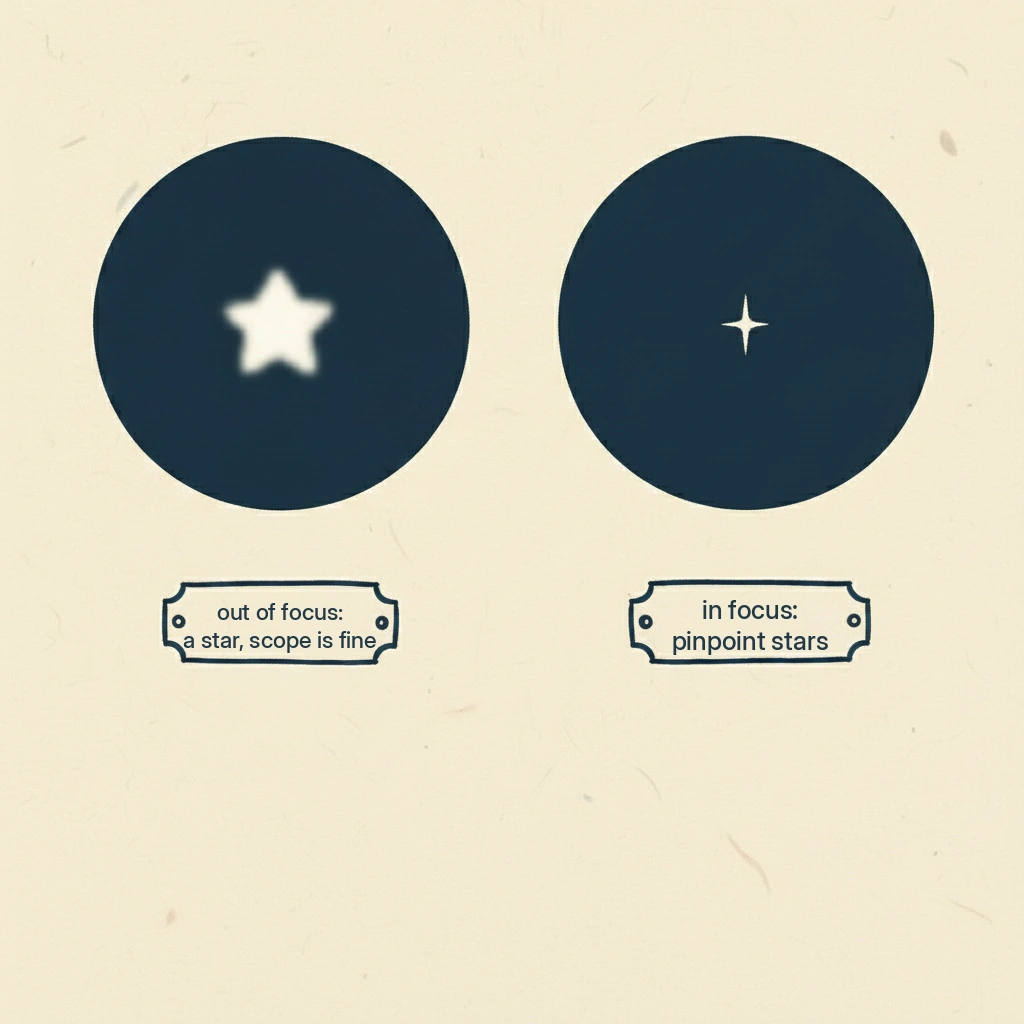
The failure hiding inside the failure: focus
A lot of “it’s broken” is really “it’s not focused yet,” and the two look identical to a beginner. Turn the focus knob slowly, in small movements, until light starts pulling into a sharp point. Don’t grab the tube while you do it, because even a light touch sets the whole thing shaking and you’ll never find the sharp spot.
Here’s the single most useful test in this whole page, and it needs no equipment and no one to ask. A star, through any telescope at any price, is always a pinpoint. Always. So if you’re aimed at what should be a star and you see a fat fuzzy disc, you aren’t looking at a planet and your telescope isn’t broken. You’re simply out of focus. Keep turning the knob until that blob collapses to a point. That one fact will save you from concluding you wasted your money on the very first night.
Give it time to cool down
Your telescope has to stop being warmer than the night air before it shows sharp views, and a warm tube makes everything shimmer. How long people say to wait is honestly all over the map: I’ve seen fifteen minutes, I’ve seen twenty to thirty, I’ve seen one full hour, and one imaging guide says a few hours. The reason for the spread is real, not sloppy. A bigger tube holds more heat and takes longer. So skip the exact number and use the mechanism: set the scope outside when you start getting ready, not when you sit down to look. By the time you’ve found the Moon, it’s close enough.
When it really is the mount
Sometimes the tube is fine and the problem is what it’s sitting on. If the picture jumps every time you breathe on the focus knob, you’ve met the thing that fills more closets than bad optics do. There’s a test: tap the end of the tube and count how long the image shakes. If it’s still shivering after three or four seconds, the mount is your enemy, not the glass.
There’s one honest argument I have to hand you straight, because the experts don’t all agree. Some say an equatorial mount, the kind with two angled axes and a counterweight, is simply a poor mount for a beginner, and that fighting it’s its own hobby killer. Others, just as experienced, say they taught people to use one in an afternoon and those people did fine. I’m not going to settle a fight the people who do this for a living haven’t settled. What I’ll tell you is this: if your mount is the equatorial kind and every session starts with a wrestling match, the mount is hard, not broken, and there’s no shame in that. The full argument about why the tripod matters more than the tube lives on best cheap telescope.
There’s also a word you’ll run into, collimation, which just means the mirrors inside a reflector are lined up. If your views are blurry even when you’re sure you’ve focused, and you own a reflector, that’s the likely culprit. I’ll be honest that this is where I hand you off. Getting mirrors aligned is a real skill and it’s a different neighbor’s garage, not mine. Name it, don’t let it scare you, and go find a good walkthrough for your specific scope.
The sky gets a vote
Two more things that aren’t your fault and aren’t your telescope’s. First, the air itself. On a turbulent night, even a perfect scope shows a boiling, mushy image, and that’s the atmosphere churning, not a defect. Try again on a calm night before you blame the gear. Second, light pollution, but with an honest caveat that should cheer up every city reader: the Moon and the planets shrug off city lights almost entirely. What light pollution steals is the faint stuff, the galaxies and nebulae. So if you’re in a bright suburb and nothing looks good, you may not have a bad scope. You may just be aiming at the wrong objects. Point at the Moon and Saturn, which don’t care about your streetlights.
What actually helps, and it’s cheap
I’m not going to try to sell you a second telescope. You already own one, your problem isn’t a purchase, and steering you toward another tube would be the most cynical thing I could do on this page. What follows are the few small things that genuinely fix the failures above, and nobody here has looked through any of them, which you’ll see said plainly on the About page.
- A decent low-power eyepiece, if the one your scope came with is junk. Hobby-killer scopes often ship with a poor old eyepiece design and a skinny 0.965-inch barrel, which is the tell of a bargain build; you want a Kellner or Plossl in the standard 1.25-inch size. A brand-name 32mm Plossl runs about fifty dollars as I write this. Cheaper generics exist.
- A red flashlight, so you can see your gear without wrecking your night vision. White light resets your eyes instantly and you’ll spend twenty minutes recovering. A dedicated red astronomy light runs about twenty dollars.
- A star app so you know what’s actually up tonight. The one owners keep naming costs about seven dollars for the basic version and points your phone at the sky to name what you’re seeing.
If your scope turns out to be a genuine lost cause, a wrecked mount and those skinny old eyepieces, the honest move isn’t another telescope at all. It’s a good pair of binoculars, which I make the full case for on telescope vs binoculars.
Questions people actually ask
Why can’t I see anything through my telescope?
Almost always one of four things: the dust cap is still on, you’re using the high-power eyepiece instead of the low-power one, the finder scope was never aligned so you’re aiming at nothing, or you haven’t focused yet and a real star just looks like a blob. Work down that list in order. The tube is usually fine.
How do I use a telescope for beginners, step by step?
Cap off, lowest-power eyepiece in, finder scope aligned in daylight on a distant pole, scope set outside to cool while you get ready, then point at the Moon and focus slowly without touching the tube. Get one good look at the Moon before you try anything harder. That single success is what keeps the scope out of the closet.
How do I use the finder scope on top?
Do it in the afternoon, not the dark. Center a far-off stationary object, a pole or a treetop, in the main eyepiece and lock the scope still. Then look through the finder and turn its screws until it’s centered on the same spot. Once it agrees with the main tube, aiming at the Moon at night becomes easy.
I bought a Celestron or a Gskyer from a store. Am I using it wrong?
Probably not wrong so much as un-taught, which is a different thing. The same four checks apply no matter whose name is on the tube: cap, low power first, finder aligned, Moon first. If your box advertised a giant magnification number, ignore that number and start with your biggest, lowest-power eyepiece. The scope will do more than the marketing suggested and less than the poster promised, and both of those are normal.
How do I use a telescope at night without ruining everything?
Set it outside to cool before dark, keep a red flashlight instead of your phone’s white screen, start on the Moon while your eyes adjust, and give yourself fifteen or twenty minutes of no bright light so your night vision comes up. Then work outward to the planets. Don’t start the night hunting for something faint and hard.
What I’d tell a parent in the hallway
If your kid’s telescope “doesn’t work,” don’t box it up yet. Nine times out of ten it’s the cap, the wrong eyepiece, an unaligned finder, or a warm tube, and it’s twenty minutes to a real view of the Moon that will fix the whole night. The scope is almost certainly fine, and so is the kid holding it.
A few things you’re probably also wondering:
- Getting a clear view but it’s smaller than you expected? See what can you see with a telescope.
- Think the scope really might be junk? See best cheap telescope.
- Ready to give up on the telescope and try something simpler? See telescope vs binoculars.
- Want to buy right next time? See how much does a telescope cost.
Ray Ostrander
Ray spent three decades explaining the sky to twelve-year-olds and their parents, and every January, hearing which Christmas telescopes ended up in the closet. He doesn't own a wall of gear and won't pretend to. He reads everything, tells you what owners agree on, and flags what's just his judgment. His goal is simple: no more January closets.