
The Number on the Box: One Lie, Four Aisles
The magnification number printed on the box measures the eyepiece, not the instrument. Every optical tool has a physical ceiling set by its front end, and past it more magnification gives you a bigger, dimmer, shakier picture, not a better one. Across telescopes, binoculars, loupes, and spotting scopes, the number on the box gets bigger as the glass gets worse.
 Ray Ostrander · Updated July 24, 2026 · how I decide
If you buy through a link here, the site earns a little. It's never why anything gets picked.
Here’s the one thing worth carrying into any store that sells anything with a lens. The magnification number printed on the box measures the eyepiece, not the instrument. You can screw a strong eyepiece into a bad tube and print any number you like on the carton. What you can’t do is make that tube gather more light, or hold steadier in your hands, or see through the wavy hot air over a field. So every optical tool has a real ceiling, set by its front end, and past that ceiling more magnification hands you a bigger, dimmer, shakier picture, not a better one. Across telescopes, binoculars, coin loupes, and spotting scopes, the same thing turns out to be true: the number on the box gets bigger as the glass gets worse.
I’ve watched this one lie fool good people in four different aisles. Let me show you all four at once, because once you see the pattern you’re immune to it for life.
What's on this page
First, what the number actually measures
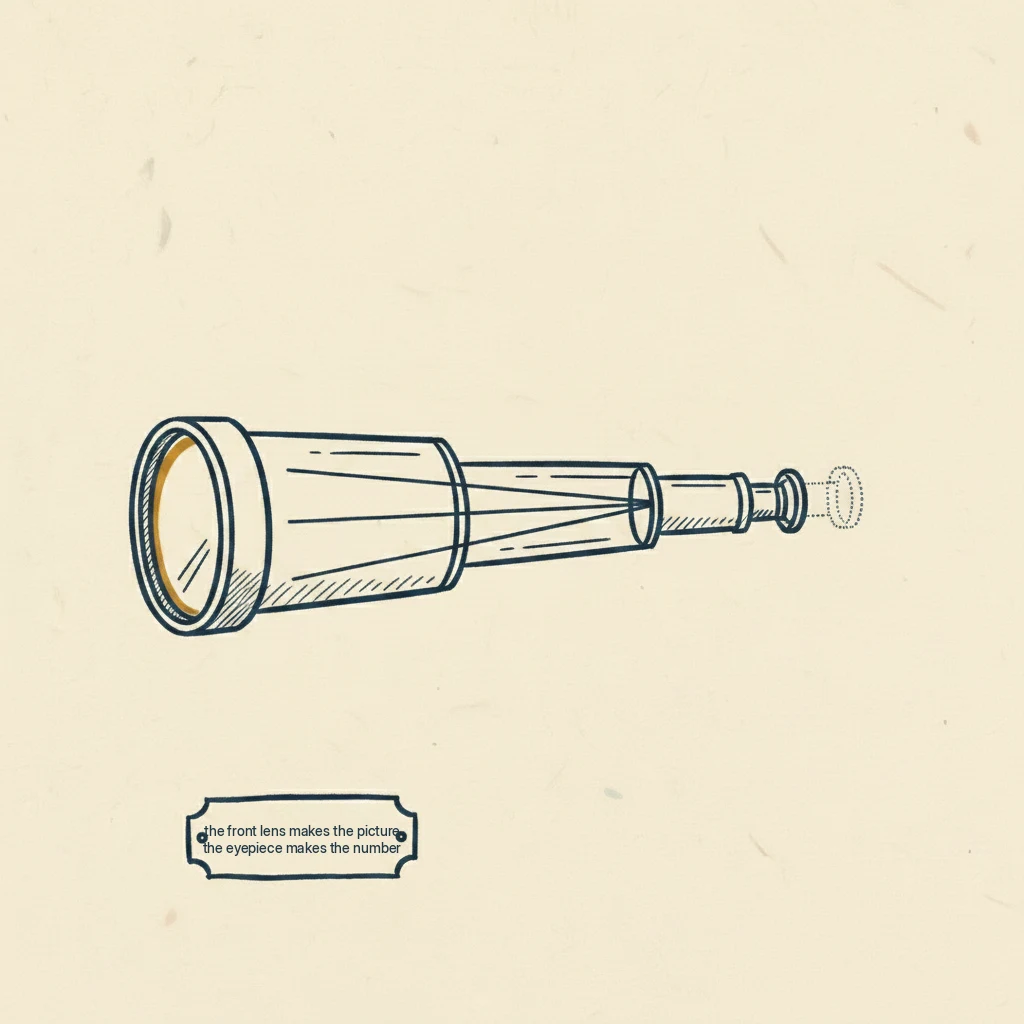
Think of any of these tools as two jobs done by two parts.
The front of the tool, the big lens or mirror, the objective, does the real work. It gathers the light and forms the picture. How much light it can gather, how good its glass is, that’s the whole ballgame, and it’s the part you can’t read off a shelf.
The eyepiece at the back does one job: it enlarges whatever picture the front already made. The magnification number is just the eyepiece’s doing. And here’s the trick that runs this whole racket. A maker can drop in a stronger eyepiece and double the number on the box without improving the picture one bit. In fact the number tends to climb exactly where the maker is skimping on the front, the expensive part, the part that matters. That’s why a bigger number so often means a worse tool. It’s covering for the glass.
Aisle one: the telescope
This is where the lie does the most damage, because it’s usually aimed at a child.
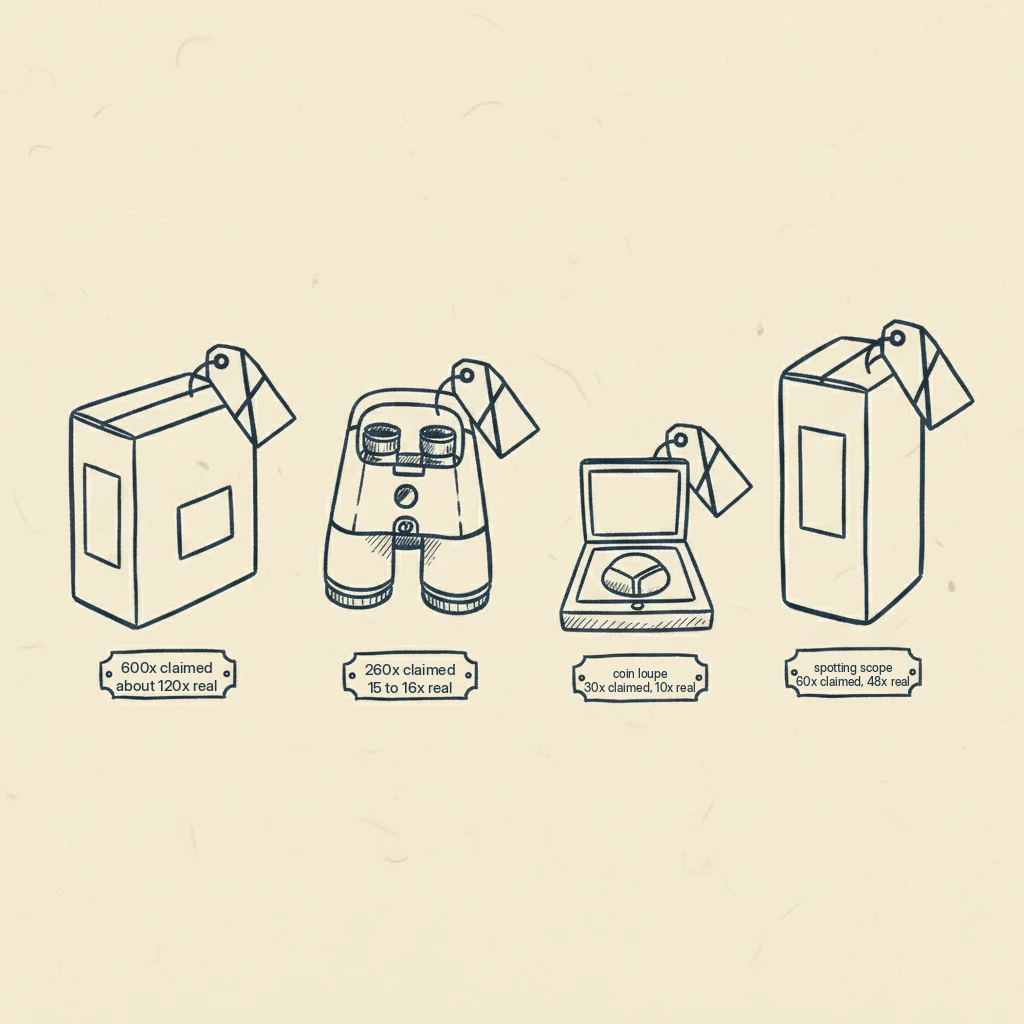
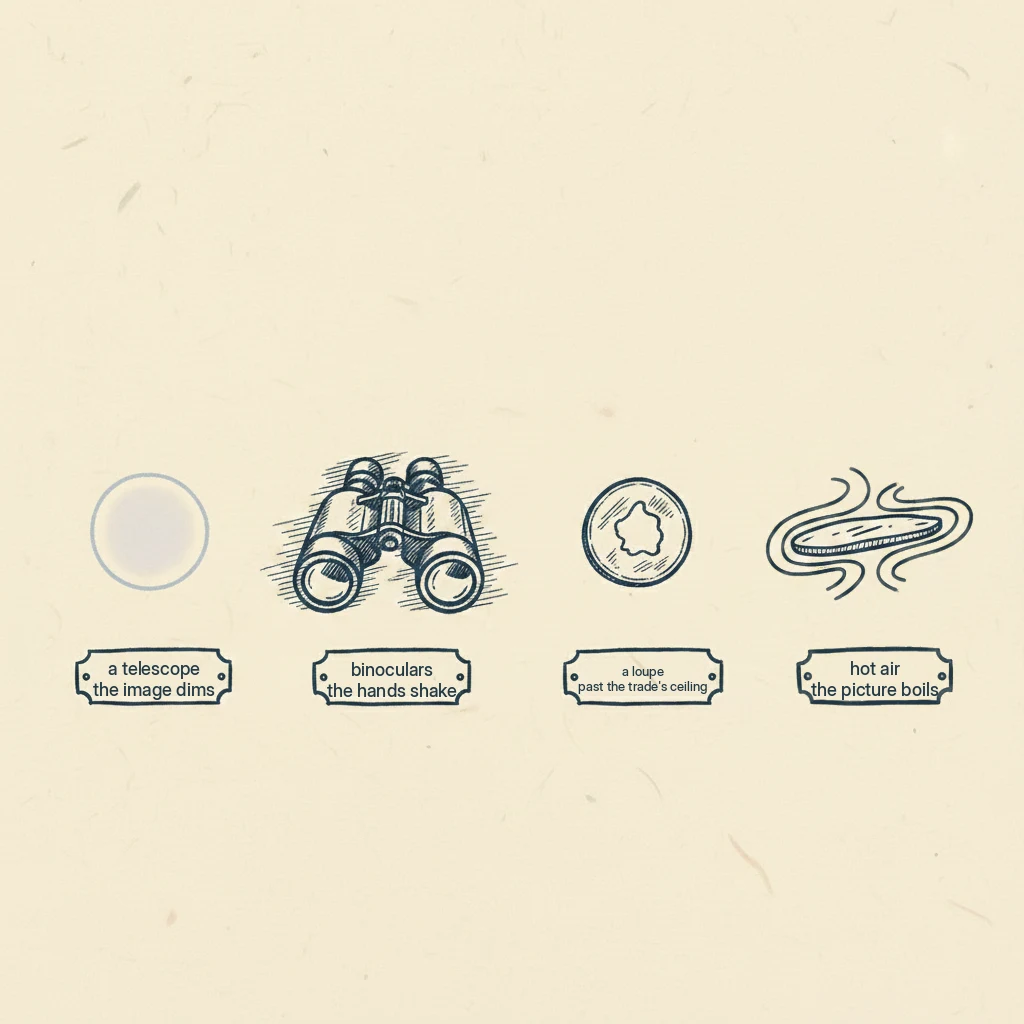
You’ll see a small department-store telescope, maybe a 60-millimeter, with “600x!” splashed across the box, sometimes “675x!!!” with the exclamation points doing the selling. The physics is blunt about it. Those excessive magnifications, often 600x, splashed on the box of the small hobby-killer scopes are, past any honest ceiling, of no real use. A scope that size has a useful ceiling of around 120 to 140 times, and claiming 600x isn’t only useless but actively detrimental. The rule of thumb, from the telescope makers themselves, is that the maximum usable power is about 50 to 60 times the aperture in inches, the width of that front lens. Push past the honest ceiling and the image just gets dimmer and mushier, because you’re spreading the same gathered light over a bigger, emptier picture.
An editor at a serious astronomy magazine put it about as plainly as anyone can. If it’s a three-inch scope and they’re advertising 675x, they’re blowing smoke. Move on.
And here’s the part I never get tired of. The honest 120x isn’t a consolation prize. Point that scope at Saturn and what lands in your eye is a real photon that left the planet more than an hour ago and ended its trip on your retina. Small, sharp, steady, and real beats big, dim, and shaking every single time. The ceiling isn’t a disappointment. It’s just the truth about light.
Aisle two: the binoculars
Same lie, different aisle, and here your own body sets the ceiling.
Search “high power binoculars” and you’ll find listings shouting numbers like “30-260X80.” Sitting right there on the first page. And it’s nonsense in a specific, physical way. The optics makers say it plainly: for handheld use you don’t want to push much past about 12x, and by 15x or 16x you’re already at the outer edge of what steady hands can do. Not because the glass can’t magnify more, but because of you.
Here’s what’s actually happening. Everyone’s hands have a tiny, constant, involuntary tremor. You can’t feel it or stop it. And a pair of binoculars magnifies that tremor right along with the image. At 8x it’s a gentle bob. At 16x it’s a wobble you’re fighting. At 260x it would be a violent, seasick blur, a picture bouncing so hard you couldn’t find the moon in it, let alone hold it. That “260x” isn’t 260 times of anything you can use. The usable number is the one you can hold still, and for a person standing there without a tripod, that tops out around 15 or 16.
Aisle three: the coin loupe
This aisle is quieter, and I want to handle it gently, because some people reaching for a magnifier are doing it because their eyes are failing them, and there’s nothing to smile about in that. But the number lie is here too, so it’s worth knowing.
A collector types “magnifying glass” and gets shown a 16x, a 20x, even a 30x pocket scope, all promising to bring the tiniest detail up close. And the trade that grades coins and diamonds for a living quietly stops far short of those numbers. The people who look at coins first reach for something modest. The American Numismatic Association notes the common numismatic loupe runs 5x, 7x, or 10x, and the modest end is plenty for a first look. When it comes to the finished grading, the grading houses hold a firm line at ten times. GIA states it flatly for diamonds: every diamond is evaluated under 10x magnification, and the grade can only be finalized using a 10x loupe. The coin graders say the same, that the common loupes among graders and serious collectors run 5x to 10x, and, in their words, “Anything higher than 10 will generally only be used for counterfeit detection.”
So think about what the 30x box is really telling you. It’s offering you three times the magnification the professionals themselves refuse to grade with. Past 10x, more power stops helping and starts hurting: a smaller slice of the coin, a darker view, every wobble of your hand thrown up huge, and no more real detail to see. The coin people put it in three words: “Avoid excessive magnification.”
And here’s the sweetest part of the whole lesson. The honest tool is the cheap one. A proper 10x jeweler’s loupe, the triplet the graders actually use, runs under twenty dollars. The 30x pocket scope that out-numbers it on the shelf costs more and does the job worse. That’s the whole site in one purchase.
Aisle four: the spotting scope
Last aisle, and here the air itself draws the line.
The cheap spotting scopes advertise “20-60x,” leaning hard on that top number. The premium makers, the ones with the best glass money can buy, deliberately stop lower: many high-end spotting scopes cap out around 48 power. Read that twice. The best glass caps itself below what the worst glass brags about.
Why would the good makers give up the bigger number? Because they know what’s out there between you and the thing you’re looking at: the atmosphere. Over any distance, especially over sun-warmed ground, the air shimmers and rolls like the wobble above a hot road. Crank the magnification past roughly 48 to 60 times and you’re not magnifying the deer or the bird anymore. You’re magnifying the shimmer. The picture boils. The honest makers cap the number where the air stops cooperating, and they’d rather sell you a sharp 48x than a soupy 60x with their name on it.
Four aisles, one law
Line them up and the pattern is impossible to miss. A telescope that says 600x is really about 120x of honest picture. Binoculars that say 260x are 15x you can actually hold. A 30x coin scope reaches past the 10x the graders themselves stop at. A 60x spotting scope is fighting air the best makers gave up on at 48. Four different tools, four different physical limits, aperture and your own hands and the trade’s own standard and the atmosphere, and one single law running through all of them: the number on the box gets bigger as the glass gets worse.
None of this is the buyer’s fault, and I want to say that plainly. You can’t judge glass or aperture from a shelf. You can’t feel your own hand tremor. But you can read a number, and bigger honestly feels like more. The boxes taught you that, on purpose. The whole point of this page is to un-teach it, once, so no shelf can do it to you again.
Not just four: the microscope bench
The law doesn’t stop at these four aisles. Walk over to the microscope counter and you’ll meet the exact same trick wearing a different name. There they call it “empty magnification,” a 2000x or 5000x number on a scope that physically can’t resolve that much detail, so the extra power just blows up a blur. Same lie, same cure. If that’s the aisle you’re standing in, the truth about 5000x microscopes and what a microscope can actually let you see carry the number-literacy over to that bench.
The one number to learn
So here’s what I’d want you to walk away with, and it’s the closest thing this site has to a mission. Learn to distrust the big number and go looking for the small honest one. Ask what the front of the tool can actually do, how much light it gathers, whether you can hold it steady, what the air and the job will allow. The magnification the box brags about is the eyepiece talking, and the eyepiece will say anything. The instrument tells the truth, and the truth is almost always a smaller, quieter number than the carton wants you to believe. Learn to read that small honest number, and no shelf, in any aisle, for the rest of your life, can fool you again.
Ray Ostrander
Ray spent three decades explaining the sky to twelve-year-olds and their parents, and every January, hearing which Christmas telescopes ended up in the closet. He doesn't own a wall of gear and won't pretend to. He reads everything, tells you what owners agree on, and flags what's just his judgment. His goal is simple: no more January closets.