
Microscope 5000x: The Number Is Real, the Picture Isn't
A 5000x light microscope is selling you empty magnification: the image gets bigger and blurrier and no new detail appears. The detail is set by the lens, not the eyepiece, which is why the people who sell microscopes tell you to walk away from anything claiming 1600x or 2000x. For home use, 40x to 400x does nearly everything, and a real microscope costs about $115.
 Ray Ostrander · Updated July 24, 2026 · how I decide
If you buy through a link here, the site earns a little. It's never why anything gets picked.
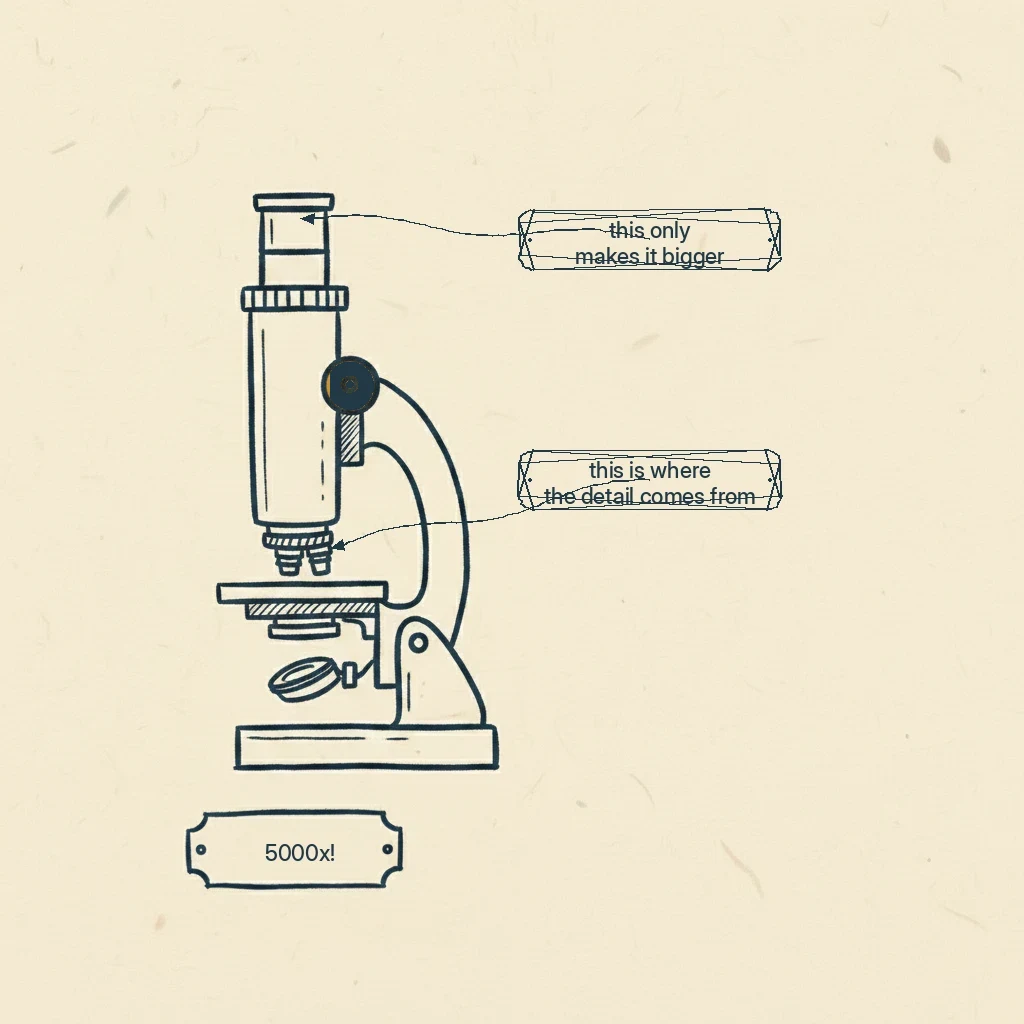
Here’s the honest shape of it. A “5000x” light microscope isn’t exactly lying about the 5000x. The eyepiece really can enlarge the image that much. It’s lying about what that number is worth, because past a certain point magnification stops adding detail and only adds size. The opticians have a name for this, and it’s a good one to carry: empty magnification. The image gets bigger and blurrier and nothing new arrives. The amount of real detail is decided by the lens at the bottom, not the eyepiece at the top, which is why the people who actually sell microscopes tell you to walk away from anything advertising 1600x or 2000x, let alone 5000x. For everything an ordinary person wants to look at, 40x to 400x does the job, and a genuinely good microscope costs about $115.
If you’ve already got a scope that says 1200x on the box and shows you a fuzzy blob, this page is going to explain why, and I want to be clear from the start: that isn’t your fault, and your microscope probably isn’t broken. It’s doing exactly what the physics says it has to.
What's on this page
- Here's what's actually happening: the eyepiece can enlarge, but it can't add
- Where the detail actually comes from
- What the professionals actually say to walk away from
- The two things to look at instead
- It's the same lie, on every instrument
- Questions people actually ask
- What I'd tell you if you already bought one
Here’s what’s actually happening: the eyepiece can enlarge, but it can’t add
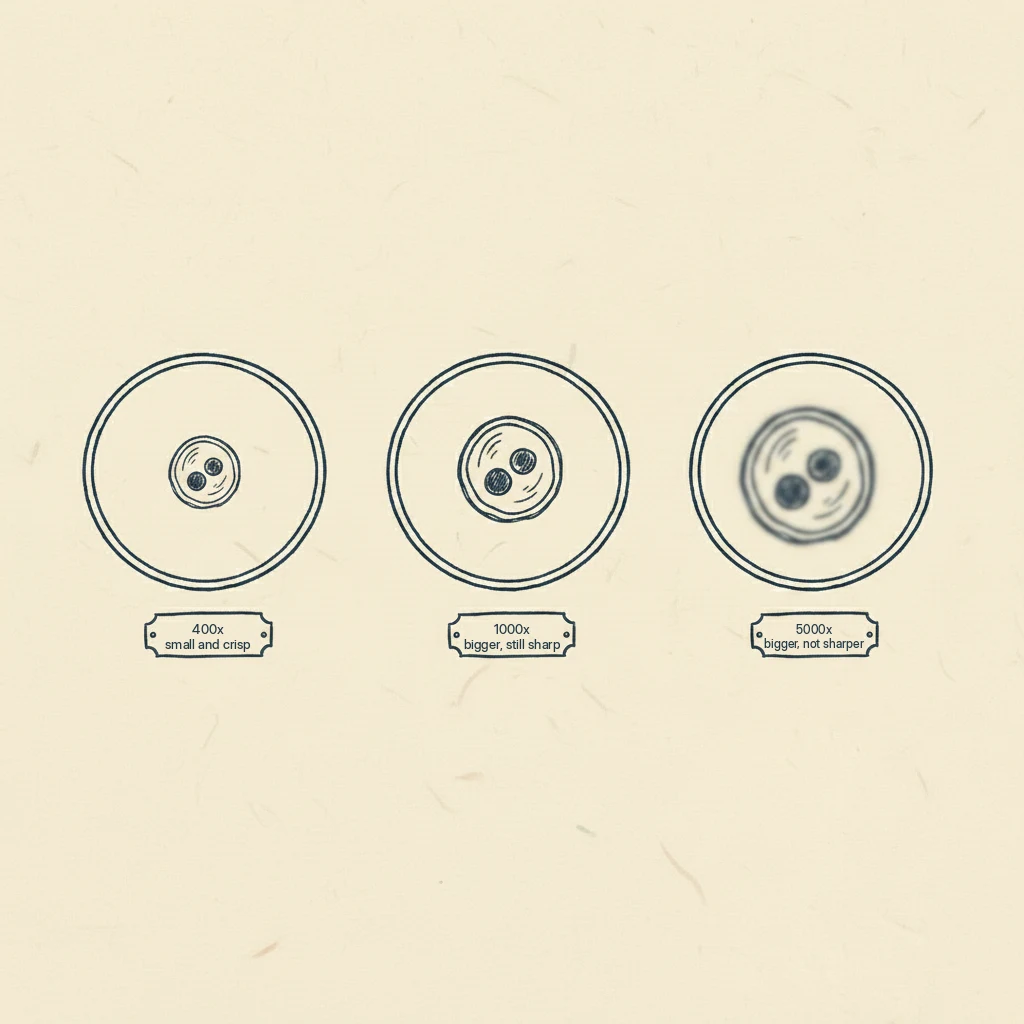
Let me give you the whole idea in one breath. Nikon’s own optics teaching resource says it plainly: turning up the magnification through the eyepiece only makes the image larger, with no matching increase in the detail you can actually resolve. Read that again, because it’s the whole game. The eyepiece can blow the picture up as big as you like. It can’t put more information into it than the lens already captured.
Optical Mechanics puts the same truth in the plainest words I’ve found: increase magnification without increasing resolution and you get, in their phrase, “bigger but blurrier images.” That’s empty magnification. The picture got bigger. Nothing new showed up.
So the honest question is never “how many times does it magnify.” It’s “how much detail is really there to magnify in the first place,” and that’s set by the lens, not the number.
Where the detail actually comes from
There’s an insider term worth learning here, and then you never have to think about it again: numerical aperture. That’s just a measure of how much light the objective lens, the one down near the slide, can gather. And the more light it gathers, the more fine detail it can actually resolve. Numerical aperture is the thing that decides how much real information exists in the image. The magnification number is the eyepiece’s doing. The detail is the lens’s doing. They’re two different things, and only one of them is real.
Nikon’s teaching resource gives the rule this way: the useful total magnification of a microscope tops out at roughly 500 to 1000 times the objective’s numerical aperture. Push past that and, in their words, you get “no further useful information or finer resolution of image detail,” and instead the picture picks up “artifacts, diffraction boundaries, and halos into the image that obscure specimen features.” In plain terms, past the lens’s honest limit, cranking the magnification doesn’t reveal more. It adds glare and mush that actively hide what you were trying to see.
I’ll tell you plainly what I can’t tell you, because it matters. I don’t have a citable figure in front of me for the exact magnification ceiling of a good light microscope, so I’m not going to make one up or do the algebra from a number I half-remember. What I can tell you is sourced and solid: the ceiling is set by the lens, not the eyepiece, and 5000x is far past where any home lens stops adding detail.
What the professionals actually say to walk away from
You don’t have to take my word for the limit, because the people who sell and use these instruments have already drawn the line, well below 5000x.
The hobby guides say flatly to avoid the cheap microscopes claiming 1600x or 2000x, because they reach those numbers with poor lenses and hand you little clarity. So the trade draws its red flag at around 1600x. A “5000x” scope is more than three times past the point the sellers themselves tell you to stop.
And here’s the proof that should settle it. A working microbiologist, someone with a doctorate who does this daily, bought an inexpensive microscope labeled 40x to 1000x and, in her own words, was “unable to get a clear image” out of it. The box delivered its 1000x. The instrument still didn’t work, because the number was never the thing that made it work. If 1000x defeated a microbiologist, you can stop wondering what 5000x is going to do for you at the kitchen table.
I want to be fair about one thing, because it’s easy to get wrong. Good microscopes carry big numbers too. That same microbiologist recommends a fine scope that goes all the way up to 2500x, and she says in the same breath that 2500x is “not essential.” The big number isn’t proof a scope is junk any more than it’s proof it’s good. It’s just the number the whole industry prints on the box, on the honest ones and the cheap ones alike. So I’m not here to name any brand and call it a fraud. I’m here to tell you the number is decoration, and to show you what to look at instead.
The two things to look at instead
Since the magnification number is empty, here’s what actually decides whether a microscope works, and there are only two things.
The first is a mechanical stage: the slide moves by geared knobs instead of your fingers, which matters enormously once you’re at high power. The second is a real condenser under the slide, which focuses the light before it reaches your specimen and is what makes the picture crisp. Those two parts, not the number, are the difference between an instrument and a toy, and I walk through exactly how to spot them on the buyer’s page.
For the number that does matter, the honest range: 40x to 400x shows you cells, pond-water life, and plant structure, which is nearly everything. The only common reason to reach 1000x is bacteria, and that additionally needs immersion oil. Everything above that’s the empty kind.
And here’s the punchline for anyone who came in typing “5000x.” You can own a microscope a professional would respect, with a proper stage, real glass, and a metal frame, for about $115. A stereo scope for looking at coins and rocks and bugs runs about $50. The 5000x number isn’t printed on either of them, and that’s precisely the point.
It’s the same lie, on every instrument
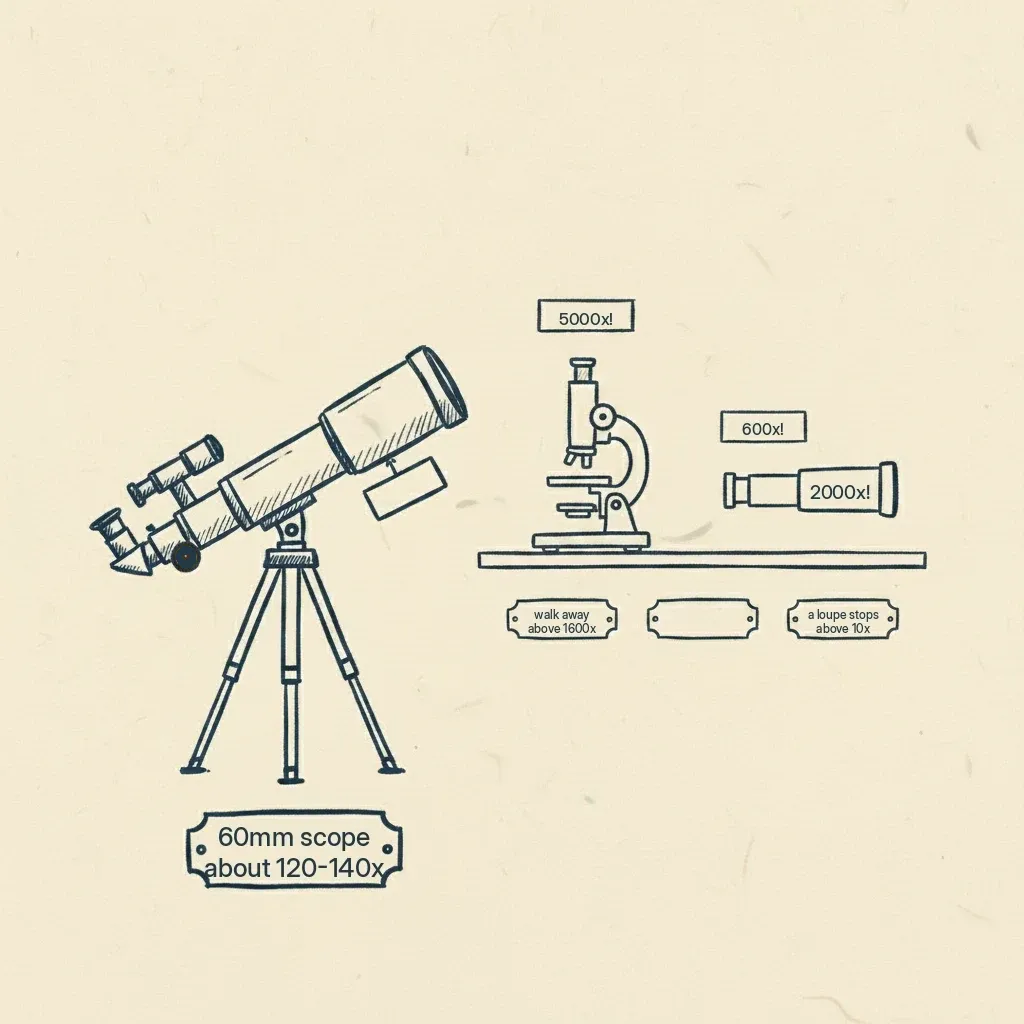
One last thing worth seeing, because it makes you fireproof. This exact trick isn’t special to microscopes. Point a telescope at the same problem and you find department-store scopes screaming “600x” when a 60mm scope is genuinely useful to about 120 to 140 times. An astronomy editor’s line about those is perfect: a small scope advertising a huge number is just “blowing smoke.” The number comes from screwing in a strong eyepiece, sometimes stacked with a small lens called a Barlow, and printing whatever product that yields. Same move on a coin loupe: the jewelry trade grades at 10x and says stronger loupes are just hard to use. Three different instruments, three different trades, and one single law running through all of them: the number on the box is bounded by the glass, and past that bound it’s decoration. There’s a whole page on that one law if you want the full tour.
Questions people actually ask
Is a 5000x microscope any good?
Not for what the number promises. A 5000x light microscope is empty magnification: it makes the image bigger without adding any detail, so past a point you just get a large, blurry, glare-filled picture. The useful limit is set by the lens, not the eyepiece, and it sits far below 5000x. The people who sell microscopes tell you to walk away from anything even claiming 1600x or 2000x.
What’s empty magnification?
It’s when a microscope enlarges the image beyond the point where its lens can resolve any more detail. You increase the magnification but not the resolution, so you get, as the opticians put it, bigger but blurrier images. No new information appears, only more size, plus glare and halos that hide what you were looking at. The 5000x on the box is empty magnification.
What magnification do I actually need at home?
For nearly everything, 40x to 400x. At 400x you can see cells, pond-water organisms, and plant structure. The only common reason to reach 1000x is looking at bacteria, and that also requires immersion oil. The enormous numbers, 1600x and above, signal a cheap scope rather than a capable one.
My kid’s microscope says 1200x but the picture is blurry. Is it broken?
Almost certainly not. It’s doing what physics requires: past its lens’s honest limit, more magnification just enlarges a blur. The 1200x is real, but the detail to fill it isn’t there, so you get a big fuzzy image. That’s not a defect and it’s not something you did wrong. It’s the number on the box overselling what the glass can do.
What I’d tell you if you already bought one
So here’s where I’d leave it, and this is really for the parent who bought the 1200x scope for a curious kid and felt let down when the pictures came out soft. You didn’t get cheated on quality so much as sold a number that was never going to pay off, and just about everyone gets caught by it once, because the box is designed to catch you. Now you know the tell. The magnification figure is the eyepiece talking, and the eyepiece will say anything. What you actually want, next time, is a mechanical stage and a real condenser, and a scope that stops bragging around 400x and simply works. That scope costs about $115, a microbiologist would recognize it, and your kid will finally see the cells that were the whole point.
For the two parts to check and the models that have them, a microscope for adults is the buyer’s guide, and to see what each magnification honestly reveals, what a microscope lets you see walks the ladder. If you’re shopping for a child specifically, a microscope for kids is the gift-side page. And because this is the same trick that shows up on telescopes and binoculars too, the number on the box is the one page that ties all of it together.
Ray Ostrander
Ray spent three decades explaining the sky to twelve-year-olds and their parents, and every January, hearing which Christmas telescopes ended up in the closet. He doesn't own a wall of gear and won't pretend to. He reads everything, tells you what owners agree on, and flags what's just his judgment. His goal is simple: no more January closets.