
Microscope for Adults: The Two Parts That Separate a Real One from a Toy
What makes a microscope real isn't the magnification number on the box. It's two parts: a mechanical stage that moves the slide with geared knobs, and an Abbe condenser that focuses the light. A microbiologist with a PhD bought a 1000x scope and still couldn't get a clear image, because it had neither. For an adult, 40x to 400x covers nearly everything, and a capable scope starts around $80 to $150.
 Ray Ostrander · Updated July 24, 2026 · how I decide
If you buy through a link here, the site earns a little. It's never why anything gets picked.
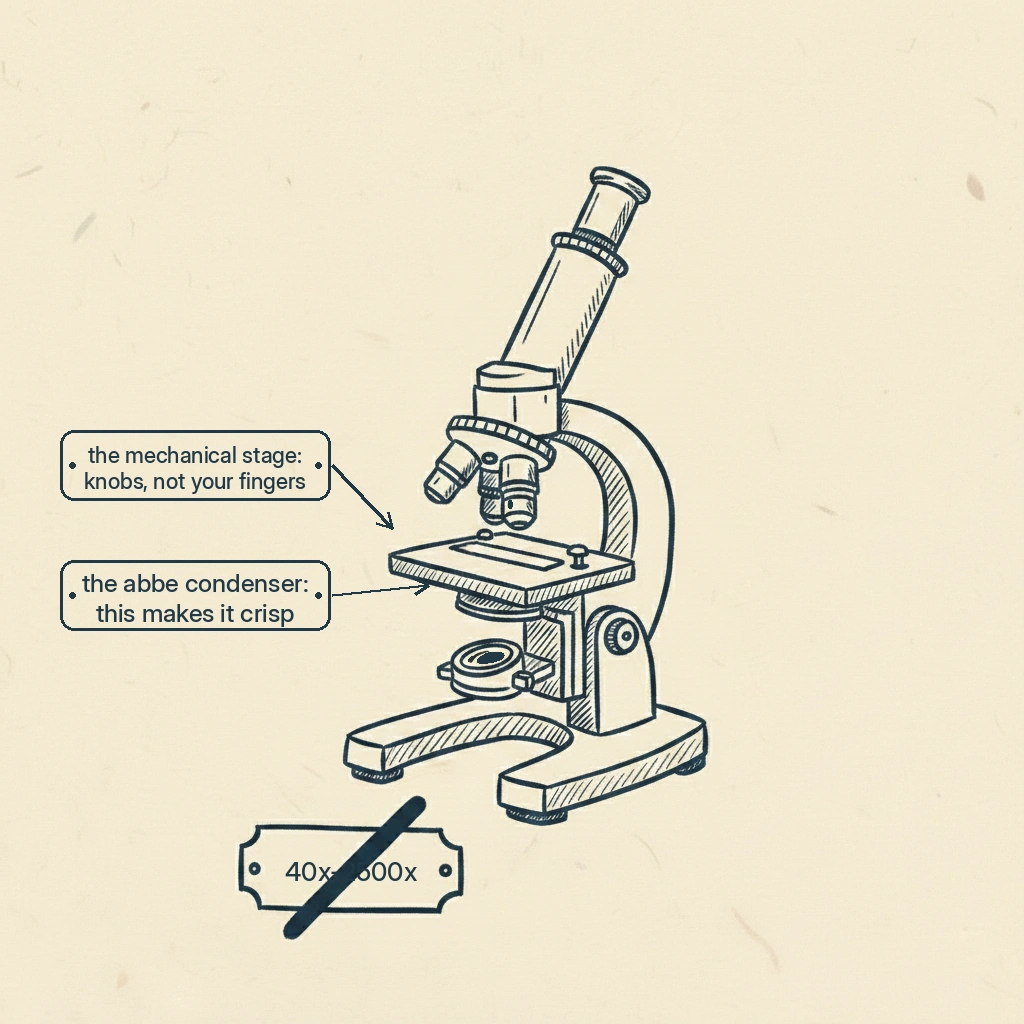
Let me answer the real question, which isn’t about power. What makes a microscope a real instrument instead of a toy isn’t the magnification number on the box. It’s two parts most listings never mention: a mechanical stage, which moves the slide with geared knobs instead of your fingers, and an Abbe condenser, the lens under the slide that focuses the lamp’s light before it reaches your specimen. Here’s the proof that the number is a distraction: a microbiologist with a doctorate bought a scope labeled 40x to 1000x and still couldn’t get a clear image out of it, because it had neither of those two parts. For most of what an adult actually wants to look at, 40x to 400x is plenty, and a genuinely capable scope starts around $80 to $150.
I’ll say up front that I taught earth science for thirty-one years and ran the science fair every one of them, so I’ve squinted through a great many microscopes, including some genuinely bad ones. I’m not a lab microbiologist, and where the serious biology comes in, I’m going to lean on one, by name, and tell you where. But on the question of what makes one of these things work versus disappoint, I’ve watched it play out on a lot of benches.
What's on this page
Why you typed “for adults”
Let’s be honest about why that word is in your search. Nobody adds “for adults” because they’re confused about magnification. They add it because every result they’ve seen so far had a cartoon on the box, and they’re tired of being sold a child’s toy when they want a real instrument. One of the shelves competing for your click literally titles itself “Skip the Toy Scopes,” which tells you the whole industry knows the anxiety and still answers it with a ranked list of products instead of the two facts that actually settle it.
So here are the two facts. They turn your worry into a skill you can carry into any store.
Here’s what’s actually happening: the stage and the condenser, not the number
A working microbiologist, Justine Dees, who holds a PhD and writes about this for a living, lays out the two things that matter, and neither is the magnification.
The first is a mechanical stage. That’s the platform the slide sits on, and on a real scope it moves by two geared knobs, a hair at a time. This sounds minor until you try the alternative. At high magnification, the patch of slide you’re looking at is tiny, and nudging it into place with your fingertips is genuinely hopeless. Dees returned an inexpensive microscope partly because she was stuck moving the slide by hand and, in her words, was “unable to get a clear image.” The stage is what lets you actually find and hold what you’re looking at.
The second is an Abbe condenser. That’s a small lens system mounted under the stage, beneath the slide. Its job is to gather the lamp’s light and focus it into a tight, even cone before it passes up through your specimen. The maker of one well-regarded scope describes exactly this: a bulb under the stage sends light up through the condenser, and you slide the condenser nearer or farther to tune the brightness and contrast. Dees calls it “really important for actually getting a crisp image of most microbes,” especially above 400x. Without it, the light hitting your slide is soft and uneven, and no amount of magnification sharpens a poorly lit picture.
That’s the whole secret. A stage that moves with knobs, and a condenser under the slide. Two things, no numbers.
The number, and the honest ladder
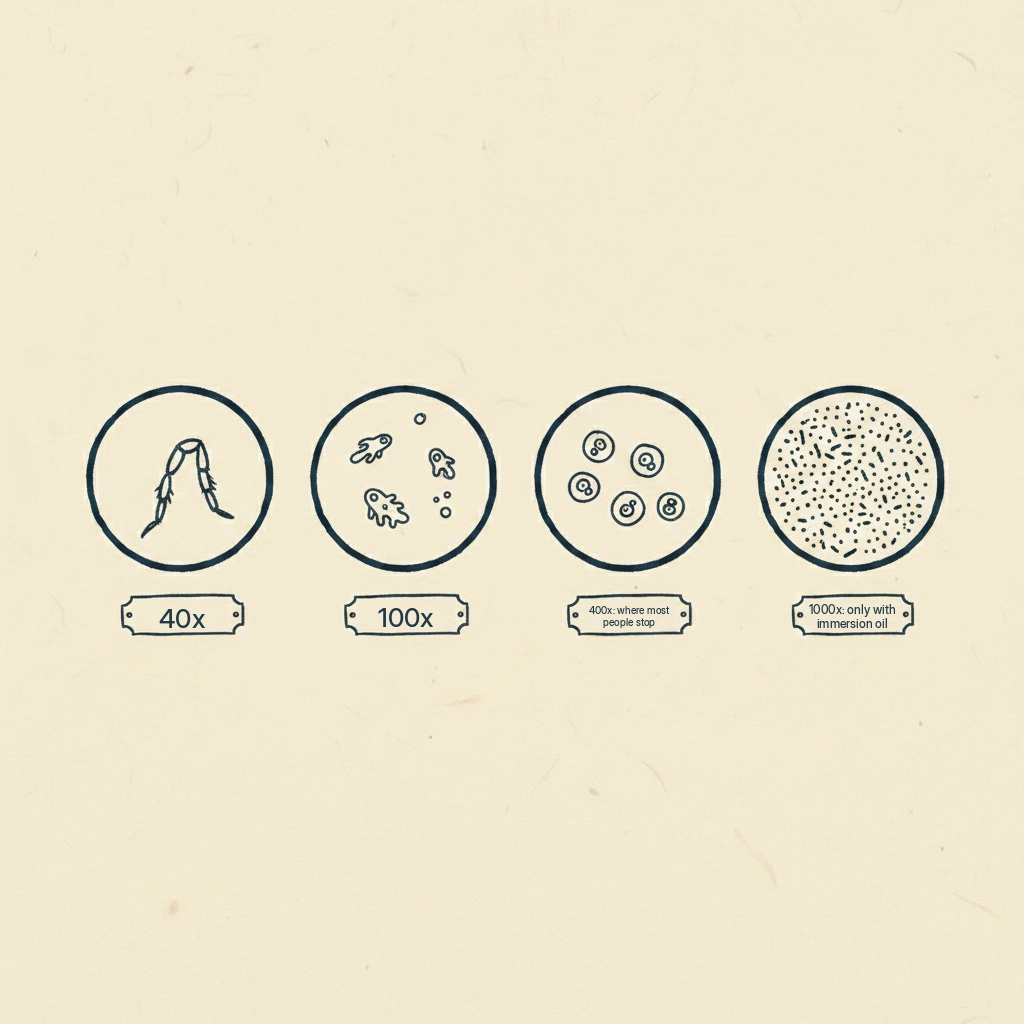
Now the magnification, since it’s what the box shouts about. Three independent sources, including the microbiologist and a couple of hobby guides, all land in the same place: 40x to 400x covers nearly everything an adult hobbyist actually looks at. At 400x you can see cells, the little organisms swimming in a drop of pond water, and the structure of a leaf. That’s most of the wonder, right there.
There’s exactly one honest reason to want 1000x, and it’s a specific one: bacteria. And it comes with a condition the boxes never print. Seeing bacteria at 1000x requires immersion oil, a drop of special oil placed between the lens and the slide, because without it the light scatters and you get nothing. So put those two facts together and you get the cleanest version of the whole lesson. A scope sold on its big 1000x headline, with no immersion oil and no Abbe condenser, physically can’t do the one job that number is for. The number was never the thing to buy on.
You’ll also see boxes climbing to 1600x, 2000x, even 2500x. The plain hobby guidance is to avoid the cheap ones waving 1600x or 2000x around, because they get there with poor lenses and give you a blurry, empty picture. But here’s a nuance I want to be careful about, because it matters. Good scopes carry big numbers too. The very microscope our microbiologist recommends goes up to 2500x, and she says in the same breath that 2500x is “not essential.” That’s the point. The big number isn’t proof of a scam and it isn’t proof of quality. It’s just the industry’s grammar, printed on good scopes and bad ones alike, and it’s simply not how you choose. The stage and the condenser are how you choose.
Compound or stereo: the fork nobody draws
Before you buy anything, one more fork, and it’s the one almost no listicle bothers with, even though it decides whether you’ll enjoy the thing.
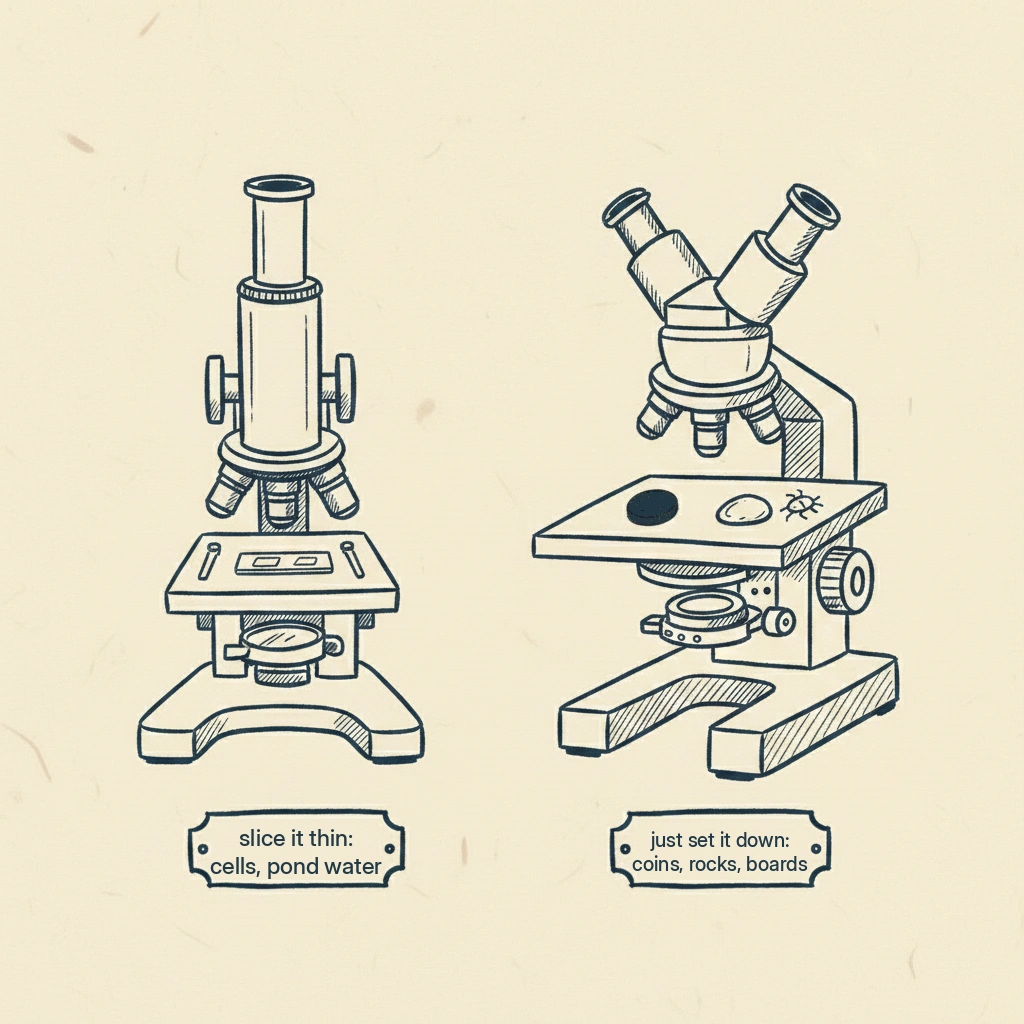
The microscope every “best of” list sells you is a compound microscope. It looks down through thin, translucent things on glass slides: cells, pond water, a sliver of onion skin. High power, flat subjects, prepared slides. If that’s the biology you’re after, it’s the right tool, and it’s where you’d want the stage and condenser we just covered.
But a lot of adults don’t actually want slides. They want to look at the solid things they already own: coins, rocks, insects, a circuit board, the weave of a fabric, a flower. For those, you want a stereo microscope instead, which gives a lower-power, three-dimensional view with room to work underneath. Our microbiologist says the same: a stereo scope is plenty for larger objects, and you only need the compound one if bacteria are the goal. Getting this fork right is the difference between a scope you use constantly and a $300 compound instrument you look through twice and shelve.
What to actually buy
For a compound scope, a solid entry point is an all-metal AmScope M150C, 40x to 1000x, around $115, which has been a reliable adult step-up for years. You may also see a closely related M150C-I listed lower, around $80, and I’ll be honest that I can’t tell you from here whether that’s a different variant or the same scope at another store, so check the exact model before you buy on the price alone. Celestron’s Labs compound line runs from about $150 for the CM800 up through the $185 CM1000C and into the $300 range for the fuller models. And the scope the microbiologist herself recommends, the Swift SW380B, runs about $240 from the official dealer, which is a real instrument at a real price.
For a stereo scope, the solid things kind, Celestron’s Labs stereo line starts around $50 for the S20, about $100 for the S1030N, and up to around $230 for the zoom model. That $50 stereo scope is, for a lot of adults, the smartest microscope purchase on this page. If your real interest is coins and rocks and bugs, it will get used far more than a compound scope three times its price.
There’s also a whole class of digital microscopes that show the image on a screen instead of through an eyepiece. The honest reason to want one is the screen itself, for sharing or photographing what you find, not the magnification. If that’s you, they run from about $35 up into the hundreds.
A word about the toy scopes
If you already bought a toy scope, for a kid or for yourself in a burst of enthusiasm, and it let you down, I want to be clear that wasn’t a foolish purchase. The boxes are designed to look capable, and the two things that actually matter are invisible in a photo. That’s exactly why I’d rather hand you the two checks than sell you a ranked list. Walk any shelf, ignore every number, and ask two questions: does the slide move with knobs, and is there a real condenser under the stage. If yes to both, you’re looking at a real instrument. If not, no magnification figure will save it.
Questions people actually ask
What magnification do I need for a home microscope?
For nearly everything you’ll want to see, 40x to 400x. At 400x you can view cells, pond-water organisms, and plant structure, which is most of the interest. The only common reason to go to 1000x is looking at bacteria, and that additionally requires immersion oil. The huge numbers above that, 1600x and up, mostly signal a cheap scope, not a capable one.
How do I tell a real microscope from a toy?
Two features, neither of them the magnification number: a mechanical stage that moves the slide with geared knobs, and an Abbe condenser under the stage that focuses the light. A microbiologist returned a “1000x” scope that lacked both because she couldn’t get a clear image. Check for those two parts and you’ll know instantly whether you’re looking at an instrument or a toy.
Should I get a compound or stereo microscope?
Compound if you want to look at thin, translucent things on slides, cells, pond water, prepared specimens, at high magnification. Stereo if you want to look at solid objects you already own, coins, rocks, insects, circuit boards, at lower magnification and in three dimensions. Most adults who think they want a compound scope actually want a stereo one, so decide by what you’ll put under it.
How much does a good adult microscope cost?
A genuinely capable one starts around $80 to $150. A solid all-metal compound scope runs about $115, and a stereo scope for looking at solid objects starts around $50. You don’t need to spend into the hundreds to get past the toy tier; you need the stage and the condenser, and those show up well below $150.
What I’d set on my own table
So here’s where I’d land, plainly. Don’t buy on the magnification number, buy on the two parts: a geared mechanical stage and a real condenser under the slide. Then decide honestly what you want to look at. If it’s cells and pond water and the hidden architecture of living things, get a compound scope around $80 to $150 with those two parts, and know that 400x will show you most of it. If it’s the coins and rocks and small solid things already in your house, get a stereo scope, spend about fifty dollars, and you’ll use it far more than you expect. Either way, you’re buying a real instrument, and nobody gets to treat you like you don’t know what you’re doing.
If a shelf ever waves a giant number at you, the truth about 5000x microscopes explains exactly why the big number is the tell. To see what each magnification actually reveals before you spend, what a microscope lets you see walks the honest ladder. For the solid-object hobbies, a microscope for rocks, a microscope for coins, and a microscope for cards each pick the right tool, and if you’re buying for a child instead, a microscope for kids is the gift-side guide.
Ray Ostrander
Ray spent three decades explaining the sky to twelve-year-olds and their parents, and every January, hearing which Christmas telescopes ended up in the closet. He doesn't own a wall of gear and won't pretend to. He reads everything, tells you what owners agree on, and flags what's just his judgment. His goal is simple: no more January closets.