
Microscope to See Cells: What You Really Can and Can't Look At
Yes, you can see cells easily, and even the nucleus inside them, with a home microscope at 400x. Bacteria too, but they need 1000x and immersion oil. Viruses are beyond the reach of any light microscope at any price, because light itself can't resolve anything smaller than about 200 nanometers. That's why every virus picture you've seen was taken with electrons instead of light.
 Ray Ostrander · Updated July 24, 2026 · how I decide
If you buy through a link here, the site earns a little. It's never why anything gets picked.
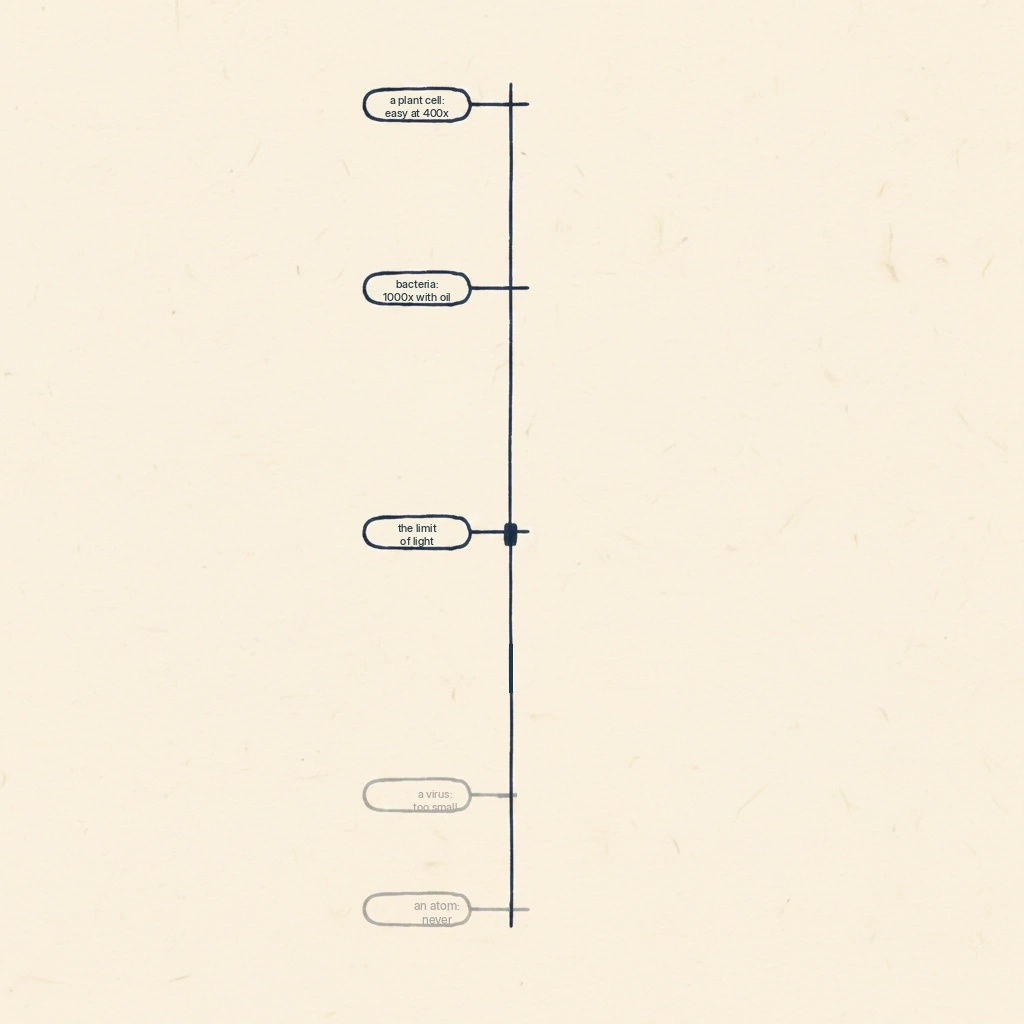
Let me answer this in the order you’re actually wondering it. Cells? Yes, easily, and better than you’d guess. A home microscope at 400x shows you plant and animal cells, and even the nucleus and the little green chloroplasts inside them. Bacteria? Yes, but with one condition the boxes never mention: you need 1000x and a drop of immersion oil. Viruses? No, and here’s the honest reason: they’re smaller than light itself can resolve, so no light microscope at any price will ever show you one. Atoms? Never, not with light. And that “no” on viruses isn’t a failure of your microscope. It’s a fact about the universe, and once you understand it, the whole thing becomes more interesting, not less.
This is the happy end of this subject, by the way. The cheapest, most reliable wonder anywhere in this whole world of lenses is a drop of pond water and a modest microscope. Let me show you exactly where the honest lines are, so you go and look instead of feeling let down.
What's on this page
The honest ladder, rung by rung
Here’s the whole picture, from what’s easy down to what’s impossible, straight from an academic microbiology manual.
Cells: yes, and you’ll see their parts. This is the easy one and the joyful one. At 400x, an ordinary home microscope shows you cells clearly. Not just their outlines, either. The textbook says it plainly: “The nucleus and chloroplasts of eukaryotic cells can also be seen.” Slice a sliver of onion skin, put it under the lens, and you’ll see the individual cells like little boxes, each with a dark dot of a nucleus inside. That’s real, it’s cheap, and it’s most of the magic.
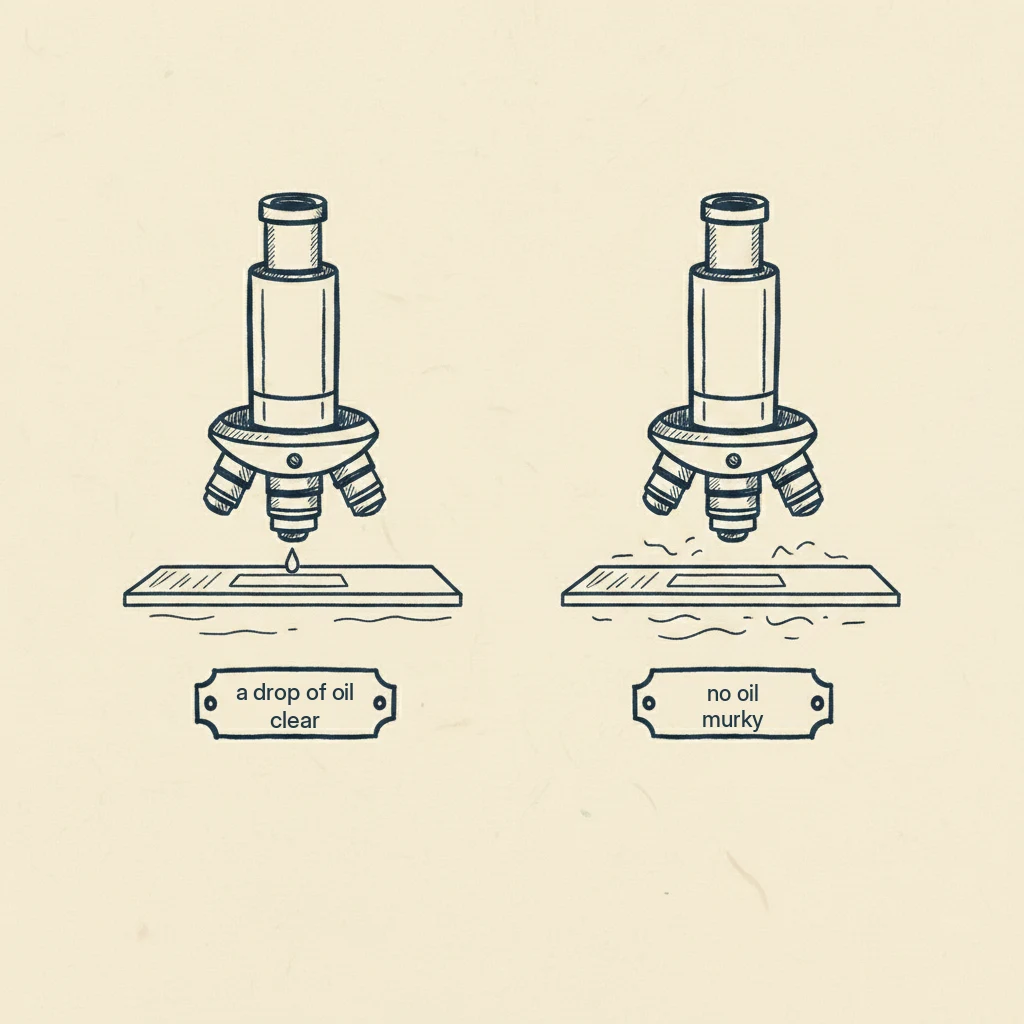
Bacteria: yes, but you need to climb to 1000x, with oil. Bacteria are much smaller than cells, and to see them you need to reach the top of what a home microscope can do. That means 1000x, and specifically a 100x oil-immersion lens, which only works with a drop of special immersion oil placed between the lens and the slide. Without the oil, the light scatters and you get nothing. A working microbiologist confirms it: 1000x for bacteria, and immersion oil is necessary to get there. So bacteria are absolutely visible, but only at the very top of the ladder, with the right lens and that drop of oil.
Viruses and the tiniest cell parts: no. Not at any price. Here the honest answer is a flat no, and it’s worth understanding why. The same textbook is blunt: “smaller organelles and viruses are beyond the limit of resolution of the light microscope.” Not beyond a cheap microscope. Beyond any light microscope, no matter how much you spend or how high the magnification climbs.
Atoms: never, with light. This follows straight from the same limit. If a virus is already too small for light to resolve, an atom, which is far smaller still, isn’t a close call. I’ll be careful here and tell you this last rung is a conclusion I’m drawing from the cited limit rather than a figure I’ve verified independently, but the direction of it isn’t in doubt.
Here’s what’s actually happening: light itself has a size
This is the idea that makes the whole ladder make sense, and it’s a genuinely beautiful piece of physics.
A light microscope has a hard floor it can never get below, and the textbook gives the number: its resolving power, the smallest thing it can distinguish, is about 0.2 microns, which is 200 nanometers. And no matter what magnification you dial up, you can’t see anything smaller than that floor. The standard top magnification on these microscopes is, as the manual puts it, “typically 1000X,” and pushing past it doesn’t help, because the limit isn’t the magnification. It’s the light.
Why does light have a floor at all? Because light travels as a wave, and a wave has a size. You can’t use a wave to resolve something much smaller than the wave itself, any more than you could feel the shape of a grain of sand through a thick winter mitten. Below about two-tenths of a micron, there’s simply nothing for visible light to show you, not because your microscope is cheap, but because you’re trying to see something smaller than the thing you’re seeing with. A virus is below that floor. So is an atom. The light can’t reach them, and no eyepiece, no matter how big its number, changes that.
That, by the way, is exactly why a “5000x” microscope is selling you nothing real. There’s no smaller detail waiting up there for a bigger number to reveal. Past the useful range you just get a bigger, blurrier version of the same 200-nanometer floor. If you want the full story on that, the number-on-the-box trap has its own page.

But you HAVE seen a virus, and here’s how
Now the graceful part, because “no” isn’t the end of the story. You’ve absolutely seen pictures of viruses, the spiky ball of a coronavirus, the lander-leg shape of a bacteriophage. So how, if light can’t resolve them?
Because someone built a different kind of microscope. An electron microscope doesn’t use light at all. It uses beams of electrons, which are far tinier than a wave of light, to build its images. That’s how every virus picture you have ever seen was made, and every image of the fine machinery inside a cell. So the honest answer to “can I see a virus?” isn’t a shrug. It’s: no, not with light, because light is too big, but yes, humanity has seen them, with a machine that trades light for electrons. The limit is real, and we climbed around it. That’s a better story than a fake number on a box will ever give you.
What to actually buy for cells
The good news is that the joyful rung, cells, is also the cheap one.
For cells, you want a compound microscope, the kind that looks down through a thin, lit slide, in the 40x to 400x range. A solid all-metal AmScope M150C runs about $115. Celestron’s Labs compound line starts around $150 for the CM800 and climbs from there. A microscope that shows you a living cell’s nucleus costs about what a game console does, which still amazes me a little.
One important warning if you’ve read my other pages: for coins and rocks and solid objects, I send people to a stereo microscope. Don’t do that here. Cells need a compound scope and a thin slide you can shine light through. A stereo scope, wonderful as it’s for a coin, won’t show you a cell. Different job, different tool.
If you want to climb to the bacteria rung, you’ll need a scope that reaches 1000x with a 100x oil-immersion lens, plus a small bottle of immersion oil, which runs about $20 to $25 and can occasionally be out of stock, so it’s worth grabbing when you see it. Some capable scopes, like the Swift model a microbiologist recommends, at around $240, come with a starter sample of oil to get you going.
What NOT to expect it to do
One firm, plain boundary, because it matters. This page is about what the instrument can physically resolve, and nothing more. A microscope is a tool for looking, for curiosity, for seeing the hidden structure of ordinary things. It isn’t a way to test your water, your food, or anything about your health, and I’m not going to suggest for a second that it is. If a question like that’s on your mind, a microscope is the wrong tool and the wrong page. Look at onion skin and pond water and the leg of an insect, marvel at it, and leave the testing to people with labs.
Questions people actually ask
Can you see cells with a home microscope?
Yes, easily, and it’s the best reason to own one. At 400x, an ordinary compound microscope shows plant and animal cells clearly, including the nucleus and the chloroplasts inside plant cells. A sliver of onion skin or a drop of pond water is all you need to start. Cells are the rung where a modest microscope genuinely delivers.
Can a microscope see bacteria?
Yes, but only at the top of a home microscope’s range: 1000x, using a 100x oil-immersion lens with a drop of immersion oil between the lens and the slide. Without the oil, you won’t resolve them. So bacteria are visible, but they’re the hard rung, and a scope advertising 1000x with no oil-immersion lens can’t actually get you there.
Can a light microscope see viruses?
No. Viruses are smaller than the resolving limit of any light microscope, which is about 200 nanometers, so no light microscope at any price or magnification can show one. Viruses are imaged with electron microscopes, which use electrons instead of light. Every virus picture you’ve seen was made that way, not with a home microscope.
What magnification do I need to see cells?
About 400x, which nearly every real compound microscope reaches. At 400x you can see cells, their nuclei, pond-water organisms, and plant structure. You don’t need to chase 1000x unless bacteria are your goal, and you certainly don’t need the huge numbers on cheap boxes, which are past the point where any new detail exists to be seen.
Go get a drop of pond water
So here’s where I’d leave you, and it isn’t a shopping instruction, it’s a nudge out the door. If you want to see cells, a modest compound microscope around $115 will do it beautifully, and the very first thing I’d put under it’s a sliver of onion skin or a drop of water from the nearest pond or puddle. That drop is teeming, and at 400x it comes alive, tiny things swimming, cell walls in neat rows, a nucleus like a dark seed in each little box. That’s the whole promise of this instrument, kept, for the price of a game console and a walk to the water. The virus and the atom will stay out of reach, and that’s genuinely fine. There’s more wonder in that one honest drop than any 5000x box will ever sell you.
For which scope to actually buy and the two parts that separate a real one from a toy, a microscope for adults is the buyer’s guide. If a shelf is waving a giant magnification number at you, the truth about 5000x microscopes explains why it’s empty. Buying for a child? A microscope for kids is the gift-side page. And if your interest is actually solid objects like coins, a microscope for coins points you to the right, and very different, tool.
Ray Ostrander
Ray spent three decades explaining the sky to twelve-year-olds and their parents, and every January, hearing which Christmas telescopes ended up in the closet. He doesn't own a wall of gear and won't pretend to. He reads everything, tells you what owners agree on, and flags what's just his judgment. His goal is simple: no more January closets.