
The Telescope to See the Moon, and the One Night You Shouldn't Look
Almost any telescope shows lunar craters beautifully, even a cheap one. The trick is timing, not gear: skip the full moon, which is flat and glaring, and look along the shadow line where craters leap out. The magnification limit is about 150 to 200x, set by the air.
 Ray Ostrander · Updated July 24, 2026 · how I decide
If you buy through a link here, the site earns a little. It's never why anything gets picked.
Almost any telescope shows lunar craters, and even a cheap one shows them beautifully. The trick here’s timing, not gear. Don’t look at the full moon, which is flat and glaring with almost no shadows. Look along the terminator, the line between the lit part and the dark part, where the sun is rising on the Moon and long shadows make the craters and mountains leap out. The practical magnification limit is about 150 to 200x on most nights, set by the air, not your optics.
This is the one page on this whole site where I get to give you unambiguously good news. Every other page I write has to talk you down from the poster. Not this one. The Moon is the single target that’s better through a cheap telescope than it’s in the photographs, and the only thing standing between you and that view is picking the right night. Let me show you how.
What's on this page
- The full moon is the worst night, and it's the one everybody picks
- What you actually see
- How much magnification, and where the ceiling really is
- Do you need a moon filter?
- The Moon shelf, and it's the cheapest win on the whole site
- A word of safety
- Questions people actually ask
- What I'd tell a parent in the hallway
The full moon is the worst night, and it’s the one everybody picks
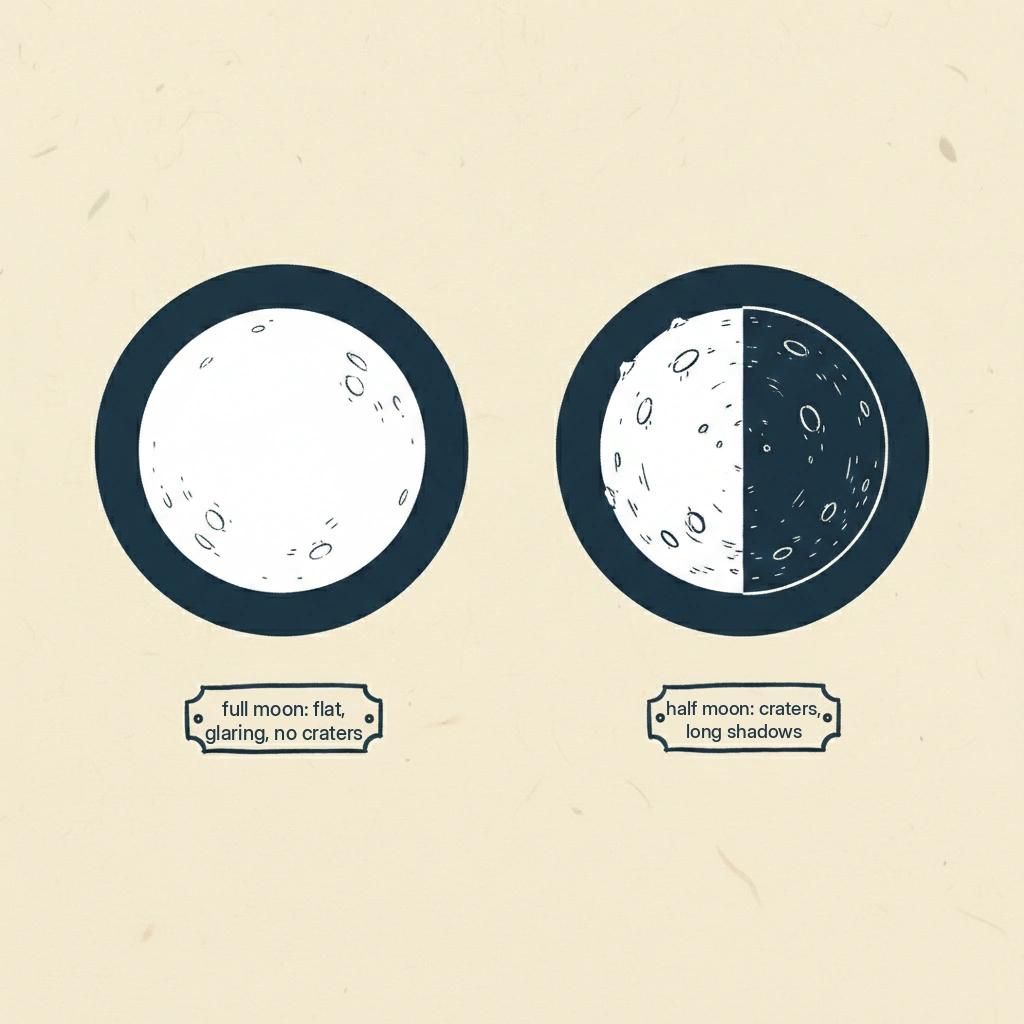
Here’s the finding that saves your first look, and it costs you nothing. People wait for the full moon because it’s the biggest and brightest, so it feels like the moment. It’s the opposite. As one longtime observer puts it plainly, the full moon is the worst time for observing, because there are almost no shadows and every feature gets drowned in glare. You point your brand-new telescope at that bright white disc, see a flat, featureless dinner plate, and conclude the telescope is bad.
The telescope is fine. You looked on the wrong night. Here’s what’s actually happening: craters only look like craters when the sun is low over them and they throw shadows, exactly the way a footprint on a beach disappears at noon and reappears with a long dark shadow at sunset. On a full moon the sun is straight overhead across the entire face, so nothing casts a shadow. Wait for a half-lit moon on an ordinary Tuesday, put your eye on that terminator line, and a seventy-five-dollar scope will show you mountains standing up out of the dark. That’s the whole secret, and it’s free.
What you actually see
For once, the honest answer is: a lot. Along that shadow line you get craters with real depth, the dark flat maria that early astronomers mistook for seas, crack-like features called rilles, and mountain ranges, including a fine one called the Apennines. The one honest caveat, and I keep it because it makes the rest believable, is that at the eyepiece the craters are often softer and more subtle than a sharpened photo suggests, and the whole surface seems to gently wobble as you look, because you’re staring across an ocean of moving air at another world. That wobble isn’t a defect. It’s the atmosphere, and in the still moments between the wobbles the fine detail snaps into view.
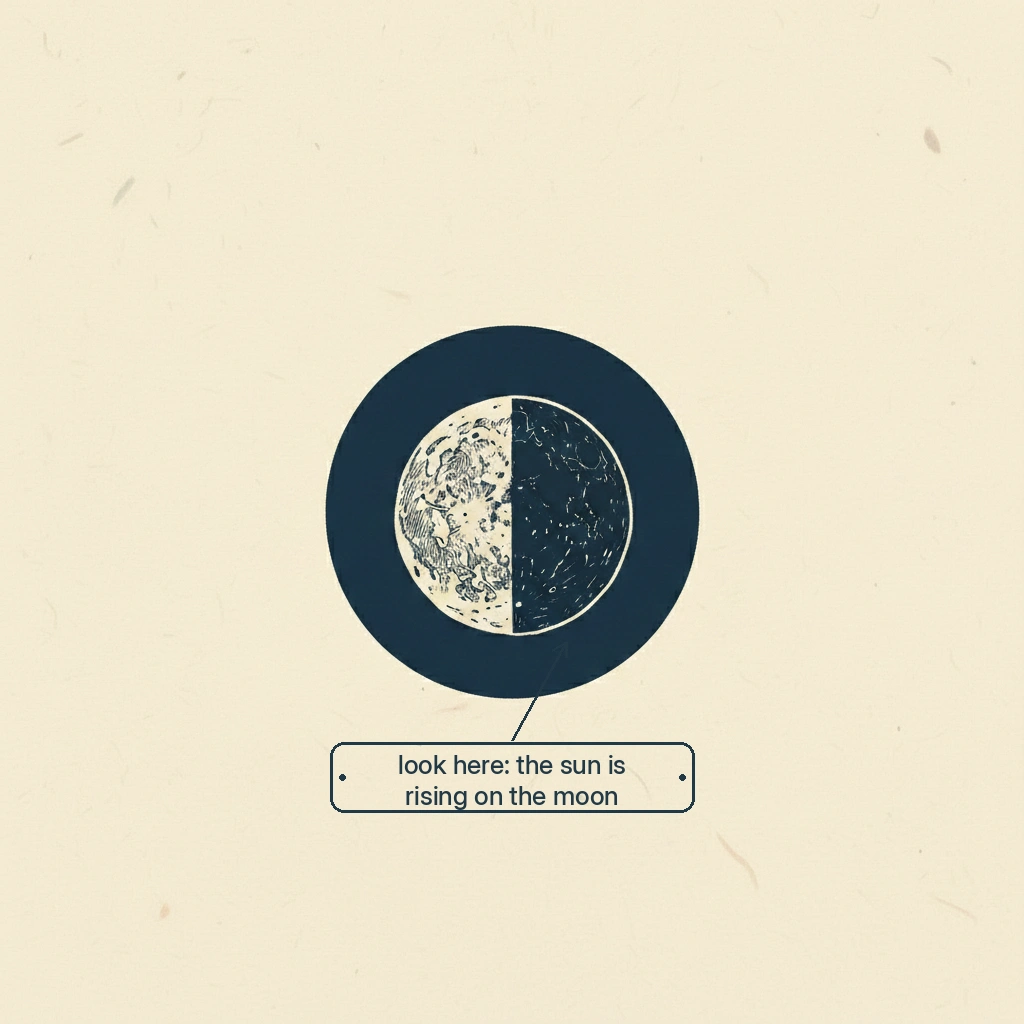
If you want a first tour, here’s one an observer laid out by the day of the lunar month, so you know what to hunt and when it shows best: the dark plain Mare Serenitatis; the crater chain of Theophilus, Cyrillus, and Catharina; the walled plain Plato; the trio of Archimedes, Aristillus, and Autolycus; the brilliant crater Aristarchus, the brightest on the Moon; and the dark-floored Grimaldi. Each of those pops best when it sits near the terminator, so a different set greets you every few nights as the shadow line marches across.
How much magnification, and where the ceiling really is
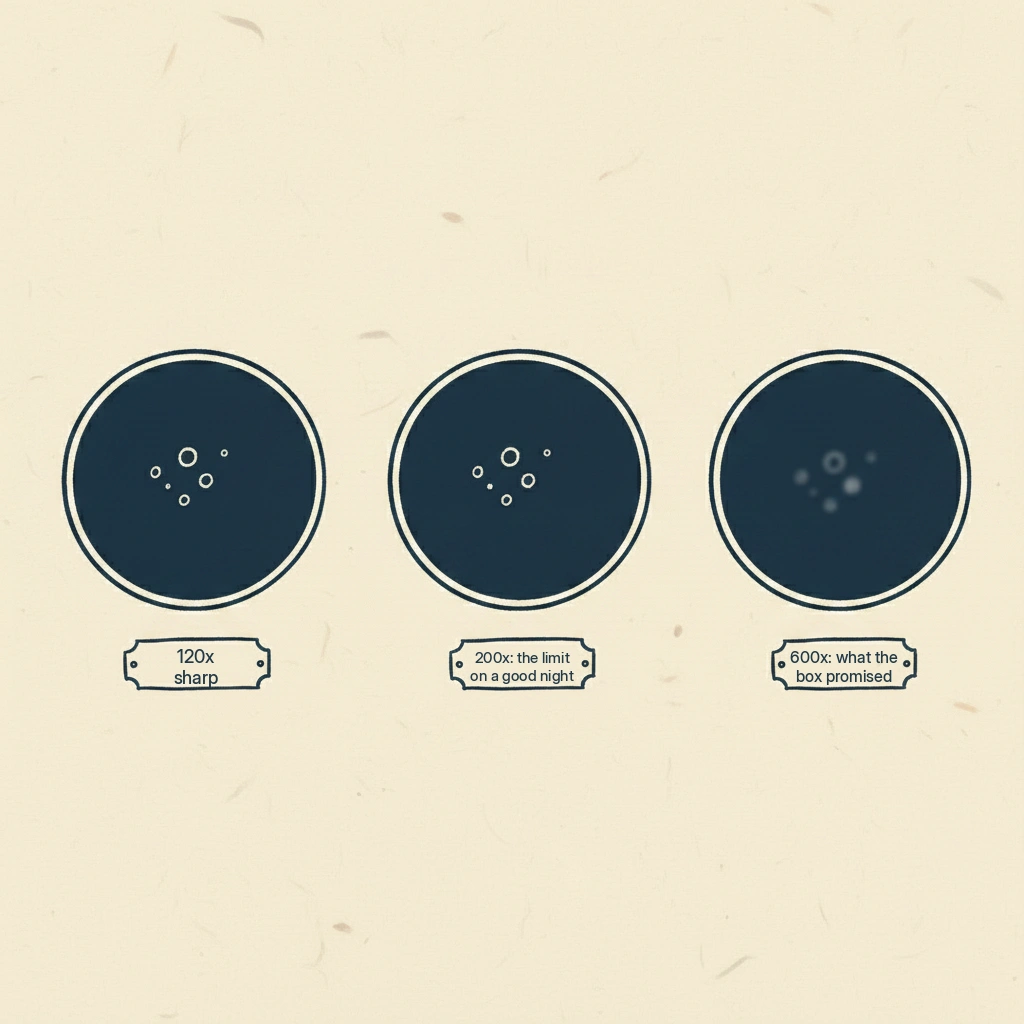
The Moon is special here, and it’s worth being precise, because this is exactly where beginners get tricked. The Moon can take more magnification than any other target in the sky. That part is true. But you’re stopped by the air long before you’re stopped by your telescope: on most nights the practical limit is about 150 to 200x, no matter how good or expensive the scope. And there’s a hard optical ceiling underneath that: the maximum usable power runs about 50 to 60 times the aperture in inches. So a 60mm scope runs dry around 120 to 140x.
Put those two halves together, because splitting them is how people get robbed. Yes, the Moon rewards more magnification than a galaxy does. No, that doesn’t mean the 4mm eyepiece or the 600x number on the box will help. Past the ceiling the image only gets bigger, dimmer, and blurrier. Give yourself the permission and the limit in the same breath: aim for a sharp view around 100 to 150x, and stop.
Do you need a moon filter?
You’ll see filters pushed hard, so let me lay out the honest disagreement. The buying shelf pushes moon filters hard, especially on larger scopes, because the Moon can be painfully bright above about three inches of aperture when it’s more than half full. But the most authoritative observer on the subject says he dislikes them, that they cause a slight loss of definition, and endorses one only when you want to look at a full or near-full moon and need to cut the hopeless dazzle.
Here’s my honest read, and it saves you money. The filter solves the full-moon glare problem. And the full moon is the night you shouldn’t be observing anyway. Observe along the terminator on a half moon and the glare problem mostly solves itself, for free, because half the disc is dark. So buy a moon filter if you genuinely enjoy looking at the full moon and want to take the sting out of it. Don’t buy one because a listicle told you the Moon is simply too bright to view. The brand-name filter runs about thirteen dollars as I write this, which is cheap enough that this is a small decision either way.
The Moon shelf, and it’s the cheapest win on the whole site
Every honest piece of evidence points the same direction here: you don’t need to spend money to see the Moon well. The small, low-cost telescopes on the shelf today give genuinely satisfying views of the Moon, and owners of the very scopes the internet loves to call junk keep saying their neighborhood kids adore them and they’re great for the Moon. All researched, none of it looked through by anyone here, and prices rounded to what I’m seeing as I write this.
- Celestron FirstScope 76mm tabletop, about $75. There’s even a version with lunar photographer Robert Reeves’s name and a Moon theme on it at the same price. The genuine floor, and genuinely enough.
- Celestron AstroMaster 70AZ. Prices are scattered on this one, from about $150 up to the maker’s own sticker near $200, so shop it around. An owner calls his great for the moon.
- Sky-Watcher Heritage 150 tabletop, about $355. Six inches of aperture on a small base, a lot of Moon for the money.
- Sky-Watcher Skymax 102, about $300, or the larger Skymax 127 around $509. These long Maksutov tubes are natural lunar instruments: high magnification, high contrast, and no color fringing on that bright edge.
- Sky-Watcher Classic 150P Dobsonian, about $515, or the Celestron NexStar 4SE, about $649, if you want the tube to point itself.
For serious lunar work, observers name a bar of about a 4-inch refractor or a 6-inch reflector. But be clear on what that means: that’s the bar for chasing the finest detail, not the bar for a great first look. The great first look starts at seventy-five dollars.
One more honest note on the cheapest option of all. Binoculars are the classic first sky instrument, and a steady pair mounted or braced will show you something of the Moon: NASA says a good pair picks out craters around six miles across and larger. The full case for binoculars as a first buy lives on telescope vs binoculars.
A word of safety
If you’re outside with your telescope in daylight, to line up the finder or catch the Moon before dark, never point it anywhere near the Sun. Doing so can destroy the telescope and your eyes. It only takes an instant. Keep it aimed at the Moon, a distant tree, anything but the Sun.
Questions people actually ask
What’s the best telescope to see the Moon clearly?
The cheapest honest one you’ll actually take outside, starting around $75 for a small tabletop scope. The Moon rewards the casual look more than any other target, because there’s no dark-sky drive and no planning involved. Clarity comes far more from looking on the right night, a half moon at the terminator, than from spending more on the telescope.
Can I see the Moon’s surface and craters with a small telescope?
Yes, and it’s the best value in the whole hobby. A small scope shows craters, the dark maria, and mountain ranges in real relief along the shadow line. Detail improves with aperture, but even a beginner’s scope on a half moon at 100x shows more craters than you can count in a sitting. The full moon is the only thing that hides them.
Why does the Moon look washed out through my telescope?
Two likely reasons. Either you’re looking at a full or nearly full moon, when the overhead sun erases all the shadows and flattens everything, or the glare is genuinely bothering your eye. Fix the first by waiting for a half moon and aiming at the terminator. If the second still bugs you on a full moon, a cheap moon filter takes the dazzle down.
Can I see the Moon from the city?
Perfectly. The Moon is bright enough to shrug off even extreme light pollution, so an apartment balcony in a bright downtown gets exactly the same Moon as a dark field out in the country. Of everything in the sky, the Moon is the most city-proof target there is. If you live under streetlights, this is your guaranteed win.
Can a telescope show the flag or the landing sites on the Moon?
That one has a clean answer rooted in physics, and it’s a no, and it isn’t about your telescope being cheap. I gave it its own full explanation, because it comes up so often, over on what can you see with a telescope.
What I’d tell a parent in the hallway
Buy the cheapest steady scope you’ll actually carry outside, wait for a night when the Moon is half-lit instead of full, and aim right at that line between light and dark. Your kid will see mountains and craters with real shadows, and it will look better than the poster. This is the one that never lets you down.
A few things you’re probably also wondering:
- Wondering what else that scope will show? See what can you see with a telescope.
- Can’t find the Moon in the eyepiece at all? See how to use a telescope.
- Ready for the next targets after the Moon? See telescope to see jupiter and best telescope to see saturn.
- Just trying to buy the right cheap scope? See best cheap telescope.
Ray Ostrander
Ray spent three decades explaining the sky to twelve-year-olds and their parents, and every January, hearing which Christmas telescopes ended up in the closet. He doesn't own a wall of gear and won't pretend to. He reads everything, tells you what owners agree on, and flags what's just his judgment. His goal is simple: no more January closets.