
Spotting Scope for Astronomy: Yes, It Reaches Saturn's Rings, Right at Its Limit
Your spotting scope shows the Moon, Jupiter's moons, and Saturn's rings, though not galaxies. The catch: it tops out around 60x, and the rings need 50 to 60x, so it just barely gets there. Already own one? Take it out tonight.
 Ray Ostrander · Updated July 24, 2026 · how I decide
If you buy through a link here, the site earns a little. It's never why anything gets picked.
Yes: your spotting scope shows the Moon beautifully, Jupiter’s four moons, and Saturn’s rings, though not galaxies or nebulae. Here’s the catch worth knowing before you expect too much. A spotting scope tops out around 60x before the image starts to soften, and Saturn’s rings need about 50 to 60x, so it only just gets there, at the very top of its range. The finer gap inside the rings needs 100x and up, which a spotting scope never reaches. So if you already own one, take it outside tonight. If you’re buying specifically for the sky, aperture is cheaper in a telescope.
Let me guess who you are, because the question tells me. Almost nobody buys a spotting scope for astronomy. You bought yours, or you’re about to, for birds, or hunting, or the range, and now you’re standing in the yard at night wondering if it’ll show you Saturn. That’s a great question, and it’s not one anybody’s answered straight, because the shopping pages that name the rings only talk to telescope owners, and the ones that mention spotting scopes never name a planet. So here’s the honest version, and the good news comes first, because it’s real.
What's on this page
- Yes, it genuinely does astronomy
- The catch is a number, and it's a clean one
- The number on the dial is lying to you, and here's how to read it backwards
- Why it shows the bird right-side up, and what that costs you
- What it will never show you, and why
- So what should you actually do?
- Questions people actually ask
- Use what you have first
Yes, it genuinely does astronomy
Point it up and your spotting scope shows you real things. It’s genuinely good for the Moon, and it will show you Jupiter’s four moons strung out beside the planet and the rings of Saturn. That’s not a courtesy; it’s a fact you can lean on. I’ll give you a sense of just how reachable those sights are: a good pair of 15x70 binoculars, which is less instrument than any spotting scope, already shows Jupiter as a small disk with its moons around it. If binoculars clear that bar, an 80mm scope at 40x clears it comfortably. Take the thing you own outside and you’ll see the headline sights of the solar system. Nobody should talk you out of that.
The catch is a number, and it’s a clean one
Now the honest limit, and it’s the whole reason this page exists, because it’s two cited numbers that happen to land right on top of each other.
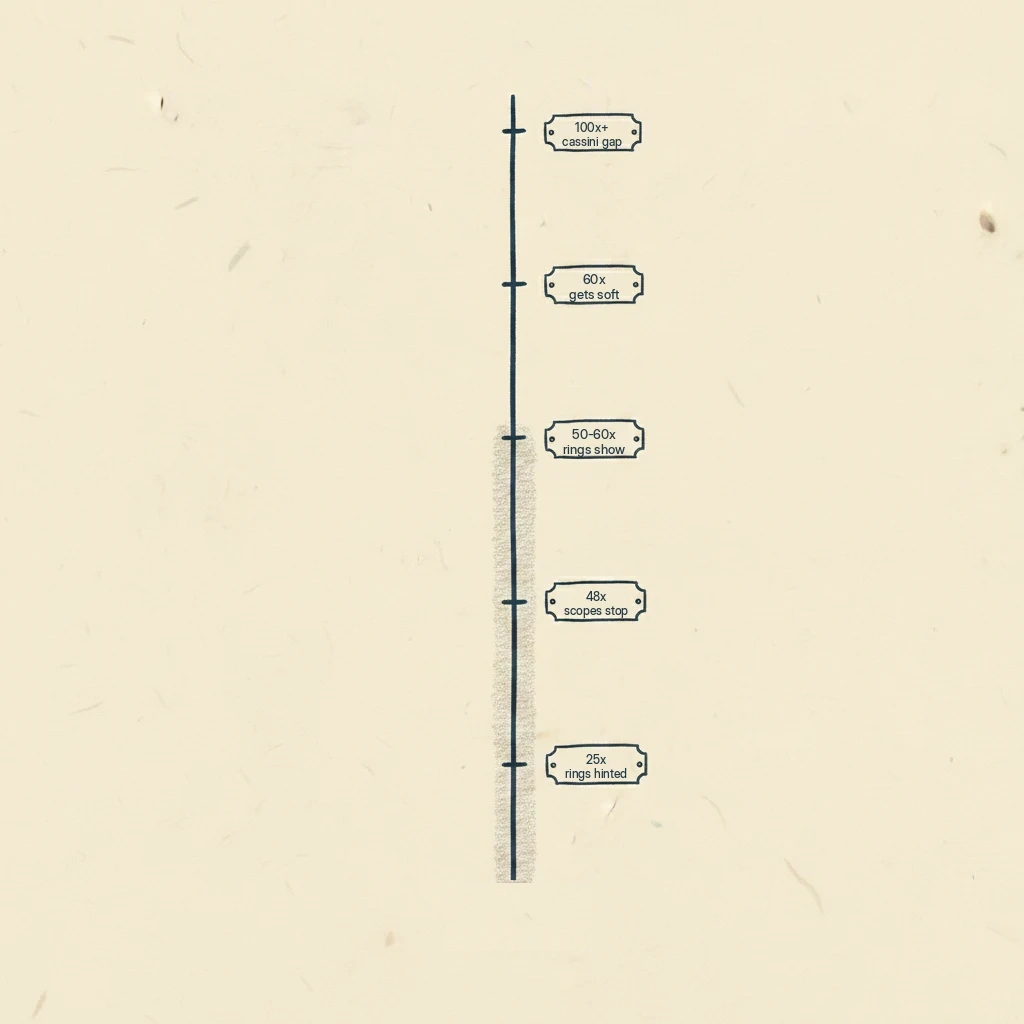
A spotting scope’s practical ceiling is about 60x. Push past that and the image gets dim and lower in contrast: mushy, in a word. And what does Saturn’s ring show require? At around 50x a good small scope shows the rings as a structure detached from the planet’s disk. Put those two facts side by side and you get the sentence nobody writes: a spotting scope arrives at Saturn’s rings at the very top of its own range, at the exact magnification where its picture is already starting to fall apart. It works. It just barely works. On a steady night you’ll see that little ringed shape, and it’s a real thrill, but you’re asking the instrument for everything it has.
And the next step up is simply gone. The famous dark gap inside the rings, the Cassini Division, needs 100x or more on a steady night. That’s not a hard target for a spotting scope; it’s an impossible one, because 100x is nearly double the instrument’s useful ceiling. A spotting scope will never show you the Cassini Division, no matter what its zoom dial claims.
The number on the dial is lying to you, and here’s how to read it backwards
This is the most useful thing I can teach you, and it’ll serve you in every optics aisle for the rest of your life. Look at what the numbers actually tell you.
The cheap spotting scopes advertise a big zoom range, 20 to 60x. The expensive, high-end scopes, the ones with genuinely good glass, deliberately cap their magnification at around 48 power. Read that again, because it’s backwards from what you’d expect: the better instrument stops at a lower number than the cheaper one. That’s not a limitation the good makers forgot to fix. It’s a confession from people who know exactly what their glass can hold. They stop at 48x because that’s where their image is still sharp, and they’d rather show you 48x of crisp than 60x of mush.
So on this shelf, and honestly on most optics shelves, a lower top number is often a sign of better glass, not worse. The 20-to-60x budget scope isn’t giving you more than the 48x premium one. It’s just printing a number it can’t actually deliver, and handing you a soft, dim image if you dial all the way up, which, for Saturn, is exactly where you’ll want to be. Once you can read the box backwards like that, you can never be sold by a big magnification number again.
Why it shows the bird right-side up, and what that costs you
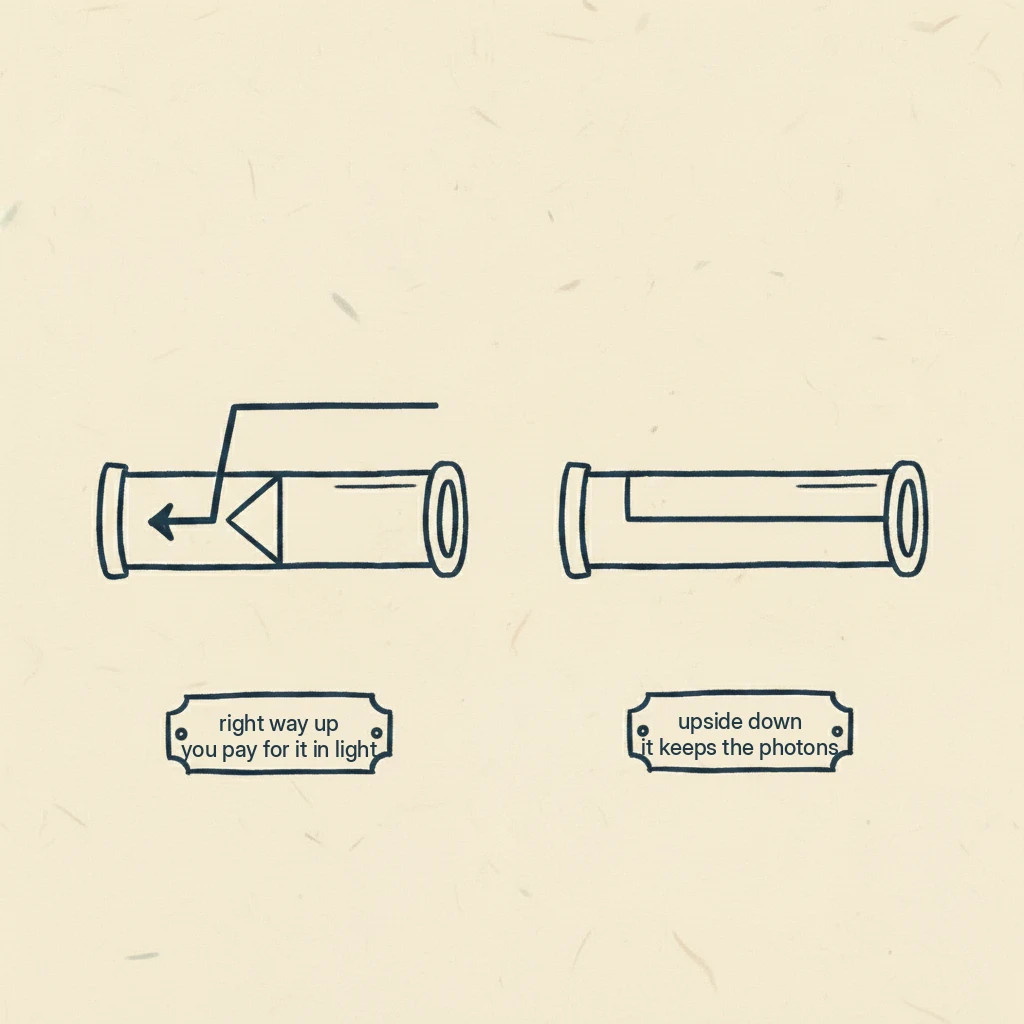
Here’s a lovely bit of physics that explains something about your scope you may never have thought about. A spotting scope shows you the world right-way-up and the right way round, which is exactly what a birder needs, because you can’t track a warbler through an upside-down view. It does that with an extra piece of glass inside called an erecting prism, which flips the image back the right way. A telescope skips that prism, which is why the view through a telescope is upside-down.
But that convenience isn’t free, and here’s what’s actually happening. Every extra surface the light passes through absorbs a little of it. The prism that turns your bird right-side up also reduces the light reaching your eye. In daylight, on a bird, you never notice. But at night, on a faint planet, every photon counts, and your spotting scope is quietly paying a light tax for the right-way-up image. That faint gleam of Saturn is real light that traveled across the solar system to reach you, and your scope gives up a little of it right at the door in exchange for showing the daytime world the right way up. It’s a fair trade for a birder. It’s just worth knowing you’re making it when you point the same scope at the dark.
What it will never show you, and why
Be clear-eyed about the deep sky, because this is where a spotting scope simply can’t follow. It won’t show you galaxies or nebulae in any satisfying way. Put plainly, a spotting scope lacks the light-gathering power for deep-sky objects like galaxies and nebulae. The reason is aperture, the width of the light-gathering lens. Faint deep-sky objects are about gathering light, and a spotting scope’s lens is capped at whatever a human can comfortably carry up a hill on a tripod. Telescopes give you far more aperture for the money, and aperture is the whole game for galaxies. So the Moon and planets, yes. The faint fuzzy stuff, no, and no dial setting changes that.
One more honest note that isn’t your scope’s fault at all: the air. On a turbulent night the atmosphere itself ripples and blurs the fine detail in Saturn’s rings, and heat waves bother every optic, cheap or expensive. You’ll want to experiment each night to find the magnification that gives the best trade-off between size, sharpness, and brightness. Some nights the sky just won’t cooperate, and that’s the sky’s vote, not a flaw in your glass.
So what should you actually do?
The best advice on this whole page costs nothing: use what you already own. You have a real astronomy instrument sitting in your closet right now. Take it outside tonight, aim it at the Moon along the line where the shadows are, then swing over to Saturn or Jupiter, and don’t spend a single dollar until you know whether you’ll go out a second time. That’s the honest move, and it’s the opposite of the gear that gets bought in a flush of excitement and never used again.
If you catch the bug and decide you want to buy for the sky specifically, here’s the arithmetic, and it surprises people. All researched, none of it looked through by anyone here, prices rounded to what I’m seeing as I write this, and I’ll flag where a price is soft.
- A well-reviewed value spotting scope, an 80mm zoom, runs about $200. It’s a fine daytime instrument, and it hits that same 60x ceiling on Saturn.
- For a little more, about $230 to $280 as I write this, a Sky-Watcher Heritage 130P, a collapsible tabletop telescope, gives you 130mm of aperture, roughly two-thirds more light, and an eyepiece socket that takes you well past 100x, through the Cassini Division threshold your spotting scope can never reach. And it collapses to fit in a backpack, so you don’t even give up portability.
That’s the honest comparison the shelf never makes: for close to the same money, a small telescope outruns the spotting scope on the exact object you’re chasing. If you’d rather stay wide and simple, a good 10x50 binocular runs about $52, a quarter of the scope’s price, and NASA itself calls binoculars an excellent, versatile first instrument for the sky.
Questions people actually ask
Can you use a spotting scope for astronomy?
Yes, and better than most people expect. It shows the Moon in fine detail, Jupiter’s four moons, and Saturn’s rings. Where it stops is the faint deep-sky stuff, galaxies and nebulae, which need more light-gathering aperture than a spotting scope has, and the fine planetary detail like the Cassini Division, which needs more magnification than a spotting scope can hold. For the Moon and planets, though, the one you own tonight is genuinely capable.
Can a spotting scope see Saturn’s rings?
Yes, right at its limit. The rings show up at about 50 to 60x, and a spotting scope’s practical ceiling is around 60x before the image softens, so you’ll see the little ringed shape by dialing near the top of your zoom on a steady night. What you won’t see is the dark Cassini gap inside the rings, which needs 100x and up, past what any spotting scope can usefully deliver.
Is a spotting scope or a telescope better for astronomy?
For the sky, a telescope, and it isn’t close on the things that matter for stargazing. A telescope gives more aperture for the money, takes interchangeable eyepieces so it can push past 100x, and reaches deep-sky objects a spotting scope can’t. The spotting scope’s edge is daytime: it’s rugged, portable, and shows a right-way-up image for birds and wildlife. If you already own the spotter, use it for the Moon and planets and enjoy it.
What magnification do I need to see planets with a spotting scope?
Whatever your scope’s top honest setting is, which for most is around 48 to 60x. Saturn’s rings and Jupiter’s moons appear in that range. Don’t be fooled by a “60x” zoom on a budget scope, though, because the image often softens before you get there. Dial up slowly and stop where the picture is still sharp rather than where the number is biggest.
Use what you have first
If you own a spotting scope, you own a solar-system instrument, so take it out on the next clear night, put it on the Moon and then Saturn, and enjoy a genuinely good view right up to the edge of what it can do. If you find you want the deep sky or the fine detail in the rings, don’t buy a fancier spotting scope. For not much more money, a small telescope gives you the aperture and the magnification the spotter never could. Use what you have first, then buy the right thing, not the near thing.
A few things you’re probably also wondering:
- Ready to price a scope properly? See best spotting scope for the money.
- Wondering if binoculars are the simpler sky answer? See best binoculars for stargazing and telescope vs binoculars.
- Chasing Saturn’s rings and the Cassini gap for real? See best telescope to see saturn.
- Using your scope for daytime wildlife too? See telescope for bird watching.
- Came here from planning a Yellowstone trip? See best binoculars for yellowstone.
Ray Ostrander
Ray spent three decades explaining the sky to twelve-year-olds and their parents, and every January, hearing which Christmas telescopes ended up in the closet. He doesn't own a wall of gear and won't pretend to. He reads everything, tells you what owners agree on, and flags what's just his judgment. His goal is simple: no more January closets.