
Best Binoculars for Stargazing: Start With the Pair You Can Hold
For stargazing, start with a 10x50 you can hold in your hands, about $52, and know what it shows: Jupiter as a tiny bright disk with pinpoint moons beside it, craters along the Moon's edge, not the photographs. Bigger binoculars see more but need a tripod.
 Ray Ostrander · Updated July 24, 2026 · how I decide
If you buy through a link here, the site earns a little. It's never why anything gets picked.
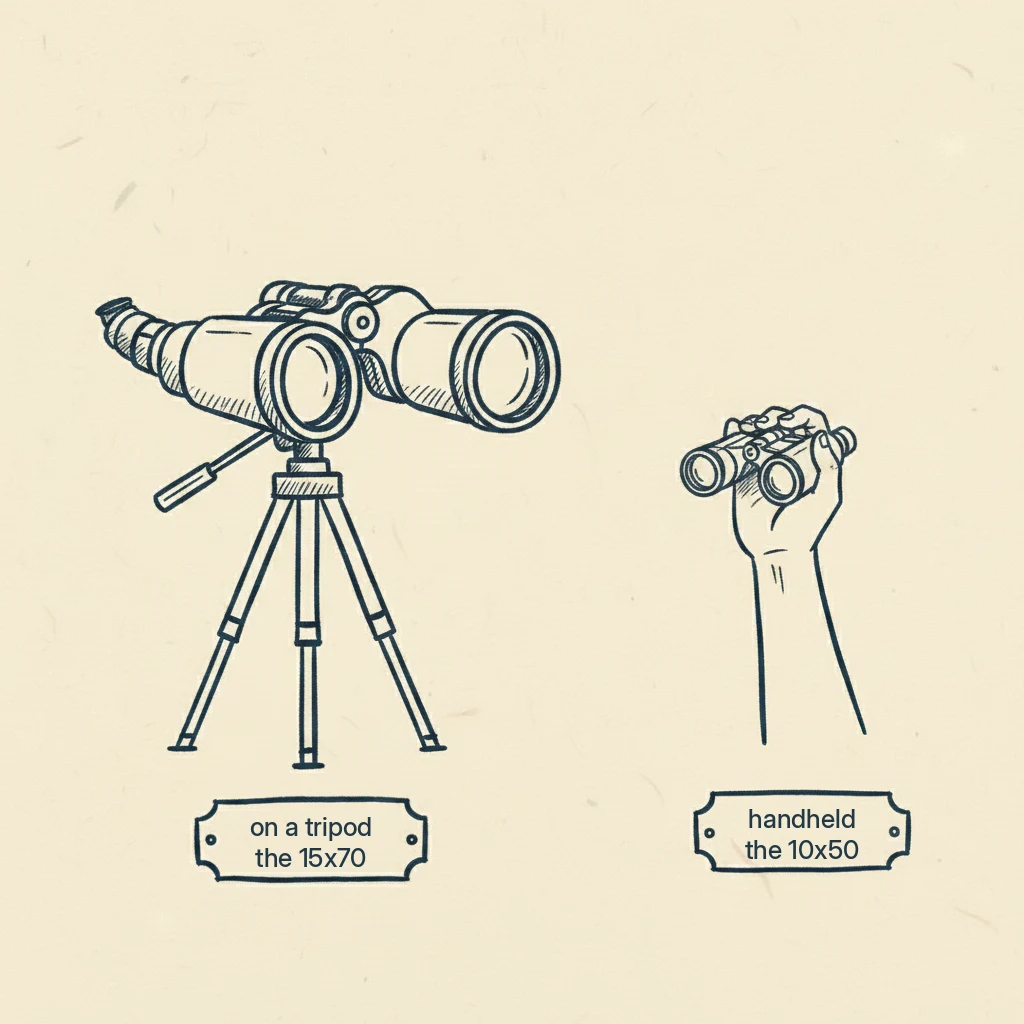
For stargazing, start with a 10x50 you can hold in your own two hands, about $52 as I write this. It’s bright enough for the Moon, the brighter star clusters, and Jupiter with its moons, and steady enough that you don’t need a tripod. Bigger binoculars, the 15x70 kind, do show more, but they need a tripod, and that isn’t optional. And here’s the part the shelf skips: through any of them, Jupiter is a tiny bright disk with pinpoints of light beside it, not the photograph. That small, real thing is the whole reward.
Quick note before we go further, because two searches sound almost identical. This page is about the night sky: the Moon, the planets, the stars. If you’re actually after seeing in the dark down here on the ground, that’s night vision, a completely different thing, and there’s a separate page for binoculars for night vision. Same words, opposite job.
What's on this page
- The mistake almost everyone makes here
- What a real observer wrote in his notebook
- The sky gets a vote
- Here's what's actually happening: why the number goes up at night
- Which is why the tripod is part of the purchase
- The honest ladder
- One quiet thing about your eyes
- Questions people actually ask
- What I'd tell a parent in the hallway
The mistake almost everyone makes here
Look at how people actually ask this. On one forum, a real person laid it out: he wanted to watch the Moon, Jupiter, and Saturn, and he was choosing between a 15x70 and a 20x80. Read that again. He’d already skipped straight past the pair he could hold, and he was picking between two binoculars that both secretly require a tripod, without knowing that’s what he was doing.
That’s the trap on this door, and it’s an honest mistake, because bigger numbers feel like more sky. So before you spend a dollar, let me hand you the one thing no listicle will: a record of what these binoculars actually show, kept by someone who wasn’t selling anything.
What a real observer wrote in his notebook
A man named Tony Hayes, in the Dundee Astronomical Society, spent an observing period comparing three binoculars on Jupiter, night after night, and he kept a log. Not a review. A notebook. Here’s what he actually saw:
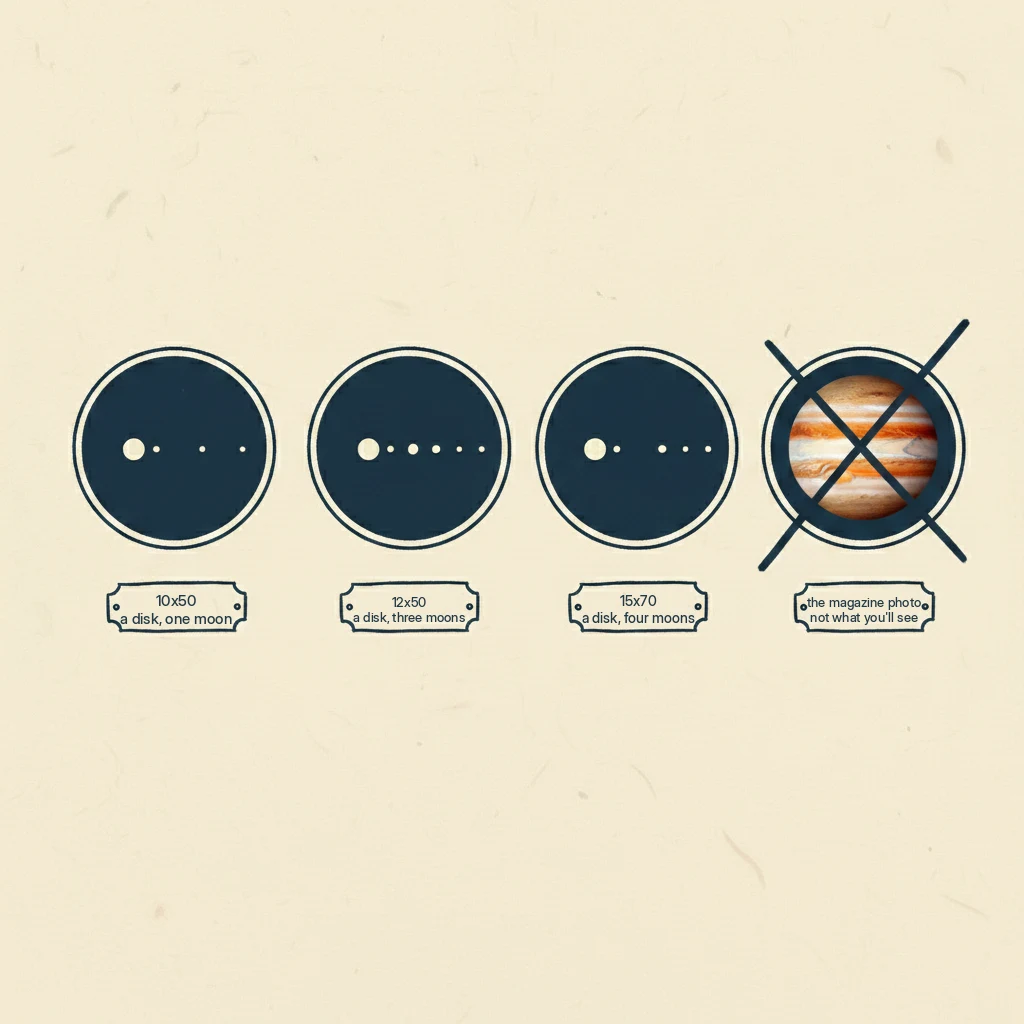
- Through the 10x50: Jupiter as a small disk, one moon on the first night, three on the clearer ones.
- Through the 12x50: a clear disk, three moons.
- Through the 15x70: a very clear disk, and on the clear nights all four of Jupiter’s moons at once, though on the damp, washed-out nights even it fell back to three.
Now hold that up against what the ranking pages on the same search promise. One says a 15x70 “clearly resolves all four of Jupiter’s Galilean moons” and that you’ll see all four “frequently.” Hayes’s notebook tells a more honest story. On a clear night the 15x70 did show all four at once. But most nights of his observing period were damp or washed out, and on those even the big glass fell to three moons, and one night Jupiter’s glare so swallowed the fourth, Callisto, that he mistook it for a star. “Frequently” is the wrong word for that. “On a clear night” is the right one, and clear nights were the minority.
And the one time he watched a fourth moon actually arrive, a bulge on Jupiter’s edge that took about twenty minutes of patient watching to separate into a moon, it came on his final and clearest night, through a humble new 10x50, not the big glass. The modest pair delivered the whole night’s reward. His notebook is the honest one.
He was honest in the other direction too. One night he thought he glimpsed a dark belt across Jupiter, and then he wrote that he couldn’t see it again, so he wouldn’t claim it as real. That’s a man you can trust. That’s the standard this whole site tries to meet.
The sky gets a vote
Read Hayes’s log closely and something jumps out: what changed from night to night wasn’t the binocular. It was the air. “Very washed out due to dampness.” A halo forming around the Moon. Cloud with only sporadic breaks. And then, finally, “seeing was much better tonight, with no lunar halo and less moisture overhead.”
The variable that decided what he could see was the atmosphere, not the glass. That’s the same truth that runs through the whole hobby: on a hazy or damp or light-fogged night, a bigger binocular just gives you a bigger view of the murk. A clear night with a modest pair beats a bad night with an expensive one. If you take one thing from this page besides the 10x50, take that.
Here’s what’s actually happening: why the number goes up at night
This is the one genuinely subtle thing about stargazing binoculars, and I’ll say it plainly.
All over the daytime pages, the rule is that a bigger lens per unit of power gives you a brighter view, and that’s still true here. Divide the front lens by the power and you get the exit pupil, and the wider it runs the brighter the view: a 10x50 opens to 5mm, a 15x70 to about 4.7mm. Brightness matters more at night, not less.
So why does the stargazing answer creep up in magnification when everywhere else I’m telling you to keep it low? Because the sky is full of tiny points of light sitting right next to each other, and magnification is what pulls them apart. Hayes’s 10x50 showed one moon on a night his 15x70 showed four. The extra power didn’t make Jupiter brighter. It made the space between the moons wide enough to see. At night you’re buying two different things at once: aperture for brightness, magnification for separation. And the price of the second one is steadiness.
Which is why the tripod is part of the purchase
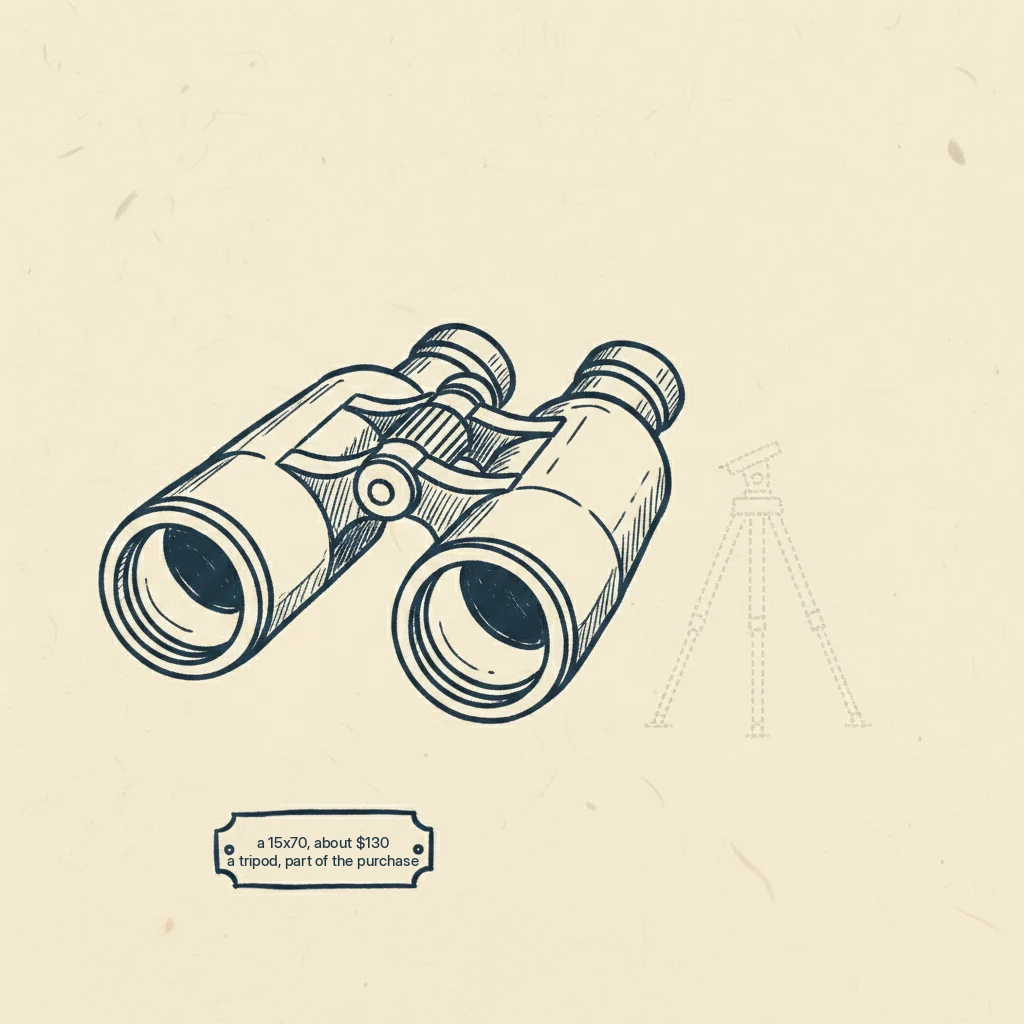
The makers agree, and Hayes proves it from the field: above about 12x you can’t hold the image still by hand, and by 15x the binocular is, in his words, “heavy and most suited for use with a tripod.” His 15x70s even have a threaded socket built into them, which is the manufacturer quietly admitting you’re going to need one. The socket is a confession.
So when you see a 15x70 for about $130 or a 20x80 for about $210, understand that the price tag is missing a leg. Figure roughly $140 for a solid tripod and another $20 for the adapter that clamps the binocular on, so about $160 the shelf never quotes you. There’s a full explanation of the shake and the ceiling on the long-distance binoculars page if you want the physics in full.
The honest ladder
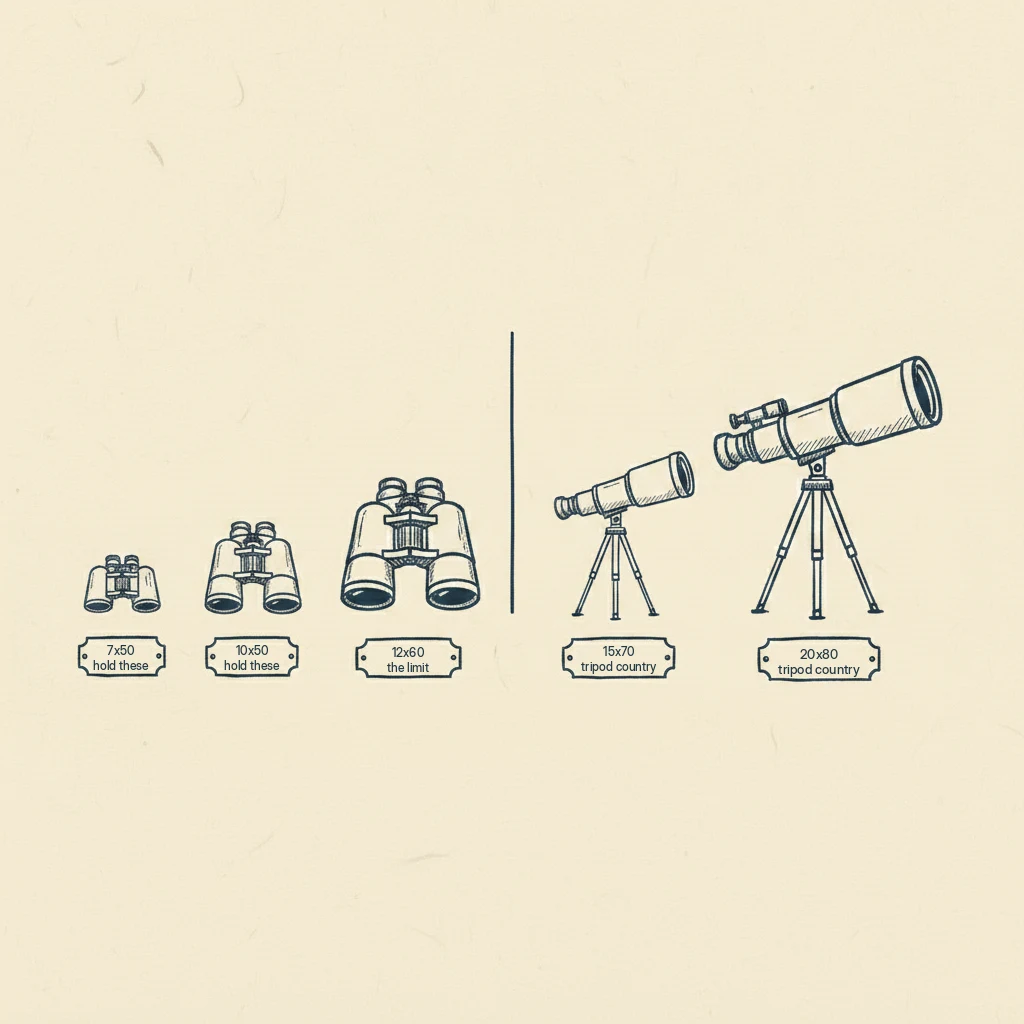
Here’s the shelf, sorted by the one question that actually matters: can you hold it?
| binocular | about | can you hold it? |
|---|---|---|
| Cometron 7x50 | $48 | yes, the classic size |
| UpClose G2 10x50 | $52 | yes, the beginner’s answer |
| SkyMaster 12x60 | $110 | barely, this is the limit |
| SkyMaster 15x70 | $130 | no, tripod |
| SkyMaster 20x80 | $210 | no, tripod |
| SkyMaster 25x100 | $520 | no, tripod and a serious mount |
The whole table is the argument, and the “can you hold it?” column is the one no ranking page prints. For most people starting out, the second row is the answer. Fifty-two dollars, held in your hands, no setup, and it does daytime birds and ballgames too.
One quiet thing about your eyes
Hayes noticed something else in his log that’s worth passing along, carefully. Partway through, he realized he couldn’t get both eyes to focus together, and he later found he had a small cataract developing. What fixed his view wasn’t better optics. It was finding a pair whose diopter adjustment suited him. The diopter is just the little focus ring on one eyepiece that lets you dial each eye in separately, because your two eyes are almost never identical.
That’s his experience, reported by him, and I’m not going to turn it into medical advice, because I’m a science teacher, not an eye doctor. But the plain, useful part is this: a binocular is a two-eye instrument, and if the view never looks quite right, the diopter ring is the first thing to check. If you wear glasses like I do, the glasses-wearers’ page goes deeper on getting a comfortable view.
Questions people actually ask
What size binoculars are best for stargazing?
A 10x50 for almost everyone starting out. The 50mm lens gathers enough light for the Moon, Jupiter’s moons, and the brighter star clusters, and 10x is still steady in your hands. Go up to a 15x70 only if you’re ready to buy and carry a tripod, because above about 12x the image won’t hold still handheld. Bigger isn’t better here. Steadier is.
Can you really see planets with binoculars?
Yes, but honestly, not the way the pictures show. Through a 10x50, Jupiter is a small bright disk with up to four pinpoint moons strung beside it, and the Moon shows real craters along the day-night line. What you see is small and real, and seeing Galileo’s own view with your own eyes is the reward, not a photograph.
Do I need a tripod for stargazing binoculars?
For a 10x50, no, and that’s a big reason it’s the pick. For anything 15x and up, yes, and it isn’t optional, because your hands can’t hold that magnification steady. Budget for it: a decent tripod plus the little adapter to attach the binocular runs around $160 on top of the glass. A 15x70’s low price tag is genuinely misleading until you add the tripod it requires.
Is 10x50 or 20x80 better for astronomy?
They’re different tools. A 10x50 is the one you’ll actually use: light, handheld, grab-and-go on a clear night. A 20x80 shows more, but it’s heavy, it needs a tripod and mount, and it lives in a case you have to decide to haul out. My judgment: buy the 10x50 first. If you fall in love with the sky, you’ll know when you want the big glass, and why.
What I’d tell a parent in the hallway
Get the 10x50 for about fifty dollars, take the kid outside on the next clear night, and point it at the Moon first, then at Jupiter. Don’t buy the big pair, don’t buy a telescope yet, and don’t apologize for starting small. Small is where the wonder is, and it never ends up in the closet the way a wobbly first telescope does.
And here’s why it’s worth it. When you find Jupiter and see those four little points of light lined up beside the disk, you’re looking at exactly what Galileo saw when he realized the Earth wasn’t the center of everything. That light left Jupiter’s moons more than half an hour ago and finished its trip in your eye, on your driveway, for the price of two pizzas. That’s the whole thing, and no photograph gives it to you.
If you want to keep going: stargazing for beginners teaches you how to actually find things in the sky, and it’s the natural partner to this page. best monocular for stargazing is the lighter, one-eyed option, and it’s genuinely worth a look if focusing two eyes is a struggle. When the sky pulls you further, telescope to see planets and best telescope for deep space are where you go next, and the honest answer on both is often “drive somewhere dark” before “buy something bigger.” And best binoculars for the money lays out the value case in full if you want to be sure fifty dollars is the right fifty dollars.
Ray Ostrander
Ray spent three decades explaining the sky to twelve-year-olds and their parents, and every January, hearing which Christmas telescopes ended up in the closet. He doesn't own a wall of gear and won't pretend to. He reads everything, tells you what owners agree on, and flags what's just his judgment. His goal is simple: no more January closets.