Best Binoculars for the Money: Where the Money Stops Working
For the money, almost everyone should land between about $40 and $200. Below $40 the glass is nearly unusable; around $200 you're surprisingly close to binoculars costing ten times more. A good 8x42 like the Vortex Triumph HD, about $98, is the sweet spot. The one time more money pays: on a tripod.
 Ray Ostrander · Updated July 24, 2026 · how I decide
If you buy through a link here, the site earns a little. It's never why anything gets picked.
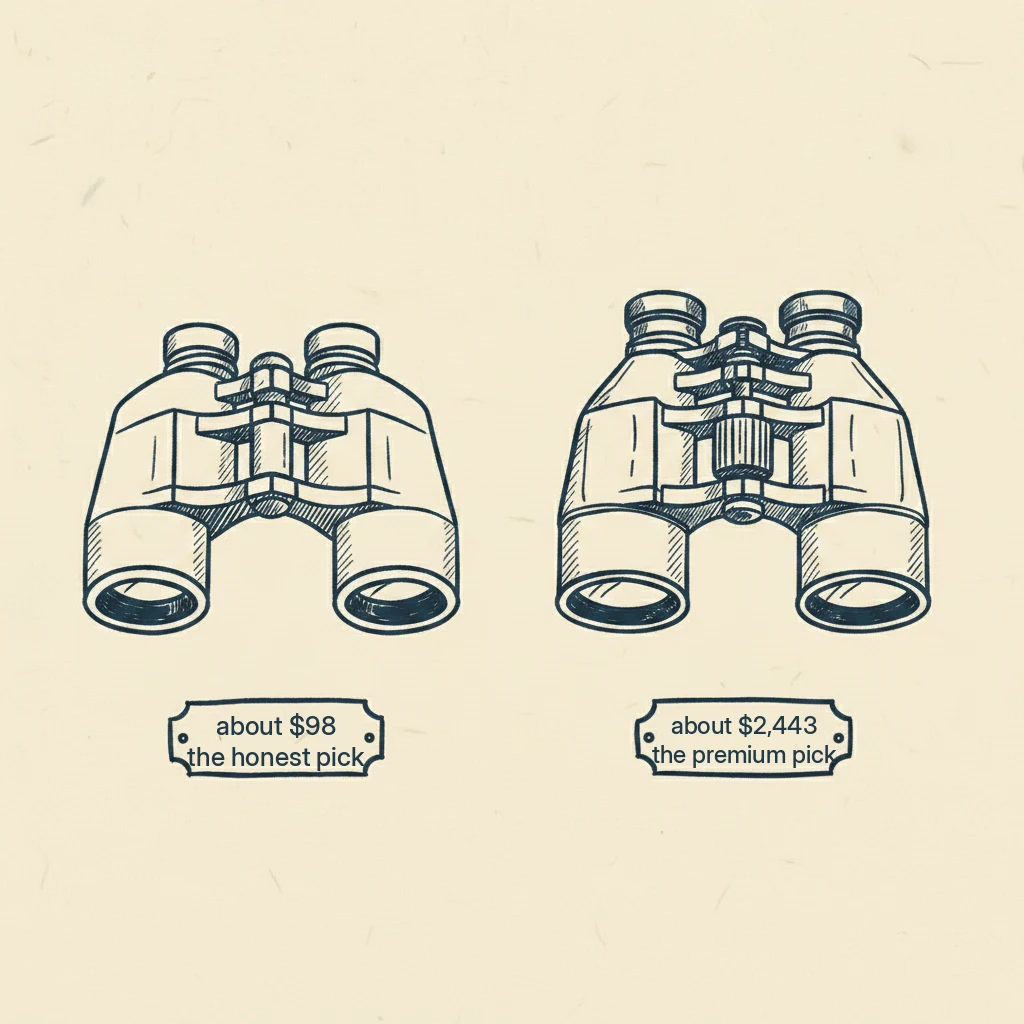
For the money, almost everyone should land between about $40 and $200. Below roughly $40 the glass gets so poor that a good expert calls it nearly unusable. Up around $200, you’re surprisingly close to binoculars that cost ten times more, because the gap between cheap and premium has never been smaller than it’s now. A solid 8x42 or 10x42 around $100 to $150, like the Vortex Triumph HD at about $98 as I write this, is the honest sweet spot. The one time it truly pays to spend more comes later, and I’ll show you exactly where.
What's on this page
- "For the money" is the most honest question you can ask
- Here's what's actually happening: the curve
- The one place expensive glass earns its money
- The floor, honestly
- What the four spec words actually mean
- Why 42mm keeps being the answer
- The same binoculars, three prices
- What you're not missing up top
- Questions people actually ask
- What I'd do with my own money
”For the money” is the most honest question you can ask
Notice you didn’t type “the best binoculars.” You typed “for the money.” That’s a different, smarter question. You’ve already accepted you’re not buying the very best, and what you actually want to know is where your money stops working. Where the curve bends.
That’s a question the whole shelf is built not to answer, because a truthful answer caps what they earn. So let me draw you the curve, because once you can see it, you’ll never overpay and you’ll never buy junk again.
Here’s what’s actually happening: the curve
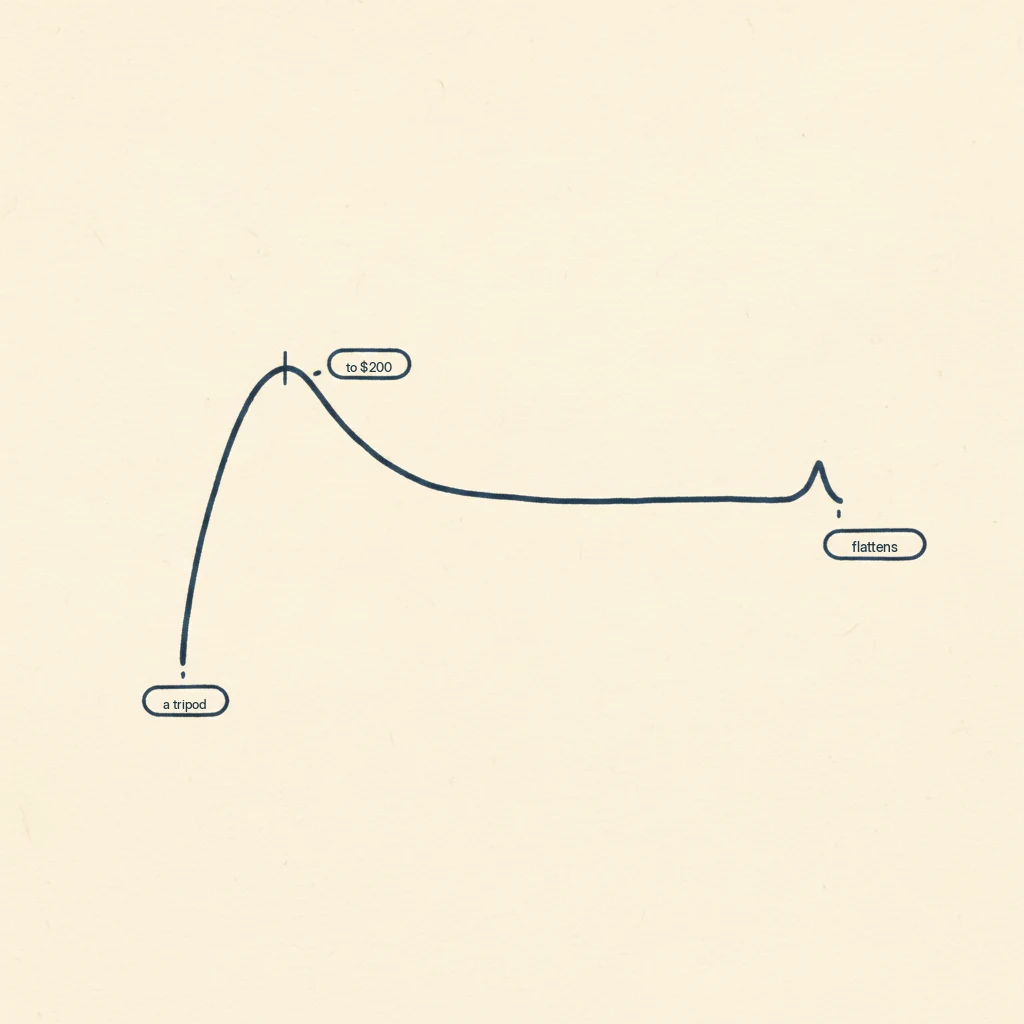
Picture a graph. Money along the bottom, how-good-it-looks up the side. It climbs steeply from about $40 up to around $200. Then it mostly flattens out. Spend $400, $800, $1,200, and yes, it keeps getting a little better, but the line is nearly flat now, and most of that improvement is past what your eye can even catch.
Then, way out on the right, the line ticks up again, but only under one specific condition, and I’ll get to it.
I’m not asking you to take my word for the flat part. The people who test a lot of glass say the difference in image quality between a binocular at this price and the very best made is far less than it has ever been. And the owners who’ve handled both go blunter still: most premium glass right now is a lesson in diminishing returns, most of it past what the human eye can even catch.
I want to be careful about who’s saying what, because it matters. The careful reviewers say the narrower thing: the gap is smaller than ever. The blunter diminishing-returns version comes from owners who’ve bought both, not the reviewers. Both are saying the curve goes flat up top. They’re two different voices, and I won’t pretend they’re one.
The one place expensive glass earns its money
Here’s the exception, and it’s precise. The owners put it exactly right: put the binoculars on a tripod and go looking for hard-to-spot animals that blend into the country, and that’s where the incremental clarity and color start favoring better glass.
Read the mechanic, because it’s the same physics that runs this whole site, just arriving backward. When you’re holding binoculars in your hands, the thing limiting what you see is you, your heartbeat, your small tremor. Good glass can’t fix your hands. But the moment you lock the binocular onto a tripod and push the magnification up, the shake is gone, and now the limiting factor stops being you and becomes the glass itself. That’s when the extra money finally shows up in the view.
So the honest rule the whole page comes down to is this: for a binocular you carry around in your hands, the money stops working somewhere around $200. If you’re going to mount it on a tripod and stare at high magnification, that’s when better glass starts to earn its keep. If that’s you, the long-distance binoculars page explains the tripod math, and a spotting scope may be the smarter buy than any binocular.
The floor, honestly
There’s a bottom to this. The reviewers who test a lot of it say the very cheapest binoculars, the ones under about $40, are often built so poorly they’re almost unusable. I think that floor is real.
But I owe you the other half, because it’s true too. The single best-selling compact binocular on Amazon is a $36 pair, and it has something like thirty-three thousand ratings averaging four-plus stars. Thirty-three thousand people. So which is it, junk or a bargain?
Both, sort of, and here’s the fair read. The expert is judging that glass against the best in the world. The thirty-three thousand buyers are judging a $36 object against their own expectations, and against having nothing at all, and for a lot of them it delivered. Neither is lying.
But if you want my real reason to skip that particular best-seller, it isn’t the price. It’s that it’s a 12x25. That means a tiny 2.1mm circle of light, dim and hard to use, at a magnification too high to hold steady by hand. The problem isn’t that it’s cheap. The problem is the numbers on it are the wrong numbers. That’s a sharper and fairer criticism than sneering at anyone who bought one and enjoyed it, and if a $36 pair got a kid outside looking at the Moon, it did its job.
What the four spec words actually mean
At this budget, four things are worth having, and I’ll translate them, because you shouldn’t have to learn optics to buy a binocular.
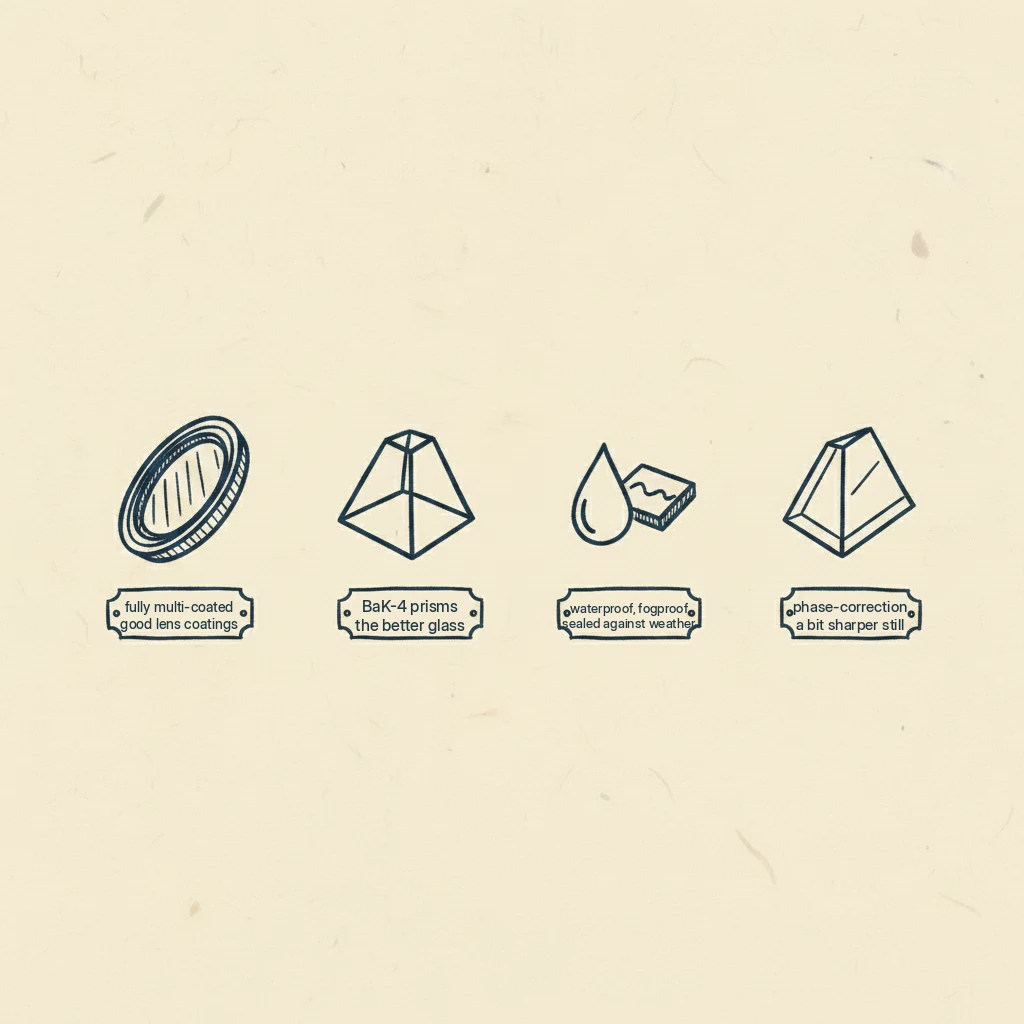
- Fully multi-coated. It means the maker put good coatings on the lens surfaces instead of skipping them to shave cost. You want “fully.”
- BaK-4 prisms. The better grade of prism glass. The spec sheets call the cheaper alternative, BK-7, the inferior one. You just want to see “BaK-4” on the box.
- Waterproof and fogproof. Sealed against rain and against fogging up inside when the temperature swings. Worth it.
- Phase-correction coatings. A coating the better pairs add. If it’s listed, that’s a plus.
Here’s the plain part: you don’t need to understand the physics of any of those, and I’m not going to invent an explanation I can’t back up. You need to see the words listed on the box. A $150 pair that names all four is doing the things that matter. And it’s not just marketing language, either. A real amateur astronomer records his own binoculars, in his observing notes, as “BaK-4 fully multi coated” glass. When the person keeping a notebook writes down the prism type, it’s a thing that matters.
Why 42mm keeps being the answer
If you’ve read the situation pages on this site, you’ve noticed almost everything lands on 8x42 or 10x42, and now there’s a clean reason why. Most binoculars fall between 32 and 50 millimeters, and a 42mm objective sits squarely in the middle, striking a well-rounded balance between brightness, size, weight, and price. It’s the size that’s bright enough to matter, small enough to carry, and priced where the curve is still climbing. That’s not a coincidence. It’s the sweet spot the whole market circles back to.
The same binoculars, three prices
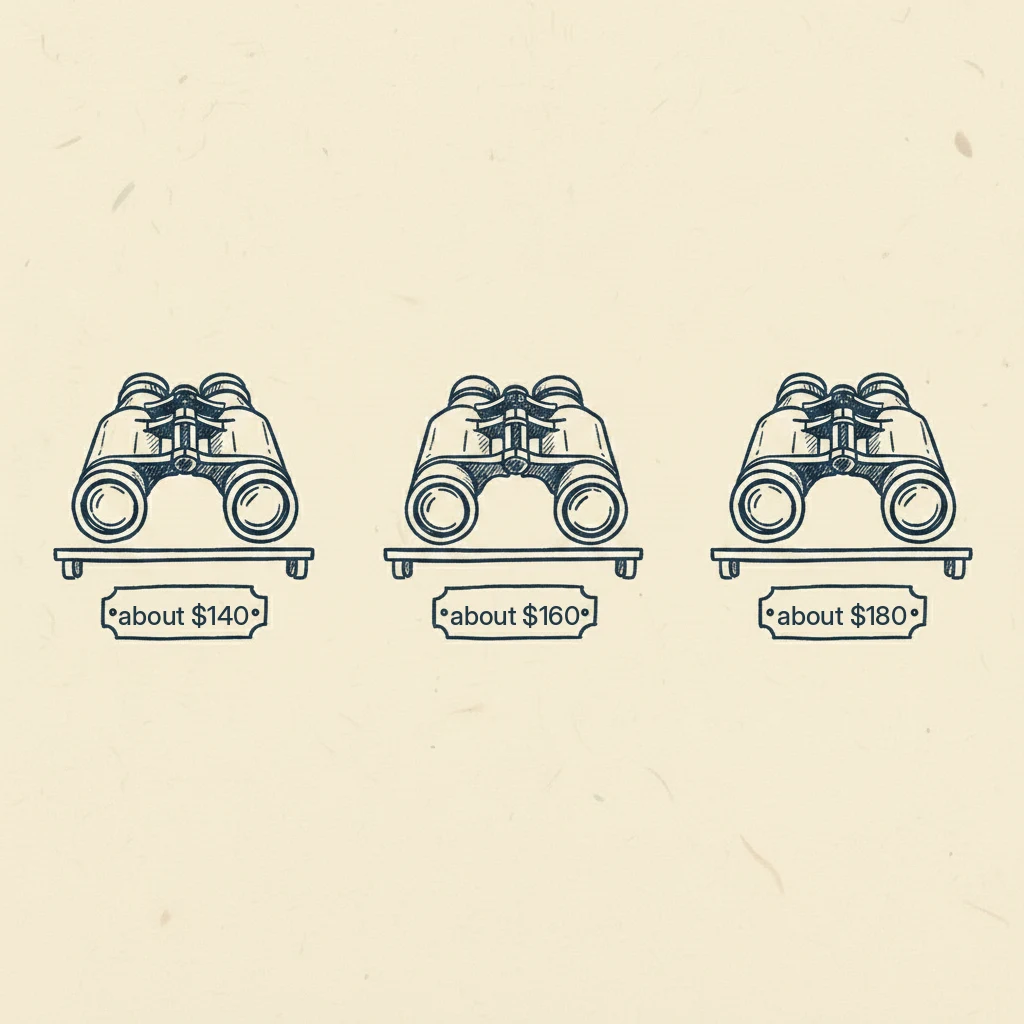
One more money fact, because it’s easy money. While pulling prices together, I found the exact same binocular, a Celestron Nature DX 8x42, listed at about $140 in one place, $160 in another, and $180 at a third, all in the same week. Same pair. Roughly a 29% spread depending on where you click.
So the last piece of advice is the simplest: once you know the model you want, shop it. The price moves, sometimes by the cost of a nice dinner, for the identical thing. And date what you read, because even a trusted guide can end up recommending a pair that’s since been discontinued.
What you’re not missing up top
Just so the flat part of the curve feels real: the premium binoculars the reviews drool over run into the thousands. Two thousand, three thousand, and up, though a lot of those figures are a few years old now. I’m not printing those numbers to make you feel poor. I’m printing them so you can see, clearly, what your $150 pair is not far behind. That’s the whole point of the curve. The distance from you to the top is smaller than the price tags suggest.
Questions people actually ask
Can $200 binoculars actually be any good?
Yes, genuinely, and this is the real surprise of the whole category. Owners who’ve used both keep saying a good $200 pair today is close to premium glass that costs many times more, because the quality gap has shrunk dramatically. At this price you want an 8x42 or 10x42 with fully multi-coated optics and BaK-4 prisms. That combination, around $200, is most of the way to the best there is.
How much should I spend on binoculars?
For a pair you hold in your hands, somewhere between about $100 and $200 is where almost everyone should land. Below roughly $40 the glass gets unreliable; above about $200 the improvements get small and hard for your eye to even see. The exception is if you’ll use a tripod at high magnification, where better glass genuinely pays. Otherwise, more money mostly buys bragging rights.
Are cheap binoculars worth it?
It depends how cheap. Under about $40, quality drops off fast and many are barely usable. In the $80 to $150 range, though, you can get honestly good binoculars that will satisfy most people for years. The trap isn’t buying cheap. It’s buying the wrong specs cheap, like a high-power compact that’s too dim and too shaky to enjoy. Spend a little more than rock-bottom and buy sane numbers.
What specs matter most for the money?
Four things, in plain terms: fully multi-coated lenses, BaK-4 prisms (the better prism glass), waterproof and fogproof sealing, and an 8x or 10x power with a 42mm lens. You don’t need to understand the optics. You need to see those words on the box. A pair around $150 that lists all of them is spending your money on the things that actually change the view.
What I’d do with my own money
If it were my money, and it usually has been the careful kind, I’d buy a good 8x42 for somewhere around $100 to $150, make sure it lists the four spec words, and stop right there. I’d only spend past $200 if I knew I was putting it on a tripod. Everything I know says that’s where the curve goes flat, and I’ve spent a lifetime being the guy who never had the budget to waste, so trust me on this one: the expensive pair isn’t the smart pair, and the too-cheap pair is the one that quietly ends up in a drawer.
And yes, if you buy through my links the site earns a little. It’s never why I pick things, and a whole page telling you to stop spending at $200 is about the clearest proof of that I can give you.
Now go price your actual use, because the situation is where the last of the choice lives. The binoculars-by-situation hub points to all of them, and the common ones each have a page: hunting, a cruise, hiking. Each one tells you the right power and size for that job. This page just made sure you’ll pay the right price for it. And if you wear glasses like I do, check the glasses-wearers’ page, because eye relief is a value question too: the wrong pair wastes the money no matter what it cost.
Ray Ostrander
Ray spent three decades explaining the sky to twelve-year-olds and their parents, and every January, hearing which Christmas telescopes ended up in the closet. He doesn't own a wall of gear and won't pretend to. He reads everything, tells you what owners agree on, and flags what's just his judgment. His goal is simple: no more January closets.