
Binoculars for Long Distance: Why the Big Number Lies
Handheld binoculars top out around 15x to 16x, because above that the glass magnifies your own heartbeat along with the view. Past that you're not buying a binocular, you're buying a tripod. Here's the honest way to see farther, and what the big box numbers hide.
 Ray Ostrander · Updated July 24, 2026 · how I decide
If you buy through a link here, the site earns a little. It's never why anything gets picked.
For long-distance viewing, handheld binoculars top out around 15x to 16x. Above 12x the shake is already constant, because the glass magnifies your own heartbeat and muscle tremor by exactly as much as it magnifies the view. Past that ceiling you’re not really buying a binocular anymore, you’re buying a tripod, and often you’d be happier with a spotting scope. So the honest 10x or 12x pair, steadied, sees more than a shaky 25x ever will.
That’s the whole answer, and I know it’s not the one the shelf is selling you. So let me show you why it’s true, because once you see it, you can’t unsee it, and it’ll save you real money.
What's on this page
- The question underneath the question
- Here's what's actually happening: it magnifies your heartbeat
- The number on the box hides three costs
- "How far can I actually see?"
- So how do you actually see farther?
- The one honest way to buy steadiness
- If you already own the shaky pair
- Where the honest money goes
- Questions people actually ask
- What I'd tell you if you came to me wanting to see farther
The question underneath the question
Almost everyone who lands here believes the same thing: more magnification equals more distance. You typed “high power,” or “long distance viewing,” and some of you typed the phrase that gives the whole game away: “best compact binoculars for long distance viewing.”
I want to be gentle about this, because it’s not your fault. That phrase asks for a thing that can’t exist. Long distance wants a big lens to stay bright at high power. Compact means a small lens. You’re asking for a small lens and high power at the same time, and the physics won’t let those two ride together. The reason the search engine and the shelf keep feeding you that fantasy is that the fantasy sells. The truth doesn’t have a Buy button.
Here’s what’s actually happening: it magnifies your heartbeat
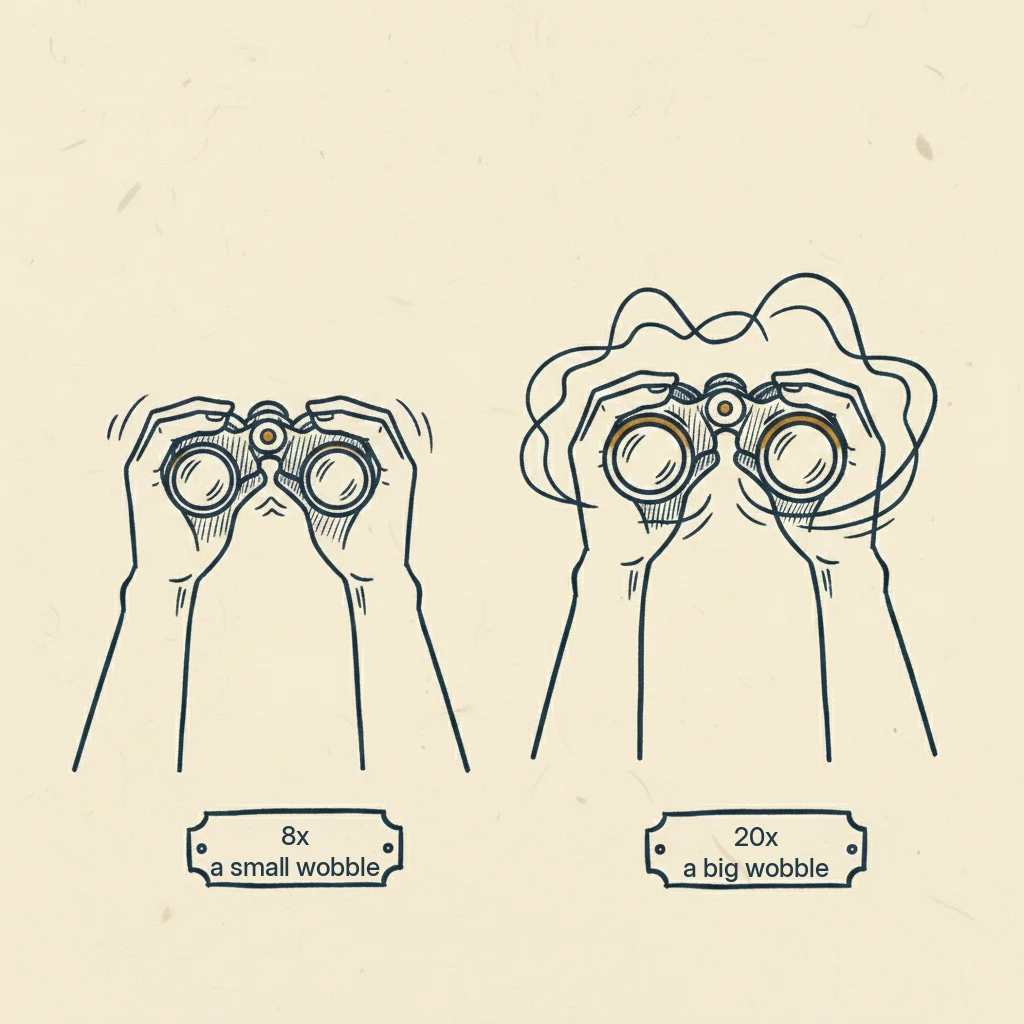
Pick up any binocular and hold it as still as you can. It’s still moving. That tiny tremble isn’t a weak grip and it isn’t your fault. It’s the normal involuntary tremor every human hand has, plus your pulse. You can’t feel it at arm’s length. But a binocular magnifies it.
Here’s the part that matters. When a binocular magnifies the deer by 10x, it magnifies that tremor by 10x too. Same amount. Go to 20x and the deer is twice as big, and so is the shake, to the point where the image visibly bounces with every heartbeat. At 20x to 25x, most people can’t hold a steady enough view to study fine detail for more than a second or two before their eyes give up.
That’s why the handheld ceiling is real. The makers cap general handheld use around 12x and steer anything higher onto a tripod. By 15x to 16x you’re at the outer edge of what steady hands can do, and above that you need to put the binocular on something.
The number on the box hides three costs
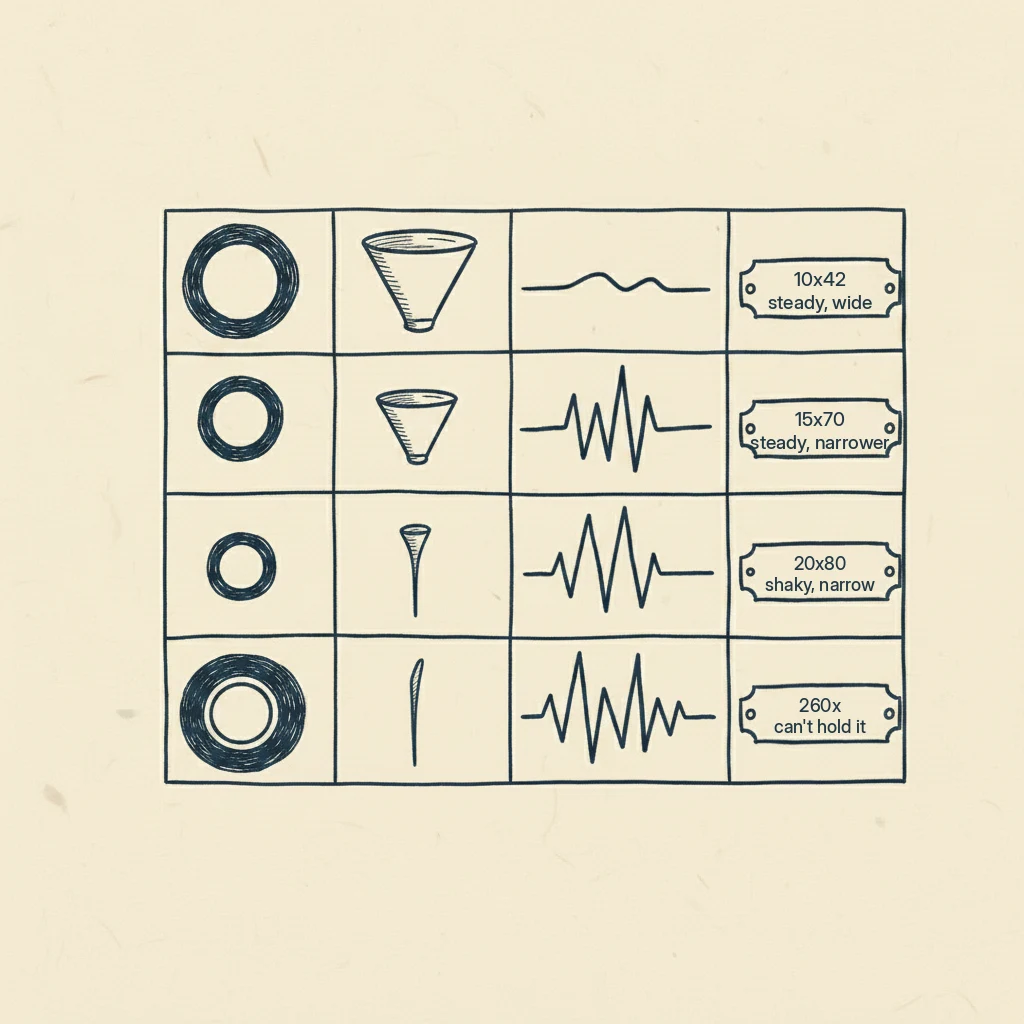
Turn the magnification up and three things get worse at once. The shelf mentions none of them.
The view gets darker. Take the lens width and divide by the power, and you get the exit pupil, which is just the width of the circle of light the binocular hands your eye. Bigger circle, brighter view. Watch what climbing power does to it:
| what the box says | circle of light | what it means |
|---|---|---|
| 7x50 (a marine pair) | 7.1mm | the brightest there is |
| 8x42 | 5.25mm | holds the last light of dusk |
| 10x42 | 4.2mm | the everyday standard |
| 8x25 (a pocket pair) | 3.1mm | fine by day, thin at dawn |
| 20x40 (a “high power” buy) | 2mm | dark rings form around the edge |
Look at the bottom row. Take a 20x40. Divide 40 by 20 and you get a 2mm circle, so small that dark rings creep in around the edge of the view and it gets genuinely harder to see. You bought “more power” and got a dimmer picture. Now imagine the arithmetic on a listing that promises 260 power. There’s no lens on that thing big enough to keep the circle from shrinking to a pinhole.
The view gets narrower. More power means you’re looking through a tighter straw. A 15x56 pair shows about 241 feet of the world at a thousand yards. Bump to 25x and you’re down to around 141 feet. You gave up roughly 40% of your view to gain that magnification, and a narrower view also makes the far-off thing harder to find in the first place. The shake and the straw pile on top of each other.
And you still can’t hold it. Which brings us back to your heartbeat.
”How far can I actually see?”
This is the real question, and the honest answer is that it was never a magnification question. How far you can see depends on four things: the air, the light, the size of the thing you’re looking at, and how steady you are. Only one of those four is printed on the box.
On a hot day over open ground, the air itself shimmers with heat haze, and more magnification just hands you a bigger picture of the shimmer. Nobody selling a giant number will mention that the atmosphere gets a vote. But it does, and on a lot of days it’s the vote that counts.
So how do you actually see farther?
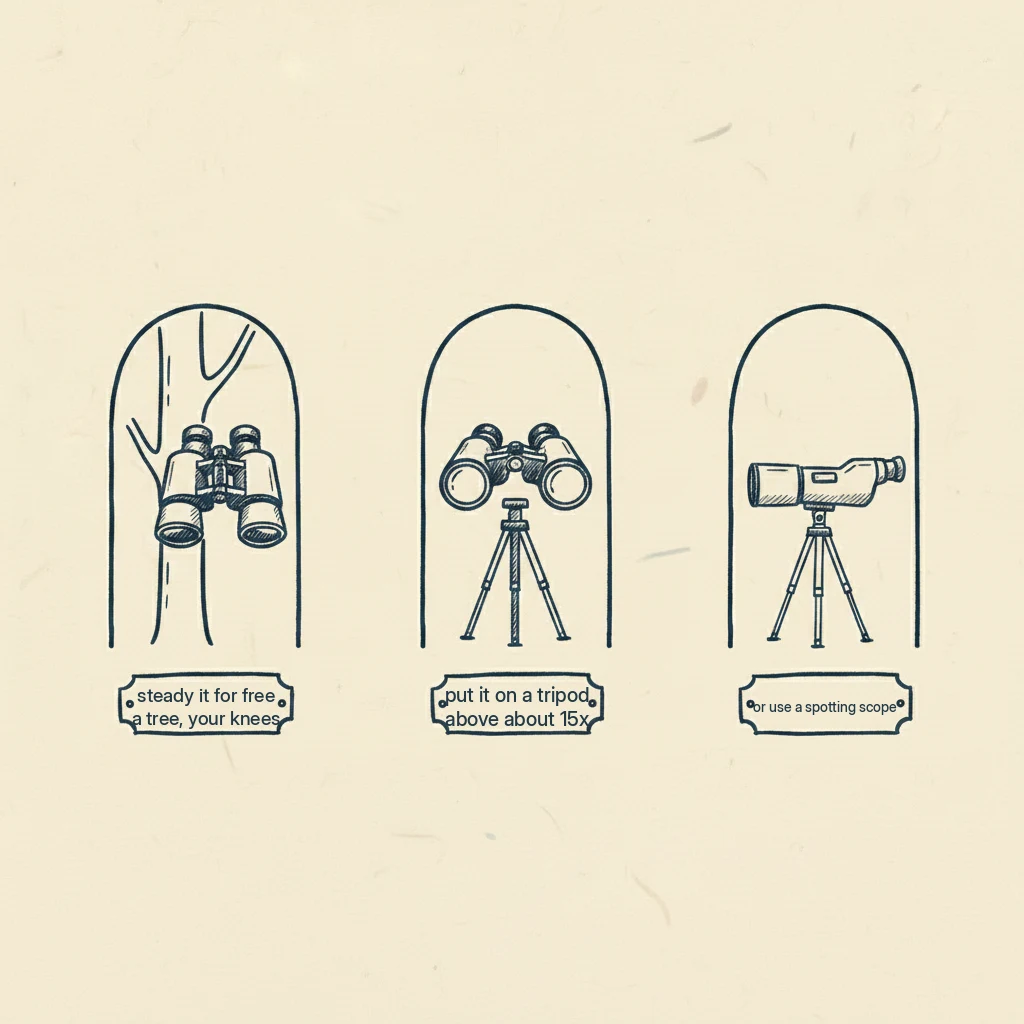
Here’s the fork, and I’ve put the free option first on purpose.
Steady it, for nothing. Most of the “my binoculars shake” problem goes away the second you stop holding them in midair. Lean against a tree, a fence, a car. Better yet, sit down, plant your elbows on your knees, and glass slowly. The hunters put it perfectly: you’ll blame the binoculars, but it’s your technique. This costs zero dollars and it’s the single biggest upgrade on this page.
Put it on a tripod. Above about 15x, this stops being optional. The good news is it’s not expensive: a sturdy tripod runs about $140 as I write this, plus a little binocular adapter for about $20, so call it $160 to turn a jittery 20x into a rock-steady one. That $160 does more for the view than spending another few hundred on “more power” ever could.
Or buy the right tool instead. If you genuinely need high magnification on a tripod for far-off work, the instrument built for exactly that isn’t a binocular at all. It’s a spotting scope, and there’s a whole page on getting a good one without overpaying.
The one honest way to buy steadiness
There’s exactly one way to buy your way out of the shake without a tripod, and it’s honest about what it does. Image-stabilized binoculars use an electronic system to cancel the tremor, and a common one runs about $729. My judgment: it works, and it’s worth knowing it exists. Just be clear on what your money bought. It bought back the steadiness, not the distance. The atmosphere and the exit pupil still get their vote.
If you already own the shaky pair
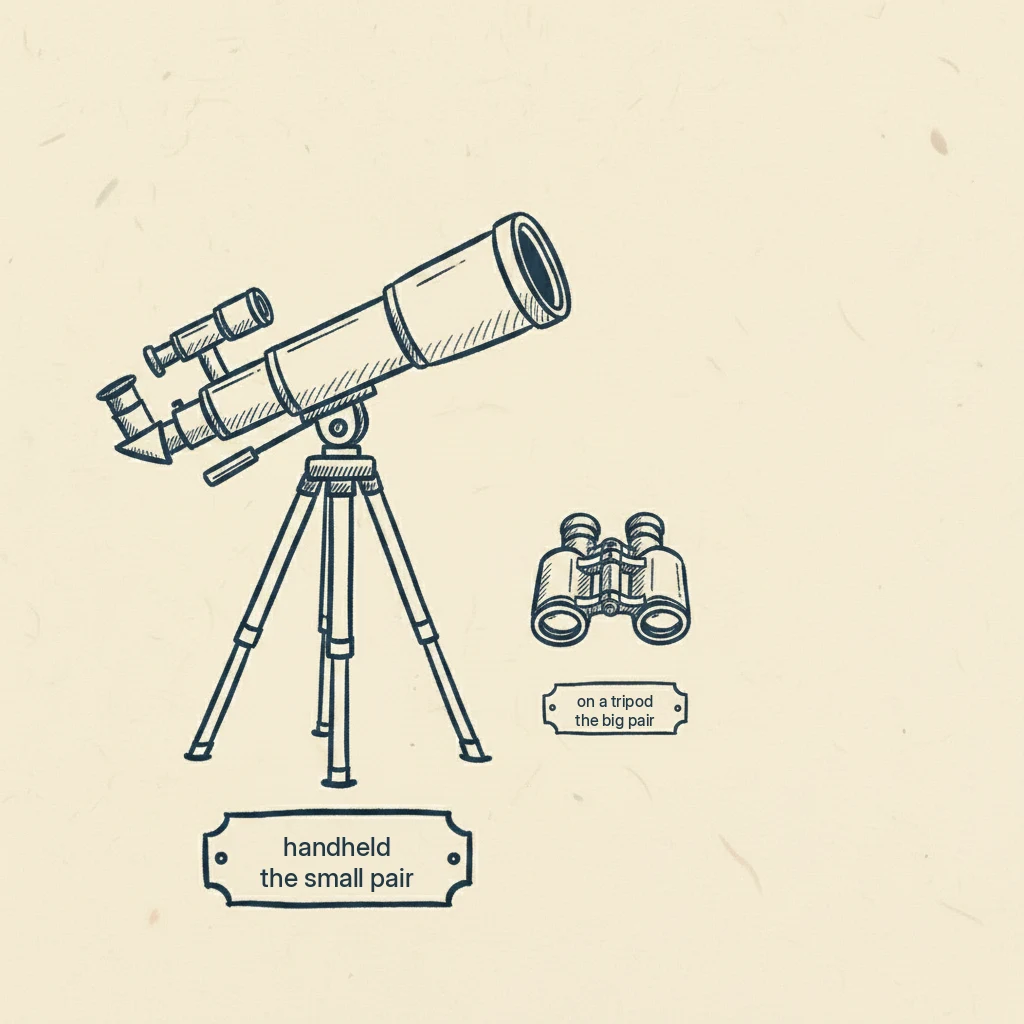
A lot of you found this page because you already bought the 20x, and now it won’t hold still, and you’re wondering what you did wrong. Nothing. You did nothing wrong. The glass is doing exactly what glass does, and the fix is a $20 adapter and something to rest it on, not a different, bigger binocular. Don’t let anyone, including a shelf, make you feel like you have to buy your way up out of this. You have to steady your way down into it.
Where the honest money goes
If you want the best long look your budget allows, stop paying for magnification and start paying for glass. Stay at 10x or 12x, put the money into optical quality, and steady it. A well-made 10x42 that costs a couple hundred dollars, held against a tree, will out-see a wobbly high-power giant every single time.
For reference, here’s the honest end of the ladder: a 10x42 with good glass runs somewhere from about $200 for a Celestron Nature DX ED up to about $297 for a Nikon Monarch M5. And if you truly want a big astronomy-style pair for wide low-power sweeping, a 15x70 at about $130 is the last step you can still just barely hold by hand. Everything above it, the 20x80 at about $210, the 25x100 at about $520, is a tripod instrument whether or not the price tag admits it.
Questions people actually ask
What magnification is best for long-distance viewing?
For handheld use, stay at 10x to 12x, and treat 15x to 16x as the hard ceiling. Above that your own heartbeat and hand tremor get magnified along with the image, so it never sits still. If you want more reach, you don’t buy a bigger number, you buy a tripod. A steady 12x beats a shaky 25x on any real target.
How far can you see with high-power binoculars?
Farther than with low power, but not as far as the box implies, because distance isn’t set by magnification alone. The air, the light, and the size of what you’re looking at all matter, and heat haze can turn extreme magnification into a bigger view of the shimmer. There’s no magnification number that lets you “see for miles” in clear detail. Steadiness and glass quality matter more.
Are compact binoculars good for long distance?
No, and the two ideas actually fight each other. Long distance wants a large objective lens to stay bright at high power, and compact means a small lens by definition. Put high power behind a small lens and you get a dark, shaking, narrow view: the worst of every trade. If reach is the goal, you want a full-size pair on a tripod, not a compact.
Why do my high-power binoculars shake so much?
Because they’re working correctly. Every hand has a small involuntary tremor, and the binocular magnifies it by the same factor it magnifies everything else, so at 20x the shake is 20 times more visible. It isn’t a weak grip and it isn’t a defect. The cure is support: lean on something, sit and brace your elbows on your knees, or mount it on a tripod.
What I’d tell you if you came to me wanting to see farther
Keep your money. Buy a 10x or 12x with the best glass you can afford, put a $160 tripod under it if you want real reach, and never pay for a magnification number you can’t physically hold. The steadiest view wins, every time, and steady is cheap.
If you want to keep reading: best spotting scope for the money is where this page points if you genuinely need high magnification on a tripod, because that’s the tool built for it. best binoculars for stargazing runs on this exact physics aimed upward, tripod and all. best binoculars for the money is where the “spend it on glass, not power” idea gets the full value treatment. There’s the binoculars-by-situation hub for every other use, and binoculars for hunting has the best free steadiness trick I know for glassing far country.
Ray Ostrander
Ray spent three decades explaining the sky to twelve-year-olds and their parents, and every January, hearing which Christmas telescopes ended up in the closet. He doesn't own a wall of gear and won't pretend to. He reads everything, tells you what owners agree on, and flags what's just his judgment. His goal is simple: no more January closets.