
Telescope for Beginners: The One Number, and the One Lie
Buy for one number: aperture, the width of the end that gathers light. Put it on a mount steady enough to aim. Below about $100, buy binoculars instead.
 Ray Ostrander · Updated July 24, 2026 · how I decide
If you buy through a link here, the site earns a little. It's never why anything gets picked.
If you have never bought one and the guides are making you feel behind, look at exactly one number first: aperture, which is just the width of the end that gathers light. A wider opening gathers more, and it beats any “600x” printed on the box. Then check the mount is steady enough to aim. Below about $100, buy binoculars instead.
That’s the whole thing. Everything below is just me showing my work, because you shouldn’t have to take a stranger’s word for it.
I taught middle-school earth science for thirty-one years, and every December a parent would corner me in the hallway with the same question you have right now. So I read everything. The catalogs, the reviews, the return policies, the forums. When owners agree, I’ll tell you. When they argue, I’ll tell you that too. And when it’s just my judgment, I’ll say so.
What's on this page
- You aren't behind, the guides are just written in a language nobody taught you
- The one number, and the one lie
- The part that actually decides everything is the legs
- What you'll actually see, said before you spend a dime
- The experts' one right answer, and why it might be wrong for you
- A plain ladder, in trash-can sizes not spec sheets
- Why owners still argue, and why that's good news
- The three tells you can actually see on a box
- Questions people actually ask
- What I'd tell a parent in the hallway
You aren’t behind, the guides are just written in a language nobody taught you
There’s a dad on the telescope forums, picking a first scope for his boys, who said the thing out loud: “it’s honestly a little confusing to someone that doesn’t understand the metrics. It’s tough for someone that isn’t in the lingo.” He was already inside the hobby’s best free resource. He still felt locked out.
Here’s what I want you to know before we go one word further. You didn’t ask wrong. The problem is that most beginner guides answer in the exact vocabulary you just told them you don’t have. Focal ratio. Two-inch focuser. Computerized alignment. None of that decides whether your kid sees Saturn on a Tuesday.
The one number, and the one lie
Aperture is the width of the light-gathering opening. That’s the number that matters, and it’s usually the one printed smallest. More aperture means a brighter, sharper image of the same object. That’s it.
Magnification is the number printed biggest, and here’s what’s actually happening when a box shouts “600x.” Physics says the highest useful magnification is roughly fifty times the aperture in inches. A cheap 60mm scope tops out around 120x to 140x before the image just gets dim and mushy. So “600x” on a 60mm tube isn’t a feature. Insiders call it “blowing smoke,” and they’re being polite. The box gets there with a trick: a tiny eyepiece plus a little lens called a Barlow, multiplying a number that was never real light to begin with.
Owners agree on this one without much argument. Push magnification too high and the image only gets dimmer, because you’re spreading the same gathered light across a bigger, blurrier picture. The wide opening is the honest number. The big magnification is the marketing.
The part that actually decides everything is the legs
Ask the people who fix broken Christmas mornings what kills a telescope, and they don’t say the optics. They say the mount.
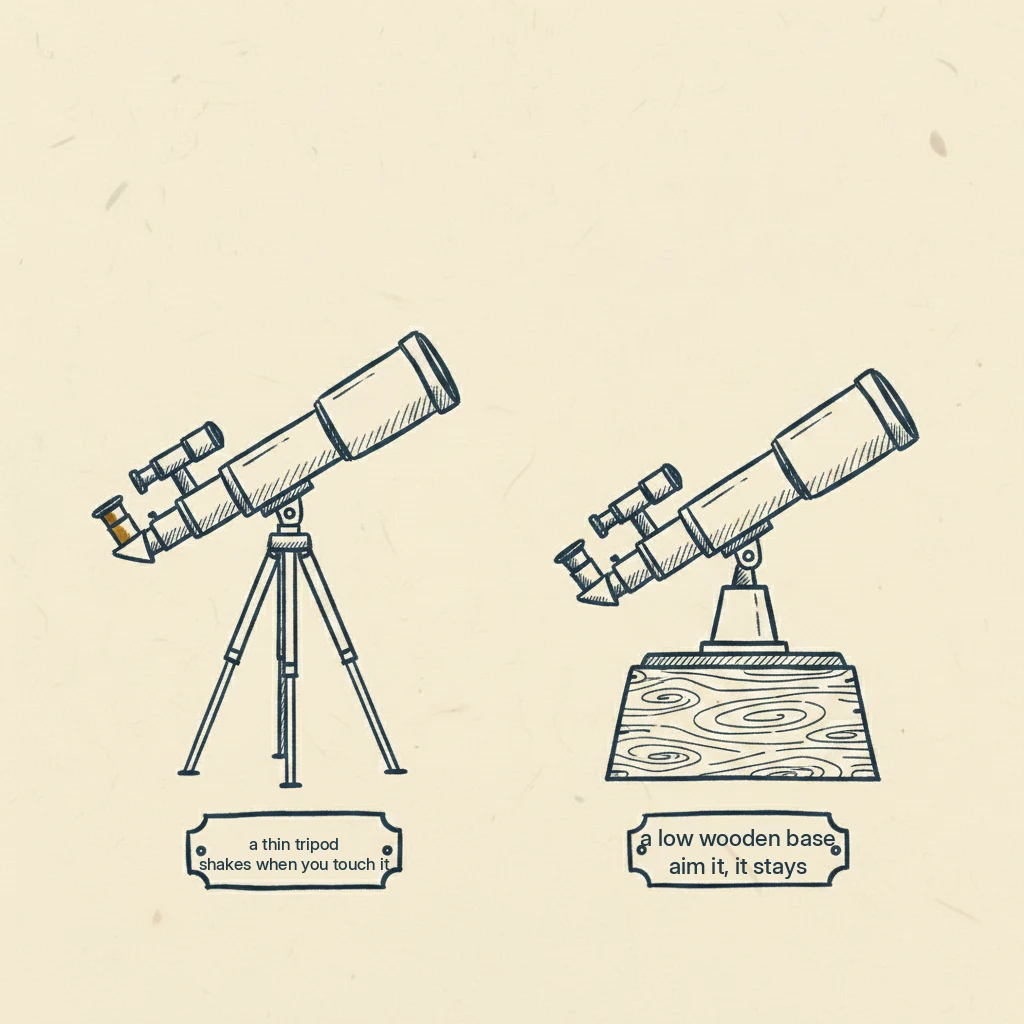
A Sky and Telescope writer who runs a January workshop for exactly this, helping people whose holiday scopes are already gathering dust, lists three things that matter and calls the mount “the real killer.” Owners on the forums say the same in plainer words: “it’s usually the tripod/mount that is the killer, not the OTA.” Another expert page puts it flat: if the telescope wobbles when you touch it, “it will be impossible to aim, focus, or keep an object in view.”
That’s the January closet in one sentence. A kid finds Jupiter, bumps the tube, and it takes ten seconds of shivering before the planet swims back into view. Do that four times and an eight-year-old is done. The tripod is the product. A steady mount on modest optics beats a wobbly mount on good ones every single time.
What you’ll actually see, said before you spend a dime
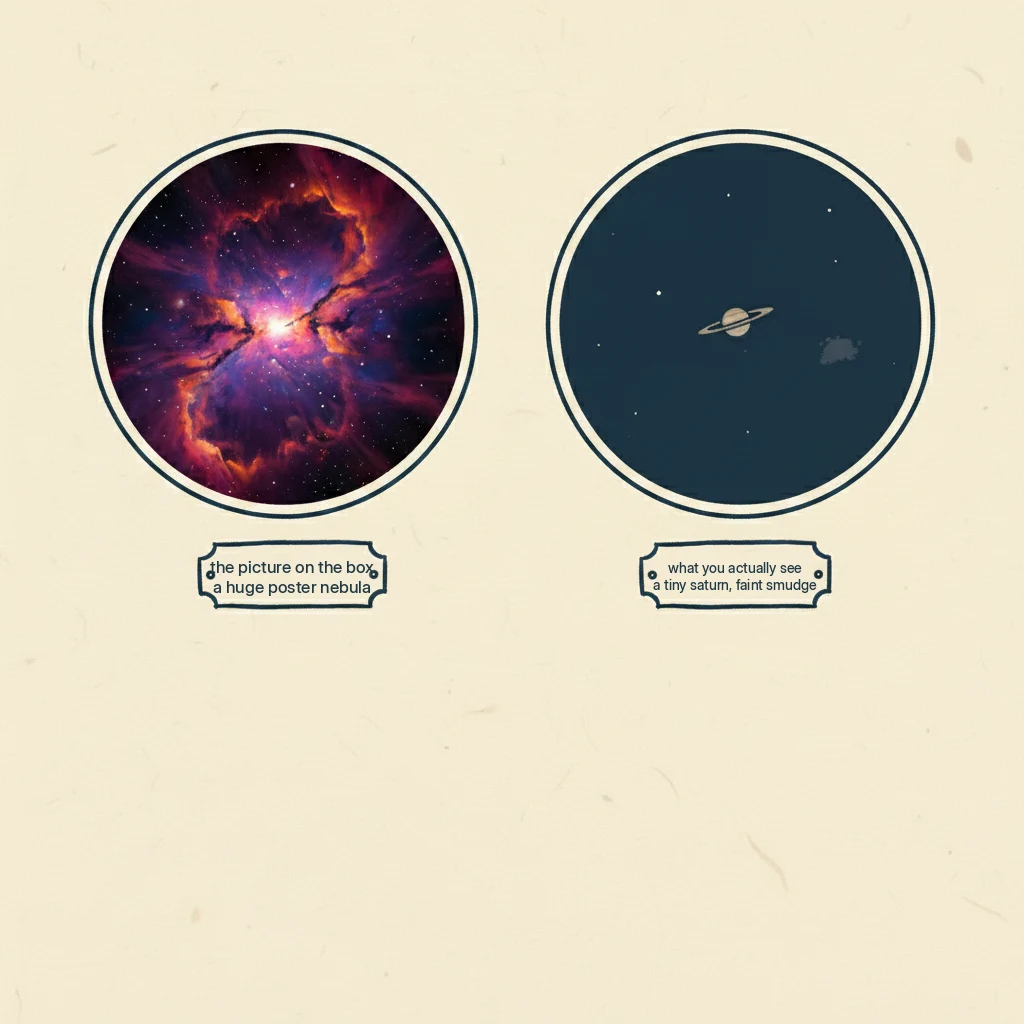
This is the promise the box breaks and the guides skip. Your eyes aren’t cameras. Those glowing purple galaxy photos are stacked long exposures run through software. To your eye, at any price, stars stay pinpoints of light and the faint deep-sky stuff shows up as small white smudges. The honest version, which the deep-space page spells out, is this: to your eye the faint stuff comes through much dimmer and without color, nothing like the photographs.
I’m telling you this so you buy the right thing, not to talk you down. Because the moon and the planets are a different story. The moon through even a modest scope is craters and shadows and a bright torn edge, close enough to feel like cheating. Saturn is a tiny hard oval with rings you can actually see are separate from the ball. Small and alive beats the poster. Every time.
And you don’t need dark country skies for that part. The moon and planets are bright enough to come through fine even under city light, even the far ones. Light pollution steals the faint galaxies, not the bright targets you actually start with.
The experts’ one right answer, and why it might be wrong for you
If you keep reading buyer guides you’ll hit one recommendation over and over: for traditional eyepiece observing, an 8-inch Dobsonian, because that shape gives you the most light-gathering opening for the money. A common top pick, the Apertura AD8, runs about $700 as I write this, and that same 8-inch class is the starter the experienced hands most often name.
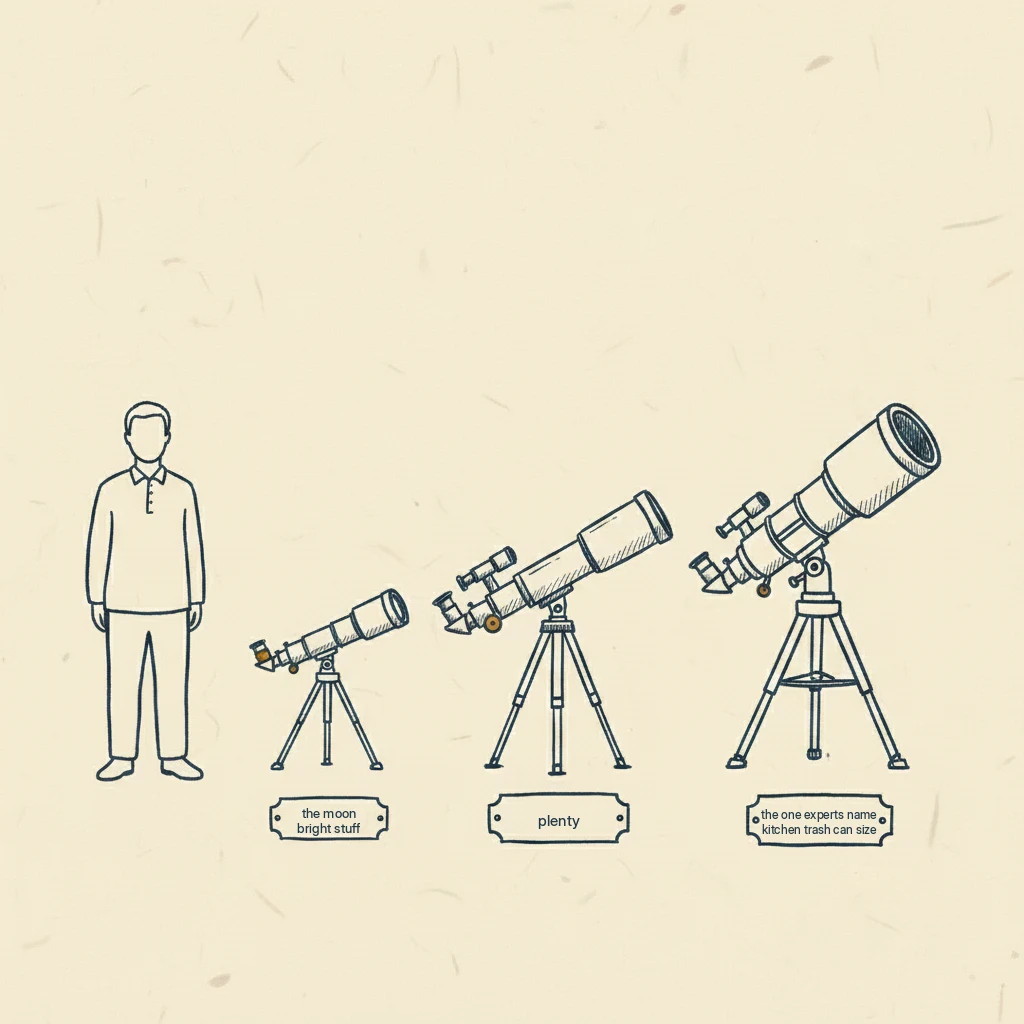
They’re not wrong. An 8-inch Dobsonian is the hobby’s one genuinely right answer. It’s also a $700 object the size of a kitchen trash can that weighs about forty pounds. My judgment: that’s a wonderful telescope and a poor first Christmas gift for a curious nine-year-old. Ledger fact, and I won’t pretend otherwise. If you’re an adult buying for yourself and you know you’re in, buy the big one and never think about it again. If you’re a parent buying for a spark that showed up last week, that’s a different answer.
So route by your actual situation, not by the number a stranger is proudest of.
A plain ladder, in trash-can sizes not spec sheets
| what you’re after | the pick I’d make | rough price | what it really is |
|---|---|---|---|
| a spark that appeared this week, cheap enough to lose | a pair of 7x50 binoculars | about fifty dollars | the moon, star fields, and no setup to kill the mood |
| a kid’s first real scope that won’t wobble | a small tabletop Dobsonian, 76mm to 130mm | about $75 to $150 | moon and the bright planets, aim-and-look, survives a nine-year-old |
| a starter you won’t outgrow in a year | a 6-inch tabletop or floor Dobsonian | around $350 | everything above, plus fainter targets on a dark night |
| the experts’ one right answer, if you’re sure you’re in | an 8-inch Dobsonian | about $700 | the big honest opening, forty pounds, trash-can sized |
Notice the first row. The cheapest honest answer on this whole page isn’t a telescope.
Why owners still argue, and why that’s good news
Here’s the honest part the ranked lists hide. The people who know the most don’t agree with each other, and watching them argue is how you learn.
One expert says an equatorial mount, the kind that tilts on an angle to follow the sky, is a poor choice for a beginner and a simple Dobsonian base is the fix. Experienced owners push right back. Several of them taught a new owner to use that same “bad” mount and the buyer ended up “happy as a clam.” One says his first scope was a much-maligned AstroMaster he still owns, and the neighborhood kids love it on the moon. Another says flatly there is “no such thing as a hobby-killer telescope,” that the frustration is usually inexperience, not the gear.
Even the cheap scopes the community loves to trash tell this two-sided story. The forums name the AstroMaster, PowerSeeker, and Travelscope lines as the ones to avoid, and the honest counterpoint is that the lower-end stuff is what keeps the makers’ lights on. Then the actual owners show up: a PowerSeeker owner will grant the mount is a bit wobbly but says the moon and planets do quite well, and a kid who got an AstroMaster reports great views of Jupiter.
My judgment, and I’ll own it: the gatekeeping lives in the guides, and the un-gatekeeping lives in the comments underneath them. The person who wrote the “hobby killers” warning started with a hobby killer. The reply that helped me most on any thread came from a guy who bought the cheap three-inch scope, let his kid dismantle it, and became a physics professor. The people at the top of this hobby keep telling beginners to relax. I think you should listen to them.
The three tells you can actually see on a box
You won’t spot every insider trap, and you don’t need to. Watch for three things a beginner can genuinely check.
The magnification lie: any small scope screaming “450x” or “600x” is selling you a number that’s not real light. Walk on.
The wobble: if a store model shakes for several seconds after a tap, or the tripod legs are thin bent metal, that’s the killer the owners warned you about.
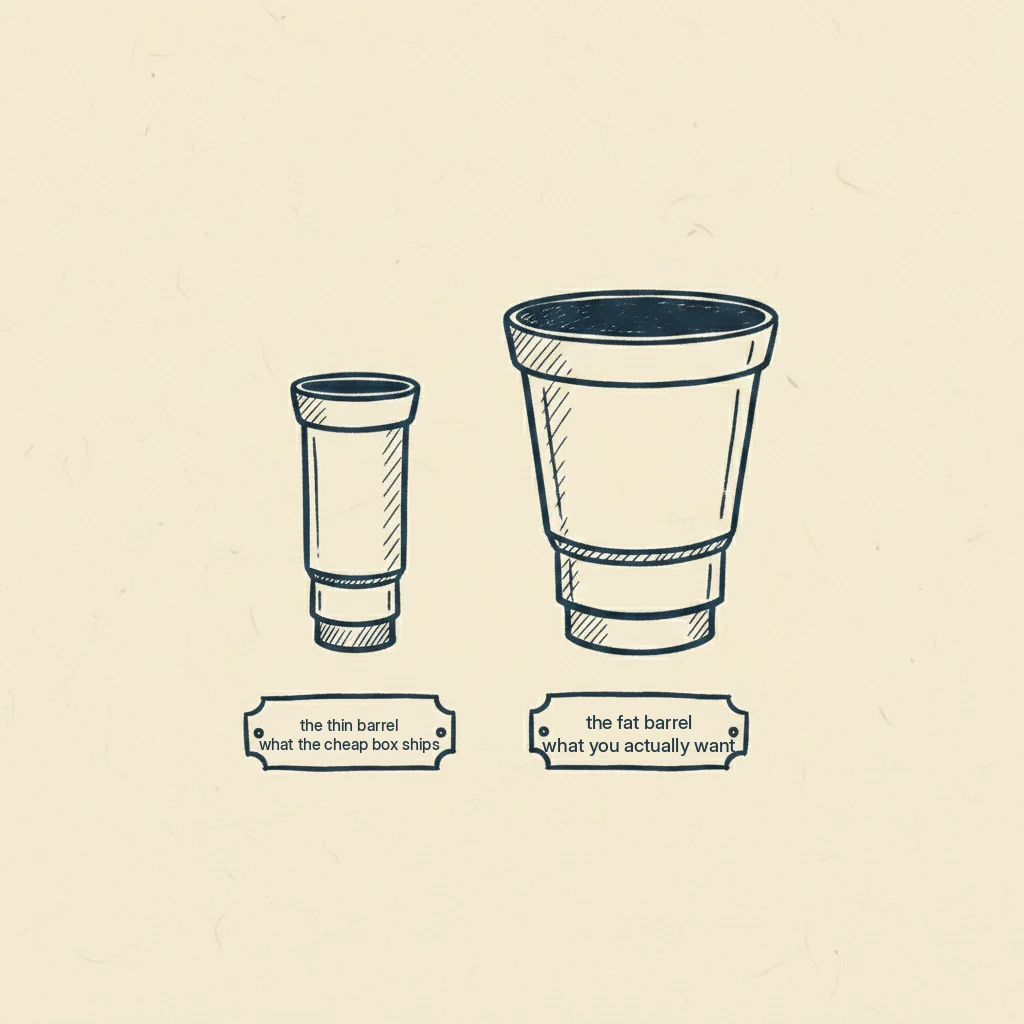
The eyepiece barrel: cheap scopes ship a pencil-thin eyepiece, under one inch across, often an old design called a Huygens. You want the fatter 1.25-inch barrel. It’s a small visible tell that a lot of thought did or didn’t go into the box.
Questions people actually ask
Why can’t I see anything through my telescope?
Usually it isn’t broken. Three things: you’re at too high a magnification, so the image is dim and swimming; the mount is wobbling faster than you can aim; or you’re expecting the box photo instead of a small bright real thing. Drop to the lowest magnification eyepiece, find the moon first, and let it settle.
Is a cheap telescope a waste of money?
Not if you buy the right cheap thing. A wobbly 600x department-store scope is a waste. A steady $75 tabletop Dobsonian or a pair of 7x50 binoculars is not. Owners who started on humble gear stayed in the hobby for decades. The trap is the flimsy mount and the fake magnification, not the low price.
Should I buy binoculars instead of a telescope?
Often, yes, and the experts say so too. A pair of 7x50 binoculars costs about what two large pizzas do, needs zero setup, shows you the moon and rich star fields, and still earns its keep at a ballgame. For most families that’s the right first buy. My whole ledger says binoculars before a telescope, and this is why.
What size telescope should a beginner get?
Enough opening to be bright, small enough to actually carry outside. Below about three inches you’re limited to the moon and the brightest things. Four to five inches is, in one veteran’s word, “plenty.” Eight inches is the experts’ dream answer and a lot of telescope to lift. The best size is the one that gets carried out the door, not the one with the best numbers.
Do I need a dark sky or an expensive location?
No, not to start. The moon and the planets shrug at city lights: from a bright backyard you still see Jupiter’s moons and Saturn’s rings just fine. The faint galaxies are what need a drive out to the dark, and those come later, if ever. Don’t let a bright backyard talk you out of the whole thing.
What I’d tell a parent in the hallway
Here’s what I’d say if you stopped me in December, the same as I said it for thirty-one years. Buy the biggest steady opening you can afford, put it on a base that doesn’t wobble, and if the budget is tight, buy the 7x50 binoculars this week instead of a telescope next month. Then go find the moon on the first clear night, together, before you read one more guide.
Because when your kid finally holds Saturn still in the eyepiece, that faint light landed in their eye after leaving the planet more than an hour before. It’s real, it traveled the whole way, and it’s small and alive, exactly like I promised. That’s the thing the closet never gets to steal.
If you just want the shortlist, here’s the best telescope for it. If you’re worried about spending too little, read the straight talk on the best cheap telescope. If your kid mostly wants planets, start at a telescope to see planets. If it’s the price that’s stressing you, how much a telescope costs lays it out plainly. And if you’re leaning toward starting simple, stargazing for beginners is the binoculars-first path.
Ray Ostrander
Ray spent three decades explaining the sky to twelve-year-olds and their parents, and every January, hearing which Christmas telescopes ended up in the closet. He doesn't own a wall of gear and won't pretend to. He reads everything, tells you what owners agree on, and flags what's just his judgment. His goal is simple: no more January closets.