
Binoculars That Take Pictures: Not a Scam, But Not a Camera Either
The built-in camera usually has its own separate lens instead of looking through the binocular, so the photo won't match what you saw. Image quality lands below a modern phone. Good for one thing: a record shot to identify a bird later, not a photograph to frame.
 Ray Ostrander · Updated July 24, 2026 · how I decide
If you buy through a link here, the site earns a little. It's never why anything gets picked.
Honest answer: these aren’t a scam, but they aren’t really a camera either. The little built-in camera usually has its own separate lens instead of looking through the binocular, so the photo won’t show the zoomed-in view you saw in the eyepiece. The image quality lands below a modern phone. They’re genuinely useful for one thing, and it’s a real thing: a quick record shot to help you identify a bird later, not a photograph you’d frame.
I went into this expecting to find junk, and I want to be honest that I mostly didn’t. The people who look hard at binoculars have asked this exact question, whether these are a scam, and landed on no. So this isn’t a page telling you the category is a rip-off. It’s a page telling you what the picture actually comes out like, so you buy for the right reason or don’t buy at all.
What's on this page
- Why you probably searched for this
- The thing nobody tells you: the camera isn't looking through the binocular
- What the expert actually said, in full
- About the image quality, and why I can't give you a current number
- The better camera is already in your pocket
- The fair part: what these genuinely do well
- Questions people actually ask
- Buy for the seeing, keep with the phone
Why you probably searched for this
Let me guess how you got here, because I think I know. You were looking through binoculars at something you’ll remember, a whale surfacing, an eagle on a snag, a bear across a valley, and you had no way to keep it. You’re not really shopping for a camera. You’re trying to solve the particular ache of having seen something and having nothing to show for it afterward. That’s a completely reasonable want, and it’s worth being clear-eyed about what actually solves it.
The thing nobody tells you: the camera isn’t looking through the binocular
Here’s what’s most likely happening inside these, and I’m going to be careful about how sure I am, because the honest answer is “the experts believe this, they don’t have the maker’s spec sheet in front of them, and neither do I.”
The people who’ve looked closely believe the little camera in these has its own small, separate lens, rather than peering through the binocular’s optics. The reasoning is simple: the makers never advertise that it shoots through the main lenses, and if it did, that’s exactly the thing they’d boast about. Nobody’s been handed a spec sheet that settles it, so I’ll flag it as the careful belief it is, not a proven fact.
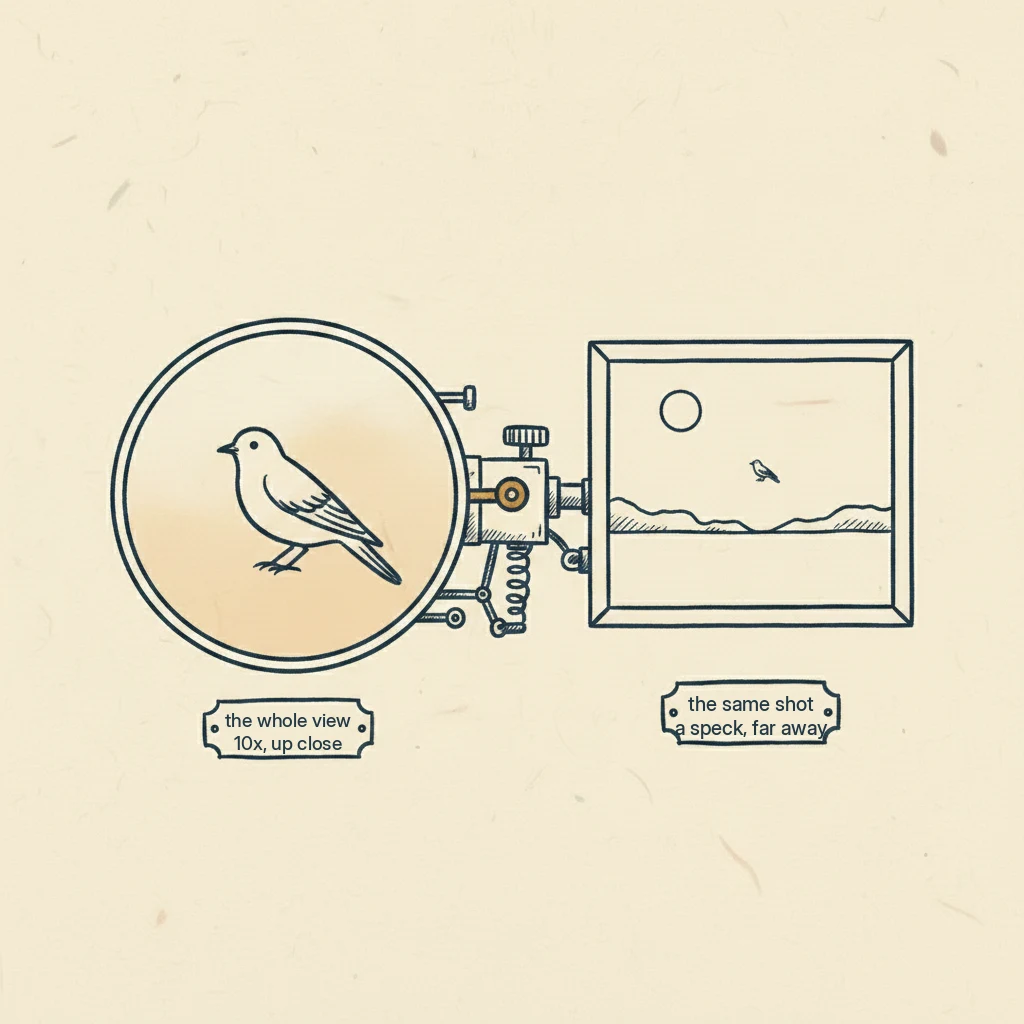
But if it’s true, and the evidence points that way, here’s why it matters so much. You hold up 10x binoculars, you see a bird filling the whole view, you press the shutter, and the photo comes out as a wide, mostly empty landscape with a tiny speck in the middle, because that separate little camera lens was never magnifying at 10x the way your eyes were. That’s the core disappointment, and notice what it is: a design decision, not a defect. No number of megapixels fixes a lens that was never pointed at the zoomed view in the first place.
What the expert actually said, in full
The honest verdict is three-part, and it would be easy to cut it down to fit a story, which is exactly what this site tries not to do. These aren’t a scam. But if you’re hoping to reproduce the quality of a real digital SLR, or expecting the glass to rival a high-end pair of Swarovskis, you’ll be disappointed. And if what you want is a quick capture of something you just watched, then they may be just what you need.
Read the whole thing and the answer is three-part, not one. Not a scam. Wrong tool if you want real photographs. Right tool if what you want is to grab a quick capture of something you just watched. That last sentence is the honest home of this product, and almost nobody selling one leads with it.
About the image quality, and why I can’t give you a current number
Here’s a frustration I have to be upfront about. The only careful, independent test of one of these I can find on the open web is about fifteen years old, and it tested a camera that shot 640 by 480, which was modest even then. The marketing on today’s models throws around numbers like 48 megapixels and 4K video, but I can’t find anyone independent who has actually put a current one through its paces to confirm those hold up in real use. So I’m not going to quote the old resolution as if it were current, and I’m not going to repeat the new marketing number as if it were verified. What I can tell you honestly is that the category’s honest test is stale, the marketing has raced ahead of it, and nobody neutral seems to have caught up. That gap is itself worth knowing.
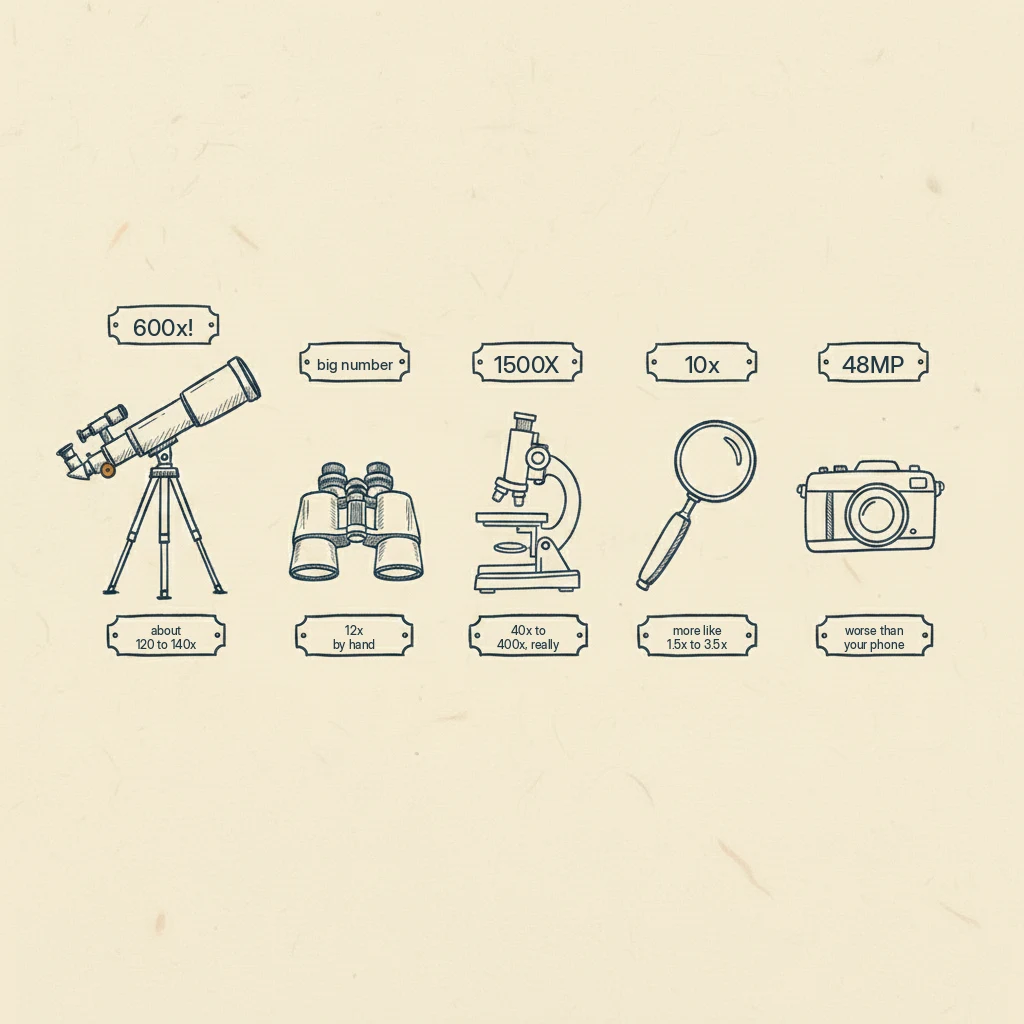
And this is where the oldest lie on this whole site puts on a new costume. On a telescope box it’s “600x.” On a cheap binocular it’s a giant magnification range. On a screen microscope it’s “1500X.” Here it’s the megapixel count. The trap is always the same: a big number in front of cheap glass. The rule holds here as everywhere: a 48-megapixel sensor behind a plastic lens still looks worse than a far smaller sensor behind good glass. The number is real and the glass isn’t, and that’s the part the box never mentions. There’s a whole page on this pattern at the number on the box.
The better camera is already in your pocket
Here’s the part that saves you money. The pictures from these come out worse than what you’d get from the phone you already own. So the sensible setup, for almost everybody, is to buy a binocular that’s simply good and use your phone for the record shots. For the money a mid-range camera-binocular costs, you can buy genuinely good glass and pocket the difference.
I’m not going to walk you through the fiddly business of holding a phone up to an eyepiece here, because it deserves its own honest write-up rather than a rushed paragraph. The short version is that the good camera is the one you carry every day, and the good binocular is the one that shows you the whale in the first place. Buy each for what it’s good at.
The priced binocular shelf, all researched and none of it looked through by anyone here, rounded to what I’m seeing as I write this: a Vortex Triumph HD 10x42 runs about $98, a Celestron UpClose G2 10x50 about $52, an Outland X 8x42 about $110, a Nature DX 8x42 about $180. Any of those is more binocular than the glass buried in a camera-model, and your phone takes better pictures than the camera in one would.
The fair part: what these genuinely do well
I don’t want to leave this sounding like a dismissal, because it isn’t one. Even that fifteen-year-old test, shooting soft, low-resolution images, found something worth respecting: the bird in the photo, blurry as it was, was still clearly identifiable. A beginner could sit down with a field guide and that soft little photo and name the bird, or email it to a friend to ask. That’s a real, useful, lovely thing. If what you want isn’t a wall print but a way to remember and identify what you saw, a camera-binocular does that, and there’s no shame in wanting exactly that.

Questions people actually ask
Are binoculars with a camera any good?
They’re not a scam, but they’re not a camera in the sense you’re hoping. The pictures come out worse than a modern phone’s, and because the camera usually has its own separate lens, the photo won’t show the magnified view you saw through the binocular. They’re good for one honest job: a quick, soft record shot to help identify what you saw. For actual photographs, they disappoint.
Why doesn’t the photo look like what I saw through the binoculars?
Most likely because the little camera isn’t shooting through the binocular’s optics at all. The reviewers believe it has its own separate, much weaker lens, so while your eyes saw a bird filling the view at 10x, the camera captured a wide landscape with the bird as a speck. It’s a design compromise, not a broken unit, and more megapixels won’t fix it.
Should I buy camera binoculars or just use my phone?
For most people, buy a good plain binocular and use your phone for pictures. The reviewers say the built-in cameras produce images worse than a phone’s, and your phone is already in your pocket. Spend the money on the optics that actually show you the sight, and let the camera you already own handle the memory-keeping.
Are the 48-megapixel camera binoculars worth it?
Be skeptical of that number. I can’t find any independent test confirming the current high-megapixel claims hold up, and a big sensor behind a cheap plastic lens still produces a poor image. Megapixels are the box number here, the same way magnification is on a telescope. If the camera doesn’t shoot through the binocular’s optics, no megapixel count makes the photo match what you saw.
Buy for the seeing, keep with the phone
If you just want to remember and identify what you spot, a camera-binocular does that honestly, and it’s fine to buy one knowing that’s the job. But if you’re picturing real photographs of that eagle, you’ll be happier buying a genuinely good binocular for the seeing and using the phone in your pocket for the keeping. Don’t pay for a big number in front of a small lens, on any instrument.
A few things you’re probably also wondering:
- Wondering what magnification actually buys you, and why the big numbers mislead? See binoculars for long distance.
- Want the most binocular for your money instead? See best binoculars for the money.
- Trying to photograph what you see through a lens with your phone? See telescope for iphone.
- Chasing that whale or eagle you wanted to capture? See binoculars for whale watching.
Ray Ostrander
Ray spent three decades explaining the sky to twelve-year-olds and their parents, and every January, hearing which Christmas telescopes ended up in the closet. He doesn't own a wall of gear and won't pretend to. He reads everything, tells you what owners agree on, and flags what's just his judgment. His goal is simple: no more January closets.