
Binoculars for Plane Spotting: Two Very Different Jobs Hiding in One Phrase
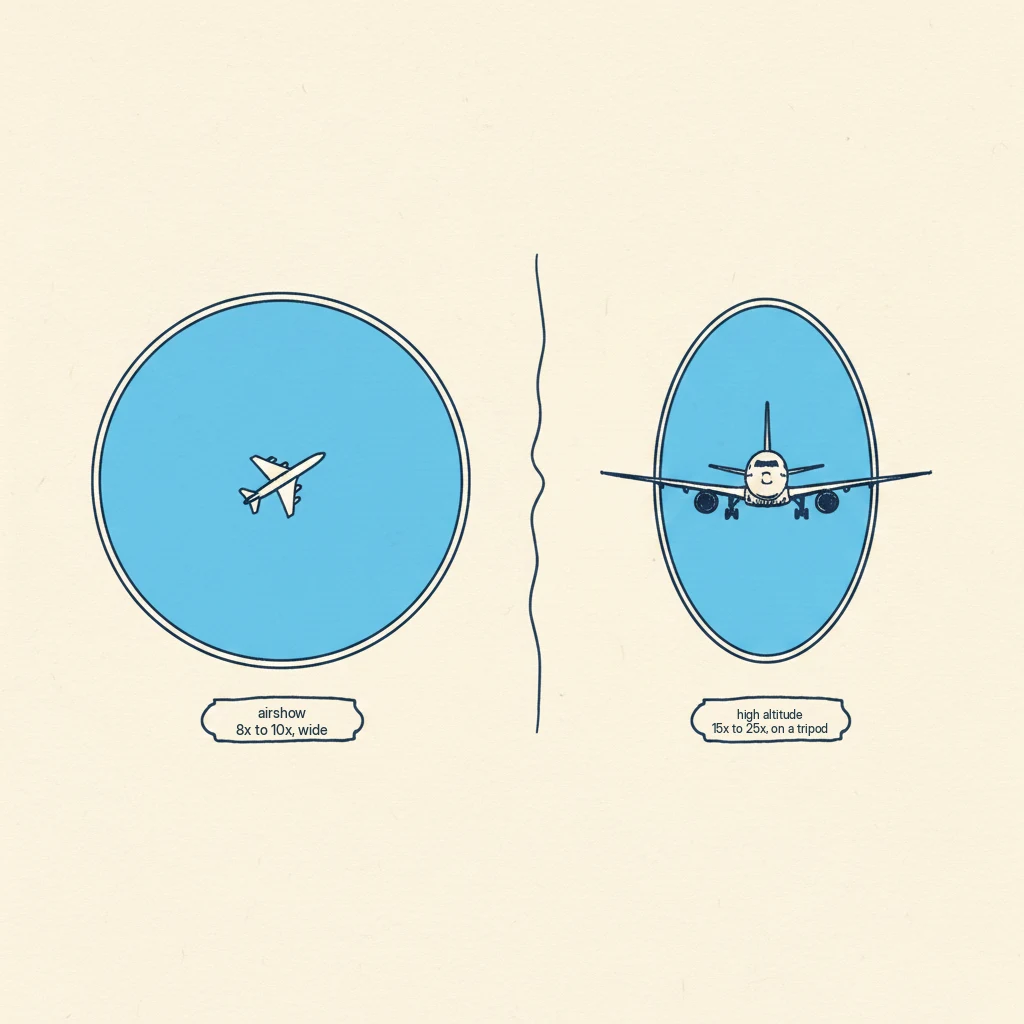
First decide which plane you're watching. An airshow jet wants 8x to 10x and the widest view you can get, because the trick is catching it. A speck at 35,000 feet wants 12x and up on a tripod. No single pair does both well.
 Ray Ostrander · Updated July 24, 2026 · how I decide
If you buy through a link here, the site earns a little. It's never why anything gets picked.
First, decide which plane you’re actually watching, because the phrase hides two jobs that want opposite binoculars. For an airshow jet ripping past low and fast, you want 8x to 10x and the widest field of view you can get, over 260 feet at 1000 yards, because your whole problem is catching the thing. For a speck cruising at 35,000 feet, you want more magnification: 12x is about the hand-held ceiling, and above that you need image stabilization out to roughly 20x or a tripod out to about 25x. Pick your job first, then pick your glass.
This is one of my favorite pages to write, honestly, because it’s pure pleasure. Nobody’s disappointed kid is in a closet here. It’s a person at a fence watching something enormous and beautiful go over, wanting to see it properly. So let me make sure you buy the pair that fits your kind of watching, because the whole shelf sells one compromise number to two readers who need opposite things.
What's on this page
The fork nobody draws: which plane are you watching?
Here’s what’s actually happening, and once you see it the whole decision snaps into focus. Every guide answers “what binoculars for plane spotting” with a single magnification, and that single number is wrong for half of you, because there are two completely different things people mean.
Job one is the airshow. A jet comes across low and fast, and the hard part isn’t seeing it, it’s finding it and keeping it in view while it moves. For that you want low magnification and a wide view, so you can sweep the sky, land on the plane, and follow it without losing it around the edge of a narrow circle.
Job two is high-altitude spotting. An airliner sits nearly still at cruising height, a distant glint you could point at for a full minute. It’s barely moving, so tracking is easy. The hard part is pulling that speck close enough to read anything, which means high magnification, a narrow view you can live with, and something to steady it.
Those two jobs pull in opposite directions on the very same dial. The airshow wants low power and wide; the high flyer wants high power and steady. That’s my read, assembled from the numbers the experts give for each, and it’s the thing to sort out before you look at a single product.
For the airshow: catch it first
The specs that fit airshow watching all point the same way: magnification somewhere between 8x and 12x, a modest objective lens, and, above everything, the widest field of view you can find. That last one is the spec nobody translates, so let me.
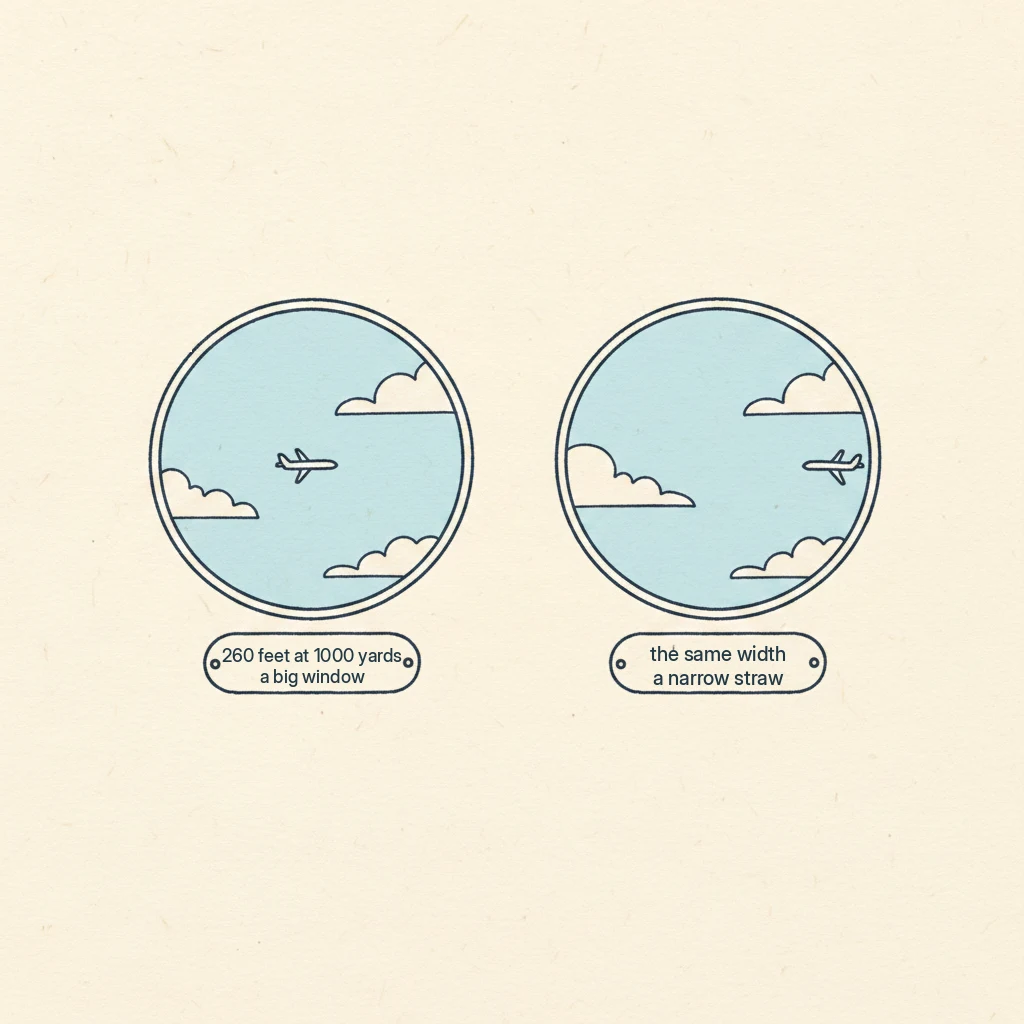
Field of view is printed on every binocular box as something like “260 feet at 1000 yards,” and most people’s eyes slide right past it. Here’s what’s actually happening: that number is how much sky you can see at once through the glass. A wide field is a big window; a narrow one is looking through a straw. At an airshow, that window is the difference between catching the jet as it crosses and swinging around a small empty blue circle while it’s already gone. The target to beat is a field of view wider than about 260 feet at 1000 yards, and that matters more than an extra bit of magnification. A wider view genuinely makes it easier to locate and follow the plane.
So for airshows, buy 8x or 10x with a generous field of view, and don’t chase power. The plane is close. Your job is to catch it, not magnify it.
For the high flyer: hold it steady
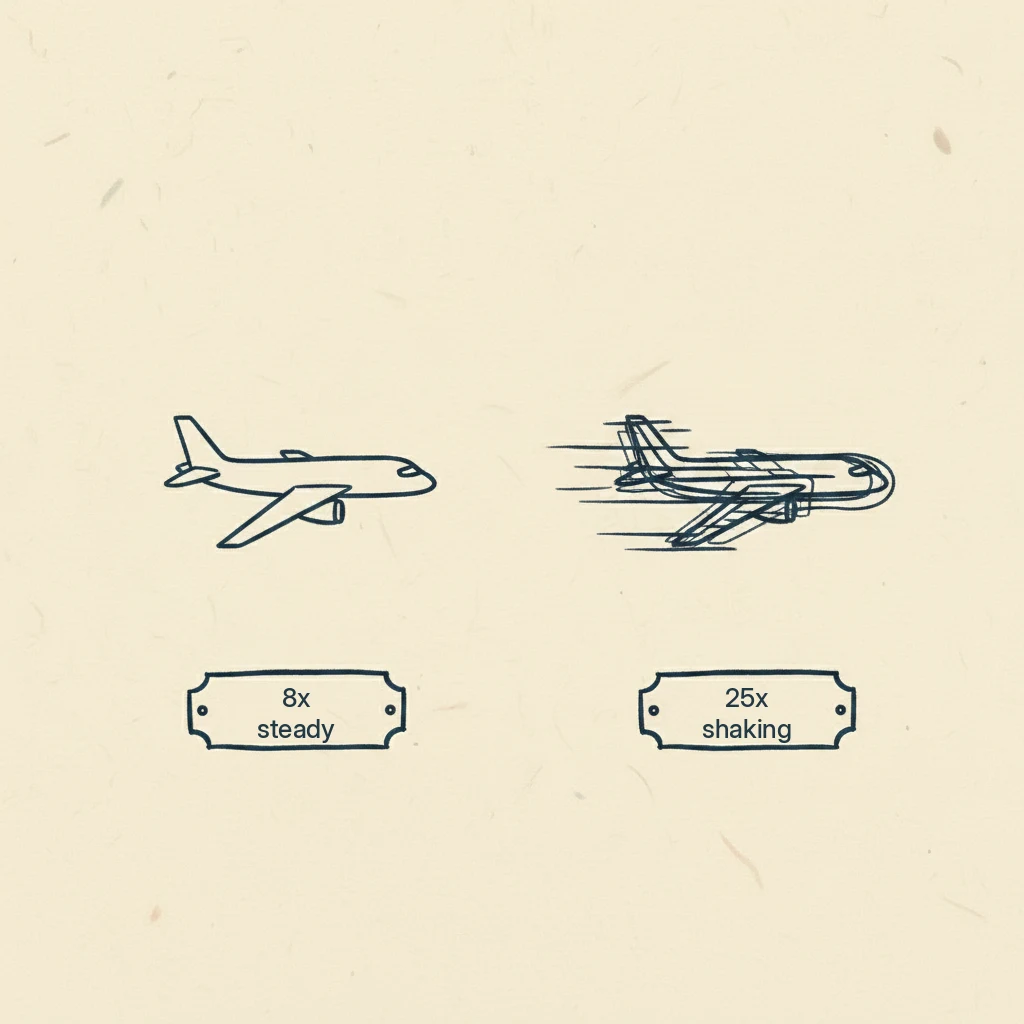
Now the other job, and here the ceiling is the whole story. You’d think you’d just buy the biggest magnification number you can, but here’s what’s actually happening as that number climbs: every tiny tremor in your hands gets magnified right along with the plane, and the view starts to dance. The makers cap general hand-held use around 12x, and that’s the sane ceiling here too. Almost anyone can hold a 10x or 12x steady enough. Past that, the image shakes too much to enjoy.
If you want more reach than 12x, you have two honest options and no third one. Image-stabilized binoculars, which quietly cancel the shake with electronics, will let you hand-hold up to about 20x, and they genuinely work, but they cost real money. Or you put a high-power pair on a tripod, which takes you out to about 25x, though honestly 15x is plenty. One nice small detail from the people who clearly do this: on a tall tripod aimed up, use a chair and sit almost underneath it, so you’re not craning your neck the whole time.
There’s a catch built into high magnification, too. More power needs more glass to stay bright, which is why a 25x pair has a big 70mm front and weighs what it weighs. And you can’t go bigger than about a 50mm objective before the whole thing is too heavy to hold steady anyway, which is another way of saying the same thing: past 12x or so, you’re buying a tripod instrument whether you meant to or not. The full why of all this lives on binoculars for long distance.
The shelf, matched to your job
All researched, none of it looked through by anyone here, as the About page says plainly. Prices rounded to what I’m seeing as I write this, and where a figure is scattered I give the dated one rather than an optimistic estimate.
If you’re watching airshows (8x to 10x, wide, hand-held):
- Celestron UpClose G2 10x50, about $52. This one deserves a spotlight. It sits exactly at the 10x sweet spot for hand-held spotting, and its 50mm front is right at the biggest lens you’d want to hold without a tripod. A fifty-dollar binocular lands precisely on the recommended optimum, which almost never happens.
- Vortex Triumph HD 10x42, about $98, a step up in build quality at the same handy 10x.
- Celestron Outland X 8x42, about $110, for a wider, easier-to-track 8x view.
If you’re watching high flyers (tripod realm):
- Celestron SkyMaster 15x70, about $130, a good first big pair, and 15x is plenty.
- Celestron SkyMaster 25x70, about $140 at the maker’s sticker, often less on the street. Big reach, but plan on a tripod and that chair. And be honest with yourself: a 25x70 is really an astronomy binocular. If you own one, you own a stargazing pair too, which I cover on best binoculars for stargazing.
The luxury middle: an image-stabilized Canon 12x36 IS III runs about $729. That’s the real, priced answer behind “hand-hold up to 20x,” and it costs what it costs.
Notice the shape of that shelf: the cheapest pair on it, a $52 ten-power, is the perfect airshow tool, while the shelf’s own showpiece 25x70 demands a tripod, a chair, and basically a different hobby. Buy for your job, not for the biggest number.
Questions people actually ask
What magnification is best for plane spotting?
It depends on your plane. For airshows and low passes, 8x to 10x with a wide field of view, because you need to catch and follow a fast target. For distant high-altitude aircraft, more power helps, but 12x is the practical hand-held limit before shake ruins it. Above 12x you’re into stabilized binoculars, good to about 20x, or a tripod, good to about 25x.
Can I hand-hold high-power binoculars for spotting planes?
Up to about 12x, comfortably. Beyond that, every small hand tremor gets magnified too, and the view dances so much it’s hard to enjoy. If you want serious reach for high-altitude spotting, you realistically need either image-stabilized binoculars, which cancel the shake out to around 20x, or a plain high-power pair on a tripod. There’s no hand-held 25x that stays steady.
What does “260 feet at 1000 yards” mean on the box?
That’s the field of view: how much width of sky you can see through the binoculars at once. A bigger number is a wider window. It matters most at an airshow, where a wide view lets you find a fast jet and keep it in sight, while a narrow high-power view has you swinging around trying to relocate a plane that’s already crossed. For airshows, favor a wide field over extra magnification.
Do I need a tripod for plane spotting?
Only for the high-magnification kind. If you’re at airshows with an 8x or 10x pair, no tripod, just hold and sweep. If you’re pulling in distant airliners with a 15x or bigger pair, yes, a tripod turns a shaky, tiring view into a steady, enjoyable one, and a chair positioned under the tripod saves your neck when you’re aimed up.
Let the plane pick the binocular
If you’re mostly at airshows and low passes, buy a wide 8x or 10x pair, a $52 to $110 range covers you beautifully, and spend your attention on the field of view, not the magnification. If you’re pulling in high cruisers, get a 15x on a tripod and skip the fantasy of a hand-held 25x. Figure out which plane you love watching, and the right binocular picks itself.
A few things you’re probably also wondering:
- Want the full story on why high magnification shakes and dims? See binoculars for long distance.
- Trying to get the most binocular per dollar? See best binoculars for the money.
- Wear glasses at the eyepiece? See binoculars for glasses wearers.
- At a stadium or arena instead of an airfield? See binoculars for sporting events.
- Wishing you could photograph the plane too? See binoculars that take pictures.
Ray Ostrander
Ray spent three decades explaining the sky to twelve-year-olds and their parents, and every January, hearing which Christmas telescopes ended up in the closet. He doesn't own a wall of gear and won't pretend to. He reads everything, tells you what owners agree on, and flags what's just his judgment. His goal is simple: no more January closets.